Wrocław: Centennial Hall, a Panorama from Lviv and Dwarfs
A Gothic town hall, the 1913 Centennial Hall, the Racławice Panorama and the Orange Alternative dwarfs explain a city that changed rulers and kept building.
Cover: AI-generated illustration. © ANUSHKA DAHANAYAKE (PVT) LTD.
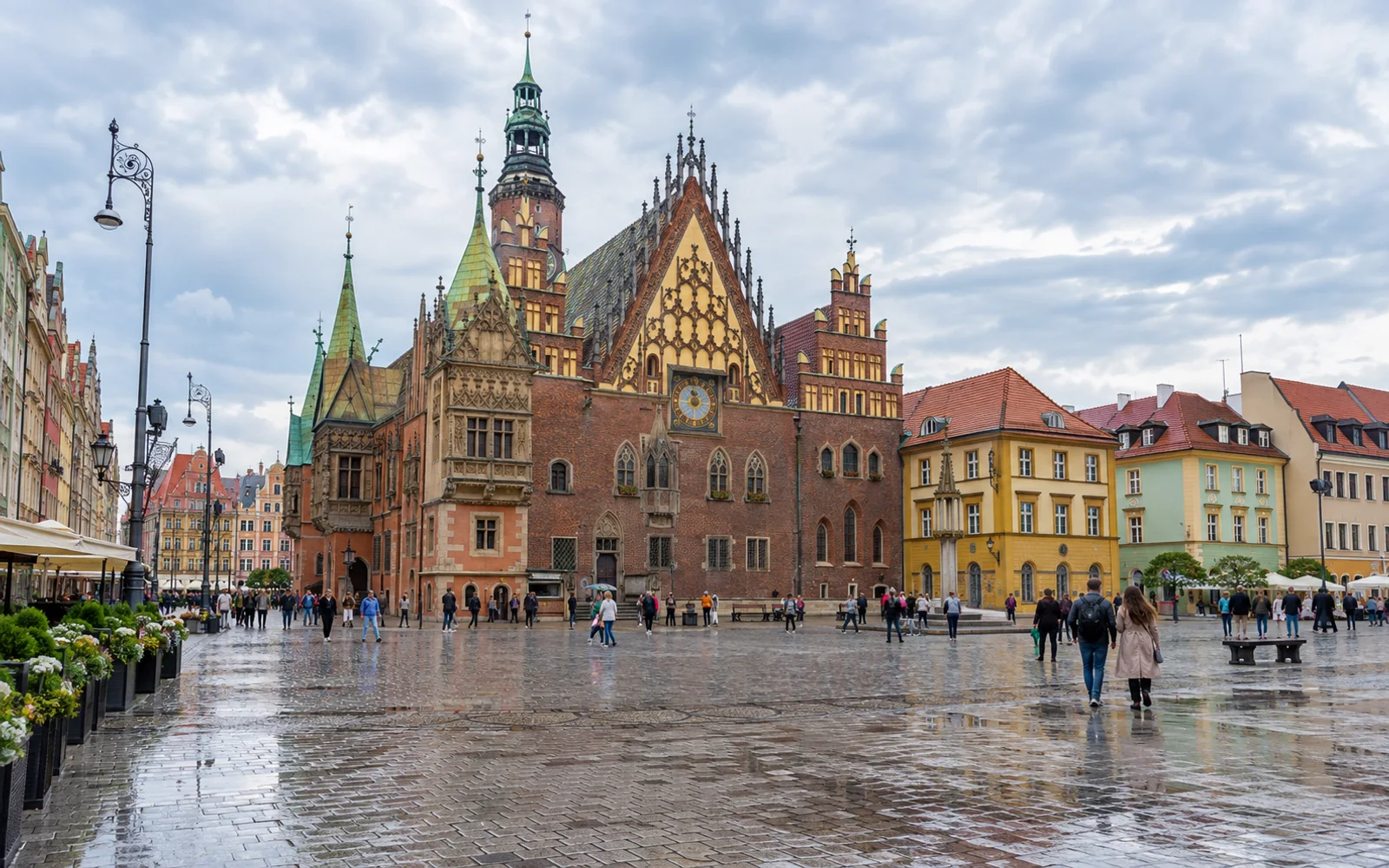
Wrocław's skyline is a record of how many hands have held the city. The Gothic Old Town Hall, whose origins reach back to the thirteenth century, took its late Gothic form in a long expansion around 1470 to 1504, was badly damaged in the 1945 siege and was reconstructed and conserved afterwards. Across the Oder, the Centennial Hall of 1911 to 1913 is an early reinforced-concrete landmark. Between those two landmarks the city moved from Breslau to Wrocław, and from German to Polish administration, with new residents arriving from Poland's former eastern territories.
A concrete dome that changed architecture
Max Berg, the municipal architect of Breslau, designed the Centennial Hall, built in 1911 to 1913 for the city's Centennial Exhibition. UNESCO inscribed it on the World Heritage List in 2006, and the surrounding exhibition grounds, with the pergola and the Pavilion of Four Domes by Hans Poelzig, are part of the same story. Tram to the hall and begin at the visitor centre or an official tour. When an event closes the main interior, the pergola, pond and park still reward the trip.
A painting brought from Lviv
The Racławice Panorama was painted in 1893 to 1894 by Jan Styka and Wojciech Kossak, with several other artists, and unveiled in Lviv in June 1894. It reached Wrocław after the Second World War together with part of the Ossolineum collection from Lwów, and the purpose-built rotunda where it hangs opened on 14 June 1985. The painting is a monumental, strongly national account of one battle in the 1794 uprising, and a visit is a timed experience, so know what you are booking before choosing it over the National Museum.
Dwarfs with a political past
The bronze dwarfs scattered across the old city come from the Orange Alternative, an opposition art movement that began at the University of Wrocław, where Waldemar "Major" Fydrych drew dwarfs over painted-out political slogans. Papa Dwarf, the first figure, was set on Świdnicka Street on 1 June 2001 by sculptor Michał Siarek. Count a few for fun, especially with children, but remember that they commemorate a satirical protest against the communist authorities, so skip playful dwarf-hunting at remembrance sites.
Rynek, the Market Hall and the islands
Begin at Rynek before café terraces fill, and notice the entrances and the Hansel and Gretel houses rather than collecting a panorama. The Old Town Hall now houses the Museum of Bourgeois Art, and a city-history exhibition explains changing rulers, languages, wartime destruction and resettlement. Continue through the university quarter, where the Aula Leopoldina may close for ceremonies, then cross to the Market Hall for produce and lunch. It is a working market, so ask before photographing sellers and keep delivery paths clear.
Cathedral Island, Ostrów Tumski, is commonly called an island though changes to the river mean it no longer is one. Churches remain places of worship, so check visitor hours, dress respectfully and stop sightseeing during services. The cathedral towers involve stairs and weather can remove the view. At dusk, return across the islands, where a lamplighter may follow a scheduled route; do not surround or obstruct the worker.
Reading the city's layers
Wrocław has Polish, Czech, Austrian, Prussian, German, Jewish and other histories. Avoid presenting one period as the only authentic identity, and choose museums and guides that explain both wartime destruction and forced postwar migrations. Surviving German inscriptions are evidence, not curiosities to erase or argue about. Synagogues, cemeteries and memorials call for different behavior from entertainment venues, so photograph ceremonies only with permission.
A three-day pattern
Day one is Rynek, the Old Town Hall and the Market Hall. Day two is Ostrów Tumski, the Botanical Garden or riverside paths, and an afternoon museum or the Panorama. Day three belongs to Centennial Hall, or to the zoo and Afrykarium for families, or to Nadodrze's galleries and markets. Murals are not permission to enter private courtyards. Book one timed attraction each morning and leave the rest adjustable; rain favors museums and the Market Hall, and clear weather suits the islands.
Pace matters in a city this layered. Two heavy subjects back to back dull the visitor, so alternate the town hall and the Panorama with a park, a market or a neighbourhood meal. Eat beyond the central square for better value and less group noise, and try pierogi, soups, Silesian-influenced cooking and seasonal pastries before looking at Wrocław's modern food scene. Keep translated allergy terms ready.
Trams, tickets and costs
Wrocław Główny is the main rail station, linked to the centre by tram and a manageable walk, and airport buses serve the station area. Trams and buses use time-based tickets, so validate paper tickets immediately or activate an app ticket under its rules. The official Wrocław transport guide lists single and timed tickets; compare them with your rides, and price museum admissions separately. Driving is inconvenient in the centre because of restricted streets, parking and tram traffic.
Rynek carries a location premium, so compare menus nearby and review bills before paying. Milk bars offer inexpensive meals but ordering may be brisk and Polish-only. Keep a small złoty backup, and decline dynamic currency conversion when your bank offers the better rate. Parks, church exteriors and river walks keep costs down.
Weather, access and safety
The centre is compact, but cobbles, gradients and tram rails create barriers. Low-floor vehicles run often but not on every departure; modern museums and Centennial Hall offer accessible routes, while historic towers generally do not. Spring and early autumn suit walking, summers can be hot, and winter brings early darkness and ice. After heavy rain, riverside paths can be wet or restricted. Normal city precautions apply; emergency number 112 works throughout Poland. Cyclists should use signed lanes and cross tram rails as close to a right angle as possible.
Continue your journey
Continue through the Poland destination hub, read what makes Poland special, combine the journey with the Kraków guide or the Poznań guide, or browse country guides. Read the full departure station name, because Wrocław has several stops besides Główny, and allow time to navigate the main station. With another day, consider a carefully planned Lower Silesian excursion, but verify rail, opening hours and the last return.
Questions and answers
How many days are enough for Wrocław?
Three days cover Rynek, Cathedral Island, one major museum and either Centennial Hall or a neighborhood visit without rushing.
Do you need a car in Wrocław?
No. The center is walkable and an extensive tram and bus network reaches Centennial Hall, the station and outer districts.
Are Wrocław's dwarf statues a good itinerary?
Find a few for fun, but chasing every figure becomes repetitive. Use them to interest children while keeping architecture and history central.
Sources
Warsaw · 52.2297° N, 21.0122° E
This story belongs to Wrocław, Poland. A country often overrun by its neighbours that kept changing how the world thinks, and rebuilt its cities from fragments.