Ypres Visitor Guide: Cloth Hall, Ramparts and Respectful War Memory
A remembrance-led Ypres route that separates city history from battlefield touring and gives museums, cemeteries and the Last Post the time and conduct they require.
Ypres should not be treated as a collection of war-photo locations. Begin with the Cloth Hall and In Flanders Fields Museum, walk the reconstructed city and ramparts, then attend the Last Post only after understanding what it commemorates. Outlying cemeteries and battlefield landscapes belong on a separate, carefully researched segment rather than a hurried drive between headstones.
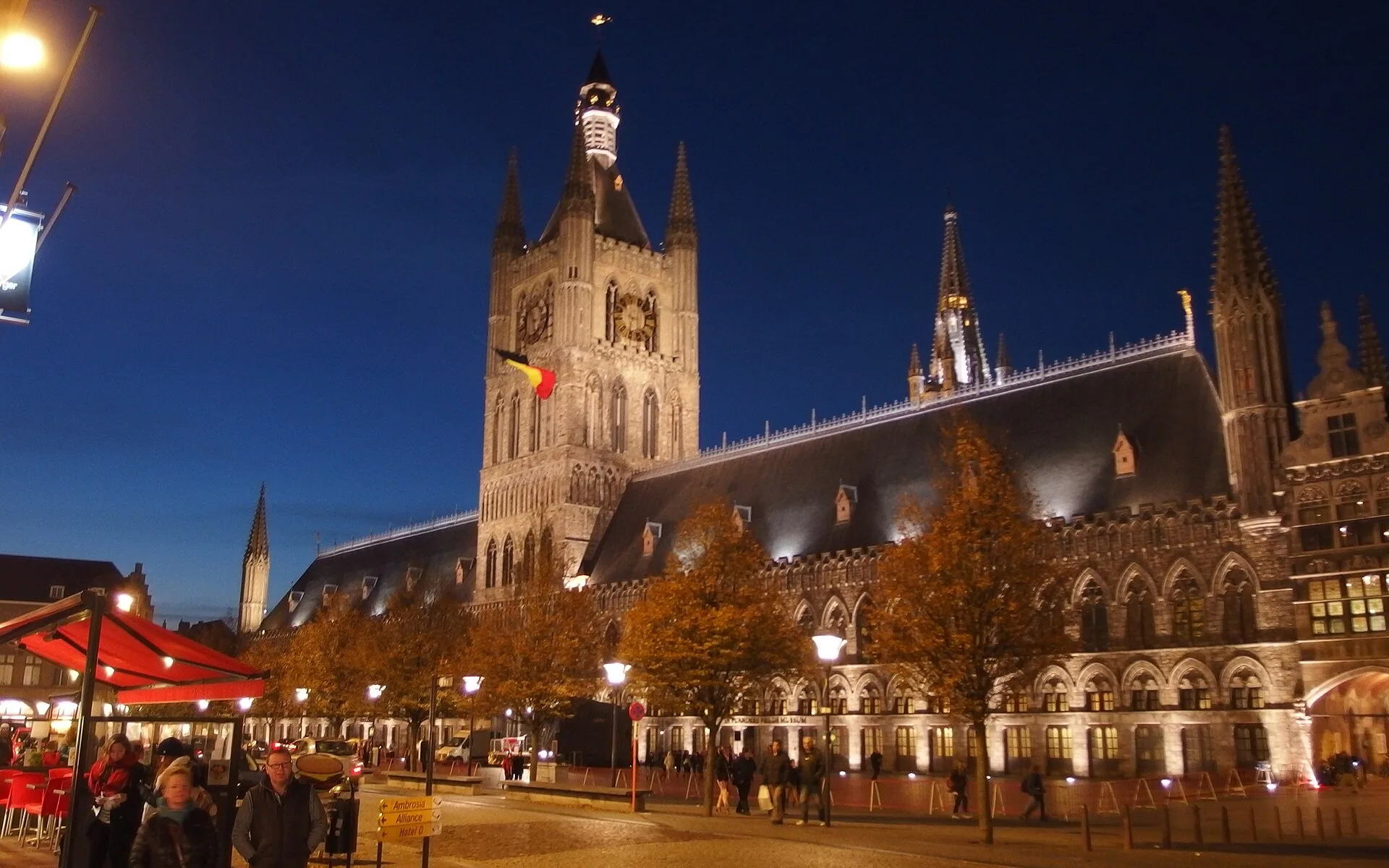
Cover photograph: “20141110 Cloth Hall, Ypres 06” by Mark Ahsmann, licensed CC BY-SA 4.0. Cropped to 16:10 and converted to WebP; no generative alteration.
Why Ypres matters: a medieval cloth city that became a place of remembrance
Ypres, officially Ieper, was a great Flemish trading city centuries before its name became tied to war. Its wealth came from cloth, and the monuments it left are still the ones on the Grote Markt: the Cloth Hall and belfry, St Martin's Cathedral and the medieval remains the city now shows in its Lapidarium. The local tourism office invites visitors to explore more than 1,000 years of Ypres history, and residents keep some of that older life in their own traditions, including the city's cat parade.
The First World War destroyed almost all of it. The front line around the city, known as the Ypres Salient, saw years of fighting, and the medieval centre was reduced to ruins. After the war Ypres was completely rebuilt, its new buildings shaped to reflect the medieval town that had stood there. That decision to rebuild instead of leaving a ruin is part of the identity people here take pride in.
The city also chose to remember. On 24 July 1927 the Menin Gate Memorial to the Missing was inaugurated, and buglers of the 2nd Battalion, Somerset Light Infantry sounded the Last Post. A year later, on 2 July 1928, a local initiative led by Pierre Vandenbraambussche founded the Last Post Association and held its first ceremony. During the German occupation the daily ceremony could not take place in Ieper, and from 1940 to 1944 the Last Post was sounded at Brookwood Cemetery in England instead. It returned to the Menin Gate on 6 September 1944 and has been played there at 8 p.m. every evening since; the association now counts more than 34,000 ceremonies.
For the people of Ypres, keeping that promise is a civic duty and a source of quiet pride. Seeing the city well means giving the rebuilt streets, the museum and the ceremony their own time, beginning at the station.
Arrive in a rebuilt city, not a preserved ruin
Ypres—officially Ieper—was a prosperous medieval cloth city long before the First World War. The Cloth Hall and much of the centre were destroyed during the conflict and later reconstructed. Read the Grote Markt through both histories: medieval wealth and twentieth-century rebuilding.
From the station, the central route is walkable, but cobbles and historic surfaces affect mobility. The official practical guide identifies accessible museum features, rampart entrances and Menin Gate arrangements. Store luggage before entering remembrance spaces.
Rebuilt façades are twentieth-century work in a medieval form. Reconstruction is itself a significant choice about identity and recovery.
Give the museum the first serious attention
In Flanders Fields Museum occupies the Cloth Hall and uses objects, testimony and interpretation to address the war in the Ypres Salient. Check the official museum for tickets, opening, exhibitions and access.
Allow several hours. Choose depth over completion when attention fades, and use personal stories to resist turning casualty numbers into abstraction. Travellers researching a relative should prepare names, units and dates before arrival; staff cannot reconstruct every history instantly.
The museum contains distressing material. Adults should prepare children honestly and allow an exit or pause. Photography rules and quiet zones should be followed without debate.
Walk the Cloth Hall as civic reconstruction
After the museum, step back into the square and examine the Cloth Hall's scale. The belfry belongs to the transnational UNESCO-listed Belfries of Belgium and France, but current tower access, tickets and steps must be checked locally.
Use the building to reconnect war memory with the city's longer history of trade and municipal power. Nearby streets, churches and the Yper Museum can extend that story if time remains. A few hours away from military content gives the visit balance.
Lunch should provide a real break. Keep conversations about graphic material quiet in a busy restaurant, and remember that local residents are going about their own lives.
Use the ramparts to connect city and memorial landscape
Ypres' ramparts provide a green route around parts of the centre and lead towards the Menin Gate area. Select one section; a full circuit before an evening ceremony is too much. Paths, slopes and entrances vary; the tourism office notes accessible points but not every historic feature is step-free.
Walk quietly around cemeteries or memorials encountered on the route. Keep dogs controlled where permitted, keep off headstones and never rearrange tributes for a photograph.
Rain makes leaves, cobbles and slopes slippery. In poor weather, shorten the path and reach the Menin Gate through streets.
Attend the Last Post as a ceremony
The Last Post at the Menin Gate is an act of remembrance, not a nightly attraction added to an itinerary. Check Last Post Association information for current time, location, special ceremonies and access. Arrive early enough to find a place without pushing through the crowd.
Silence phones, remove hats where appropriate, follow stewards and keep the roadway clear. Do not use flash or hold equipment above others throughout the ceremony. Applause, conversation and posed photographs should follow the organisers' tone, not habits from another event.
Wheelchair users and others needing an assigned position should review official arrangements before arrival. The main hall can be accessible while some name panels and rampart approaches are not.
Decide whether an outlying tour adds understanding
Essex Farm, Tyne Cot, Hill 60, trenches and many cemeteries address different battles, medical histories, national forces and landscapes. Visiting more sites does not automatically produce more understanding. Choose one or two linked to a research question, family history or museum theme.
Public transport does not connect every site conveniently. A bicycle provides independence only for confident riders accustomed to traffic and weather. Taxis require arranged returns. A guided tour can solve logistics, but choose a guide who centres evidence and remembrance over dramatic anecdotes.
Use the Commonwealth War Graves Commission for cemetery information and casualty research. Other national memorial organisations may be relevant depending on the people being studied.
Visit cemeteries without ranking sacrifice
Different cemeteries vary in scale, design and national context. A small cemetery matters as much as a large one. Every grave and missing name represents an individual life and a network of grief.
Walk on paths, observe opening rules and keep voices low. Do not touch, sit on or lean equipment against headstones. Ask before photographing other visitors, especially people tracing relatives.
Flowers and tributes should follow site rules. Never remove an object, even if it appears weathered. School groups need supervision and preparation before arrival.
Separate research from battlefield myth
Family stories may contain changed spellings, unit confusion or later legends. Begin with service records, cemetery databases and museum material. A location associated with a battalion is not proof that one named person stood at an exact point.
Unexploded ordnance, recovered objects and private fields are no place for treasure hunting. Do not enter farmland, trenches or restricted areas without permission. If a suspicious object is found, do not touch it; leave the area and contact authorities.
Contemporary farms and homes occupy the former battle landscape. Respect their privacy and work.
Weather adds another layer to this landscape. Mud, cold, heat and fog can help a visitor understand physical conditions, but discomfort is no simulation of soldiers' suffering. Wear suitable clothing, stay on public routes and resist comparisons that turn a safe tourist day into false equivalence with wartime experience.
Build one day or two without emotional overload
A one-day rail visit should focus on Cloth Hall, In Flanders Fields Museum, a central meal, a rampart section and the Last Post. That is already substantial. Add an outlying tour only by reducing museum time deliberately, not by rushing both.
With two days, keep the first inside Ypres and use the second for a small number of connected sites. Leave recovery time before departure. Remembrance travel can be mentally tiring, and a quiet café or ordinary city walk is not disrespectful.
Finish by asking what the visit clarified, not how many memorials were photographed. Ypres offers its greatest value when reconstruction, personal evidence and ceremony are allowed to challenge the visitor's simplified story.
Continue through the Belgium hub, read what makes Belgium special for the wider story, compare another Flemish heritage city in the Bruges guide, or prepare a broader arrival through the Brussels guide.
Questions and answers
What is the history of the Last Post at the Menin Gate?
The Menin Gate Memorial to the Missing was inaugurated on 24 July 1927, and the Last Post Association held its first ceremony on 2 July 1928. During the German occupation the ceremony moved to Brookwood Cemetery in England, returning to Ypres on 6 September 1944. The association describes it as a daily 8 p.m. ceremony.
Does the Last Post take place every evening?
The official Last Post Association publishes current ceremony information. Verify the date, location and any special arrangements before attending rather than relying on a permanent timetable claim.
How long is needed for In Flanders Fields Museum?
Allow several hours if the museum is central to the visit. Its personal testimony and historical material lose meaning when compressed between a battlefield tour and ceremony.
Sources
Brussels · 50.8503° N, 4.3517° E
This story belongs to Belgium. Small, three-language and full of inventions the world knows without crediting Belgium: oil painting at its finest, the saxophone and lambic beer.