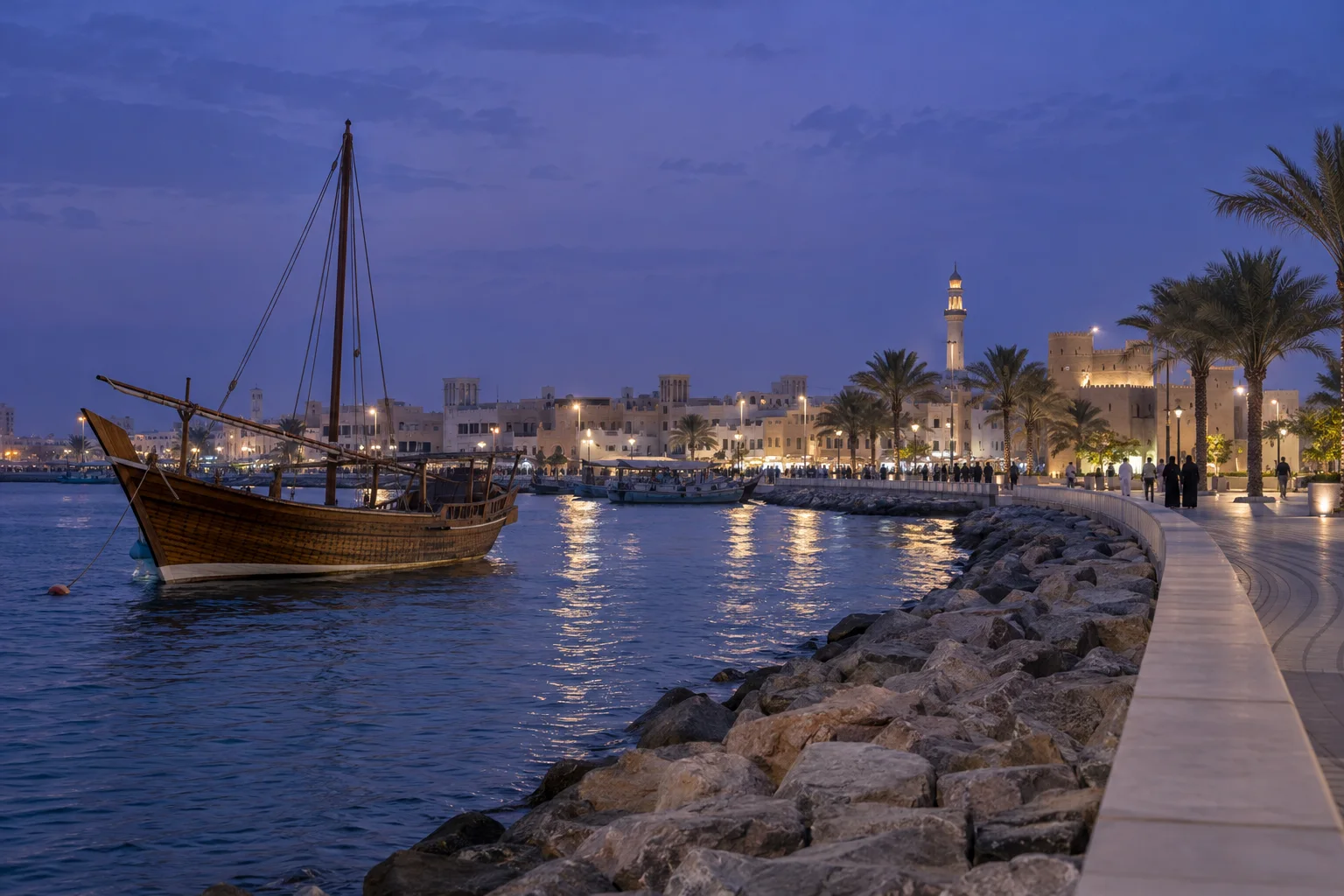
The smallest emirate joins an eighteenth-century fort and museum, a dhow-building coast and the Al Zorah mangroves, a Ramsar wetland since 2017.
A compact emirate with three stories
Ajman is one of the smallest emirates, but its coastal capital holds more of the Gulf's story than its size suggests. Fishing, pearl diving, dhow building and farming were the traditional mainstays. In 1816 or 1817 Sheikh Rashid bin Humaid Al Nuaimi took the coastal settlement, and his family has ruled Ajman since; on 2 December 1971 it joined the United Arab Emirates.
Ajman Fort, dated to the eighteenth century, was the ruler's residence until 1970 and is now Ajman Museum, with dhow models, a pearl-trade section and finds from a cemetery at Al Muwaihat dating back to 3000 BC. Al Zorah is the largest mangrove stand in the emirate and was listed as a Ramsar Wetland of International Importance in 2017, the seventh site in the UAE.
An 18th-century fort that sheltered the ruling Al Nuaimi family until 1970, a dhow-building coast and a Ramsar-listed mangrove make Ajman's small waterfront rich in stories.
· 5 min read
Questions and answers
What makes Ajman distinctive?
An eighteenth-century fort that became a museum, a tradition of dhow building and pearl diving, and the Al Zorah mangroves, a Ramsar wetland since 2017.
Is Ajman part of Sharjah?
No. Ajman is a separate emirate, although the urban areas meet and road journeys cross their boundaries.