Alaska First Trip: Wildlife, Glaciers and Distances Explained
Anchorage, Seward and Kenai Fjords carry Alaska Native history, a 1923 railroad and a young national park. The place story first, then a seven-day route.
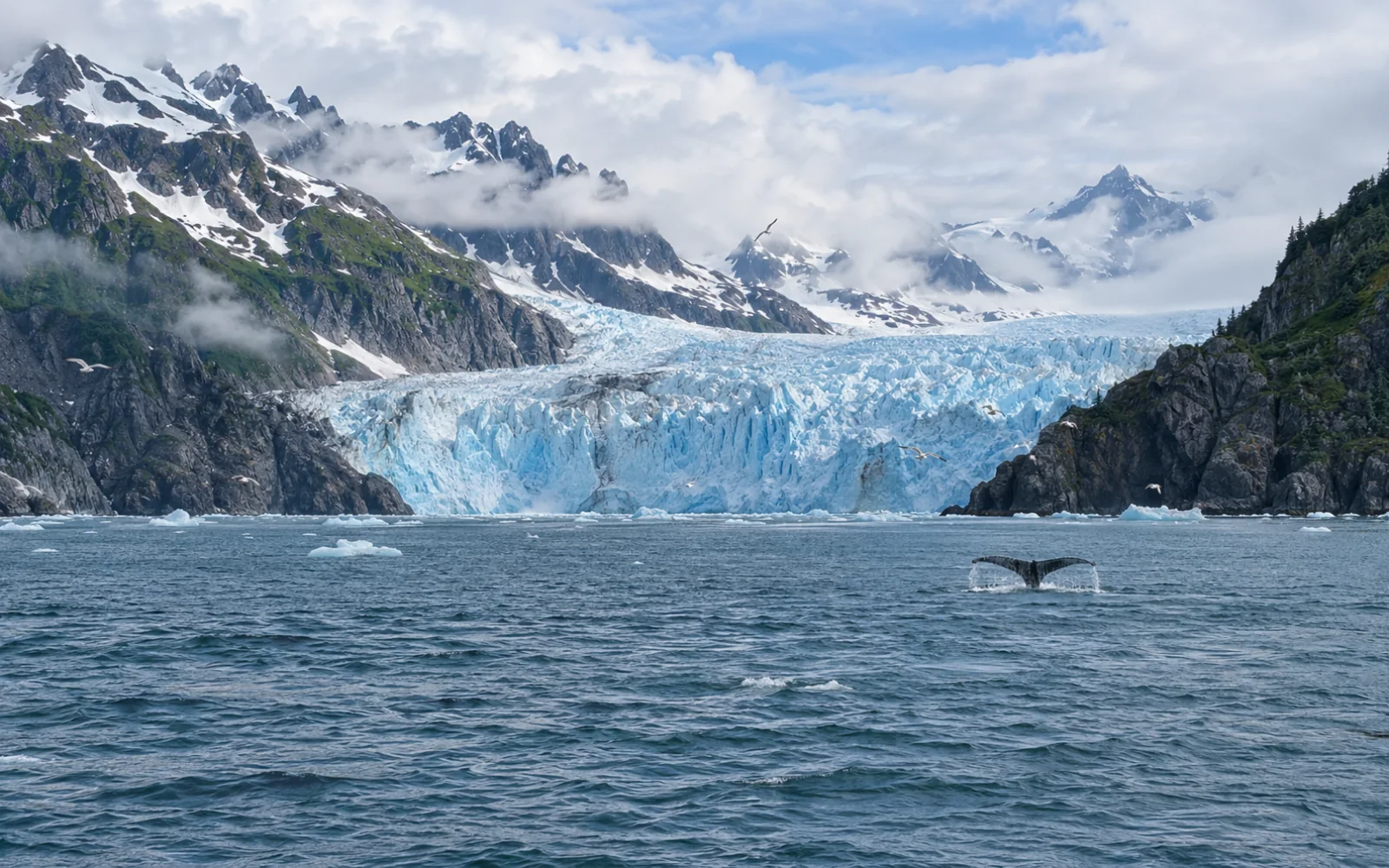
Cover: AI-generated illustration. © ANUSHKA DAHANAYAKE (PVT) LTD.
Alaska is larger than many countries, and the stretch between Anchorage and Seward holds a surprising share of its story: Indigenous homelands that are still lived in, a railroad pushed through mountains by hand, a port town that dreamed of being a metropolis, and a national park where glaciers meet the sea. Understanding those layers turns a scenic drive into a journey with a point.
The people who were here first
Long before Anchorage had a name, the shores of Cook Inlet and the Kenai Peninsula belonged to Dena'ina Athabascans, while the coast around Resurrection Bay was Alutiiq (Sugpiaq) country. Alaska's State Historic Preservation Office notes that Alutiiq people, Russians and a mixed American-Native family were already living at the head of Resurrection Bay before the town of Seward was founded.
Anchorage now hosts the Alaska Native Heritage Center, which opened in 1999 on about 26 acres and presents the living cultures of eleven Alaska Native groups: Athabascan, Eyak, Tlingit, Haida, Tsimshian, Unangax, Alutiiq, Yup'ik, Cup'ik, Siberian Yupik and Inupiaq. A path around Lake Tiulana passes dwellings built to represent each tradition. It is the best single stop for understanding who Alaskans are before heading into the landscape.
A railroad, a spike and a port town
Seward exists because of a railway plan. A party led by John Ballaine landed on the shore of Resurrection Bay on 28 August 1903 to found an ocean terminal for a line into the interior. The town took the name of William H. Seward, the Secretary of State who negotiated the purchase of Alaska from Russia in 1867. It still anchors the southern end of the Alaska Railroad and marks Mile 0 of the historic Iditarod Trail, the winter route used by miners, mail carriers and dog teams.
The private railway schemes faltered and the federal government took over construction. Colonel Frederick Mears directed the work from 1914 to 1923. On 15 July 1923 President Warren G. Harding drove a ceremonial golden spike at Nenana, on what is now the Mears Memorial Bridge, to mark completion of the line. Harding died in San Francisco on 2 August that year, weeks after the ceremony, and the railroad took its present name that same month. The spike left Alaska for nearly a century before the Anchorage Museum and the City of Nenana bought it back at auction in 2025.
A park made by a fight over land
Kenai Fjords reads as timeless, but the protection around it is recent. President Jimmy Carter proclaimed Kenai Fjords National Monument under the Antiquities Act on 1 December 1978, during the political struggle over how much of Alaska would be set aside. Congress converted it into Kenai Fjords National Park through the Alaska National Interest Lands Conservation Act, signed on 2 December 1980. The park centres on the Harding Icefield and the glaciers that flow from it to the coast, which is why a single boat day can show ice, sea cliffs, seabird colonies and marine mammals.
That history explains the national-park feel of everything near Seward. Rangers, museum exhibits and signs at the Exit Glacier area document how fast the ice has retreated, so the climate story is something to read off the ground, not a headline.
A seven-day route that follows the story
Days one and two stay in Anchorage. The Anchorage Museum places Alaska Native art, northern science and territorial history side by side, and the Heritage Center fills in the cultures behind them. The Tony Knowles Coastal Trail is a good daylight walk; moose appear in urban green space, so give them a wide berth, especially cows with calves.
Day three goes south to Seward by road or by the Coastal Classic train. The Seward Highway runs beside Turnagain Arm, where tides move fast over the mudflats: admire them from signed pullouts and do not walk out. Spend the afternoon on the waterfront near the Mile 0 marker or at the Alaska SeaLife Center, and check the next day's marine forecast.
Day four is the Kenai Fjords boat tour. Longer trips travel into exposed water and may reach tidewater glaciers; shorter bay trips suit travellers prone to seasickness. Wildlife is never guaranteed, and a reputable captain keeps legal and ethical distance from whales, sea lions and nesting birds.
Day five is Exit Glacier, the part of the park reached by road. As checked on 5 November 2026, the National Park Service lists automobile access on Herman Leirer Road as closed. Before committing to this day, check the park's current road and trail conditions and have a Seward alternative ready. The Harding Icefield Trail is a strenuous full-day climb with major elevation gain and possible snow, not an add-on to a short glacier visit.
Day six is a weather buffer for a cancelled cruise, a guided kayak trip or a ranger activity, and day seven returns to Anchorage with a generous margin before any flight. Travellers adding Denali should allow several extra days.
Practical notes for wild country
Alaska accommodation, rental vehicles, fuel and boat tours cost more than most visitors expect. Reserve the limited items first (the Seward room, the cruise and the train or car) and keep other activities refundable, since a rough-water cancellation is a safety decision that the itinerary has to absorb.
Dress for the deck rather than the street: a waterproof outer layer, a warm mid-layer, hat and gloves even in midsummer. Mobile coverage disappears on parts of the route, so download maps and tickets and tell someone the day's plan. Make noise on trails, store food properly and carry bear spray only after learning to use it; the Alaska Department of Fish and Game guidance is the standard reference. Ask before photographing people, ceremonies or subsistence activity, favour Indigenous-led experiences where offered, and pack out all waste.
Browse the United States destination hub, compare island logistics in our Hawaii guide, see a very different western landscape in our Las Vegas guide, or look at another mountain region in the Colorado Rockies guide.
Questions and answers
How many days are enough for a first Alaska trip?
Seven days can connect Anchorage and Seward with a Kenai Fjords cruise and buffer time. Ten to fourteen days is better if adding Denali, Fairbanks or another region.
Can travellers visit Alaska without renting a car?
Yes, a summer trip can use the Alaska Railroad, scheduled coaches and local tours between Anchorage and Seward. A car adds flexibility but should not be assumed essential.
When is the best time for a first Alaska visit?
June through August offers the broadest transport and activity schedule. May and September can be quieter but services, weather and daylight differ, so confirm each operator's season.
Sources
New York City · 40.7128° N, 74.0060° W
This story belongs to Alaska, United States. A country of home towns and large ideas, from Independence Hall and the first national park to jazz, skyscrapers and volcanic islands.