Andong: Hahoe Village and Confucian Heritage
A respectful Andong plan that treats Hahoe as a living river village and gives regional Confucian heritage enough time and transport context.
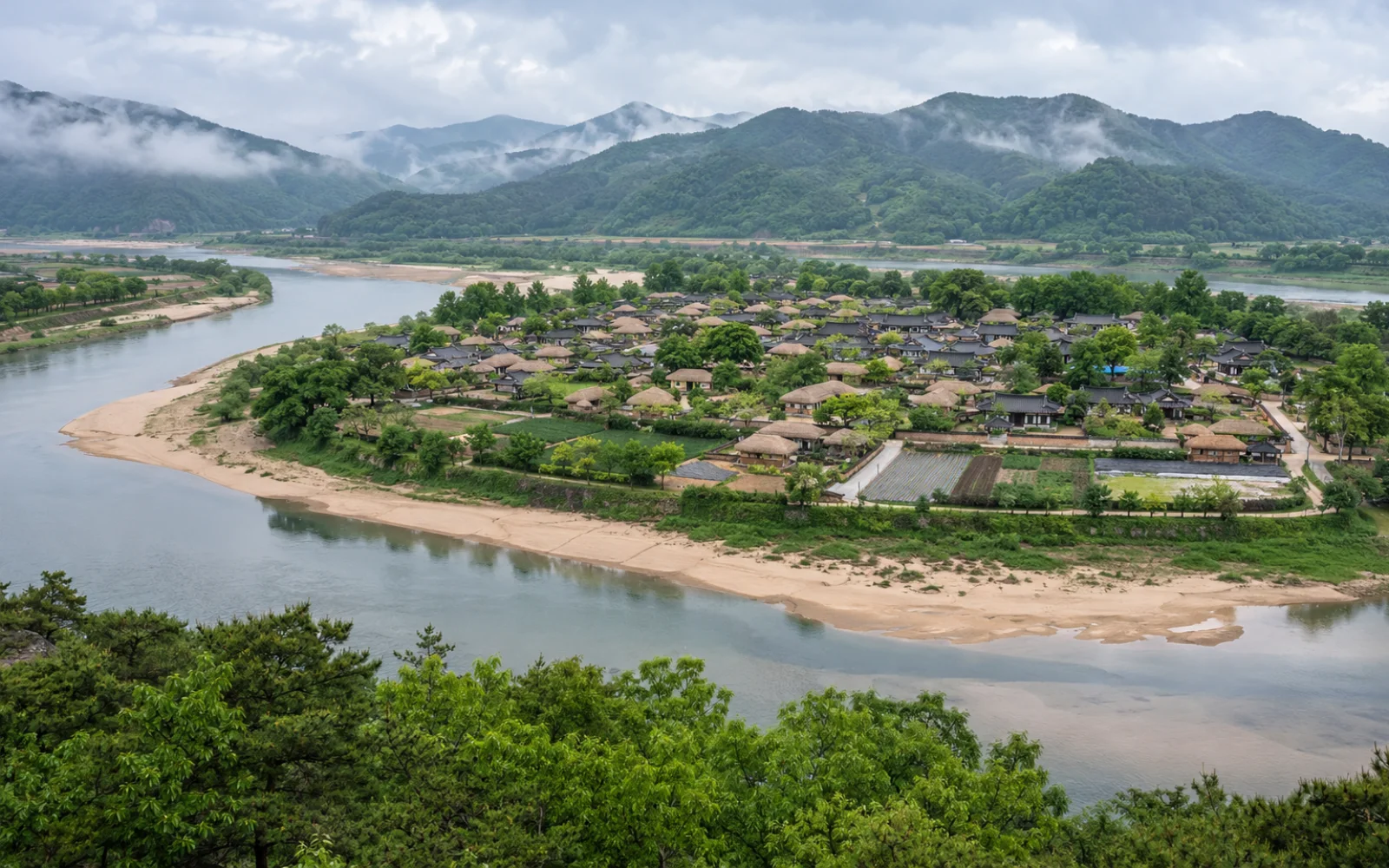
Cover: AI-generated illustration. © ANUSHKA DAHANAYAKE (PVT) LTD.
Andong's best-known image is Hahoe Village held within the S-shaped Nakdong River bend. Yet the image can mislead. Hahoe is outside central Andong, residents live within the heritage landscape, and other important sites such as Dosan Seowon require travel in different directions.
A valuable visit therefore begins with transport and conduct, not a list of façades.
Stay long enough for the distances
One night is the practical minimum for a first visit. Arrive, use the city centre for orientation and food, then reserve the next day for one regional cluster. Two nights make Hahoe and a separate academy or museum day more realistic.
Check the current train or bus arrival point; maps and old guides may refer to former stations. Record the accommodation address in Korean and confirm the last local bus. A taxi to a rural site may be easy to take outward but difficult to find for return without a booking.
Do not combine Hahoe, Dosan Seowon and every city museum simply because they share the Andong name. Waiting and road distance consume the day.
Plan Hahoe as living heritage
In 2010 the World Heritage Committee inscribed Hahoe and Yangdong together as historic clan villages. Both were founded in the fourteenth and fifteenth centuries, and the listing covers houses, fields, forest and river landscape, as well as Byeongsanseowon, the Confucian academy linked to Hahoe. Yangdong, the partner village, lies near Gyeongju; our Gyeongju Silla heritage guide covers that city. At Hahoe, that status exists alongside resident life, agriculture and cultural practice.
Use the official entrance and information service. The Andong tourism route page lists Hahoe bus stops and return services, but confirm the timetable on the day alongside admission, shuttle arrangements and opening time. Staff or cultural interpreters can clarify which buildings are publicly accessible.
Remain on public paths. A low wall, open gate or attractive courtyard is not an invitation. Do not photograph through windows, move household objects or ask residents to pose. Keep voices low and prevent children from entering fields.
The village contains both tiled-roof houses and thatched structures with different social and functional histories. Avoid describing every building as a palace or treating thatch as evidence of a frozen “simple past”. Interpretation matters.
The river bend changes how the village makes sense
At ground level, lanes reveal walls, gardens and spatial relationships. The elevated view from the Buyongdae side reveals the river, sand, fields and mountains that define Hahoe's setting.
Reaching that viewpoint may require separate road access, seasonal boat information or a longer route; never assume a river crossing operates. Confirm the current official approach and return before setting out.
Cliff edges, rain and ice require caution. Stay behind barriers and use footwear with grip. A misty or closed viewpoint is not a reason to enter a restricted path.
River sandbars and water levels change. Do not wade or improvise a crossing. Flood and heavy-rain notices override an itinerary.
Performances are scheduled cultural practice
Hahoe mask-dance traditions and the wider festival identity are important, but visitors should verify the exact performance, venue and date. A tourism description does not guarantee a show every day.
Arrive early enough to sit without blocking circulation. Follow photography rules, particularly where performers, children or indoor spaces are involved. Applause and attention are more respectful than continuous close filming.
The original Hahoe masks were carved for a village ritual, and they were designated a National Treasure of Korea in 1964. Each face plays a village character, and the performance is a humorous satire aimed at the elite. Knowing the roles makes a performance far easier to follow. If you want a mask to take home, buy from a named carver who can tell you which character it is.
Do not stage comic imitations of ritual or performance gestures for social media. Cultural experience is not permission to parody.
A practical two-day plan
Arrival afternoon: check in near a useful transport corridor, visit an Andong museum or market and confirm the next day's bus, taxi or tour. Ask the information centre about current Hahoe services and closures.
Full day: travel to Hahoe early, begin with interpretation, walk the public village route and allow a meal or rest. Add Buyongdae only when access, weather and return transport are confirmed. If an official performance aligns, treat it as the day's final anchor and do not insert another distant site.
Departure morning: choose one city museum, riverfront segment or market stop with an easy exit. Keep luggage collection and station travel protected.
With two full days, assign the second to Dosan Seowon or another selected Confucian site. Research its historical role and current visitor facilities instead of treating every academy as the same architecture.
Confucian sites need more than visual admiration
Seowon were educational and commemorative institutions embedded in particular intellectual, political and landscape histories. Use official or museum interpretation to understand who studied and was honoured there, and how access and social power operated.
Quiet courtyards are not empty photo studios. Follow signs, avoid closed platforms and do not touch tablets, books or ritual objects. Commercial photography may need permission even where personal photography is allowed.
Dosan Seowon was founded in 1574 to honour the scholar Yi Hwang, known as Toegye, who had retired there to teach. In 2019 it became one of nine academies inscribed together as the Seowon, Korean Neo-Confucian Academies, and Byeongsanseowon near Hahoe is another. Read the site's interpretation for the names of the halls, because each one marks a role in teaching or ritual.
Weather, wildfire and seasonal decisions
Andong can be very hot in summer and cold in winter. Rural heritage sites offer uneven shade and long outdoor periods. Carry water, sun protection or insulated layers as appropriate.
Heavy rain can affect river paths and rural roads. Winter ice makes courtyards and viewpoints hazardous. Spring and autumn can bring serious wildfire danger; follow emergency alerts, road controls and site closures immediately.
Never smoke, light candles or use flame near thatch, timber, fields or forest. A cultural landscape is exceptionally vulnerable to sparks. If authorities issue an evacuation, leave by the instructed route and forget the photograph.
Air quality and pollen may also affect an outdoor day. Keep a city museum alternative.
Accessibility and family choices
Hahoe's lanes can include earth, stone and uneven thresholds. Ask the tourist information centre about current mobility routes, toilets and shuttle access. A village-wide accessibility claim is not precise enough.
Wheelchair users should confirm the surface to specific public buildings and whether Buyongdae is appropriate; the elevated viewpoint is not required to understand Hahoe.
Families can focus on the river shape, two house types and one interpreted cultural activity. Children should remain away from fields, household yards and fire-sensitive materials.
For older travellers, a legal taxi or organised tour may reduce waiting and allow a safe return. Verify what interpretation is included before paying only for transport.
Food, drink and responsible buying
Andong is associated with dishes including jjimdak and with soju traditions, but visitors should ask portion size, spice, ingredients and alcohol strength before ordering by reputation. Shared dishes may be large.
Soy, sesame, seafood products and shared preparation create allergy issues. Use translated written information. Alcohol should never be paired with driving or a cliff route.
When buying masks, textiles, paper or food, look for a named maker, origin and material. A mass-produced object using heritage imagery is not automatically local. Do not bargain in a way that dismisses skilled work.
Leave the village as a resident landscape
Before departing, check that no waste or food remains along the village route and that the return bus still runs at the time you expect. If you buy a mask or craft, ask the maker for the story of that work rather than assuming every object represents the same performance tradition.
The Andong place page gathers the city's sites in one place. For a different side of Joseon heritage, the Suwon Hwaseong fortress guide covers King Jeongjo's planned eighteenth-century city, and the Seoul neighbourhood and palace guide shows the dynasty's royal capital at the scale of a modern metropolis.
Andong becomes meaningful when heritage remains inhabited and connected to land. Build time for transport, listen to interpretation and leave private life private.
Questions and answers
How much time is needed for Hahoe Village?
Allow at least half a day including travel from Andong, ticketing, the village and return. Buyongdae or a performance adds time and may require separate transport or schedules.
Can Hahoe and Dosan Seowon be combined in one day?
Only with carefully verified transport or a hired vehicle. They lie in different directions, and public-bus gaps can make a rushed combination unreliable.
Is Hahoe Village an outdoor museum?
It is a World Heritage village where people continue to live. Public routes and interpreted buildings do not make private homes, fields or courtyards open to visitors.
Sources
Seoul · 37.5665° N, 126.9780° E
This story belongs to Andong, South Korea. A peninsula of dense cities, mountain landscapes, maritime regions and layered histories, where local identity extends far beyond Seoul.