Aran Islands Day Trip or Overnight? Ferry, Bike and Weather Guide
A remote-island planning guide for choosing Inis Mór, Inis Meáin or Inis Oírr, with a safe booking chain and an honest day-trip versus overnight decision.
Choose one island first, then decide whether daylight and transport make it a day trip. Inis Mór supports the broadest first visit; smaller Inis Meáin and Inis Oírr reward travellers who want a narrower plan. An overnight stay is valuable for quieter hours and weather margin, not because it permits rushing all three islands.
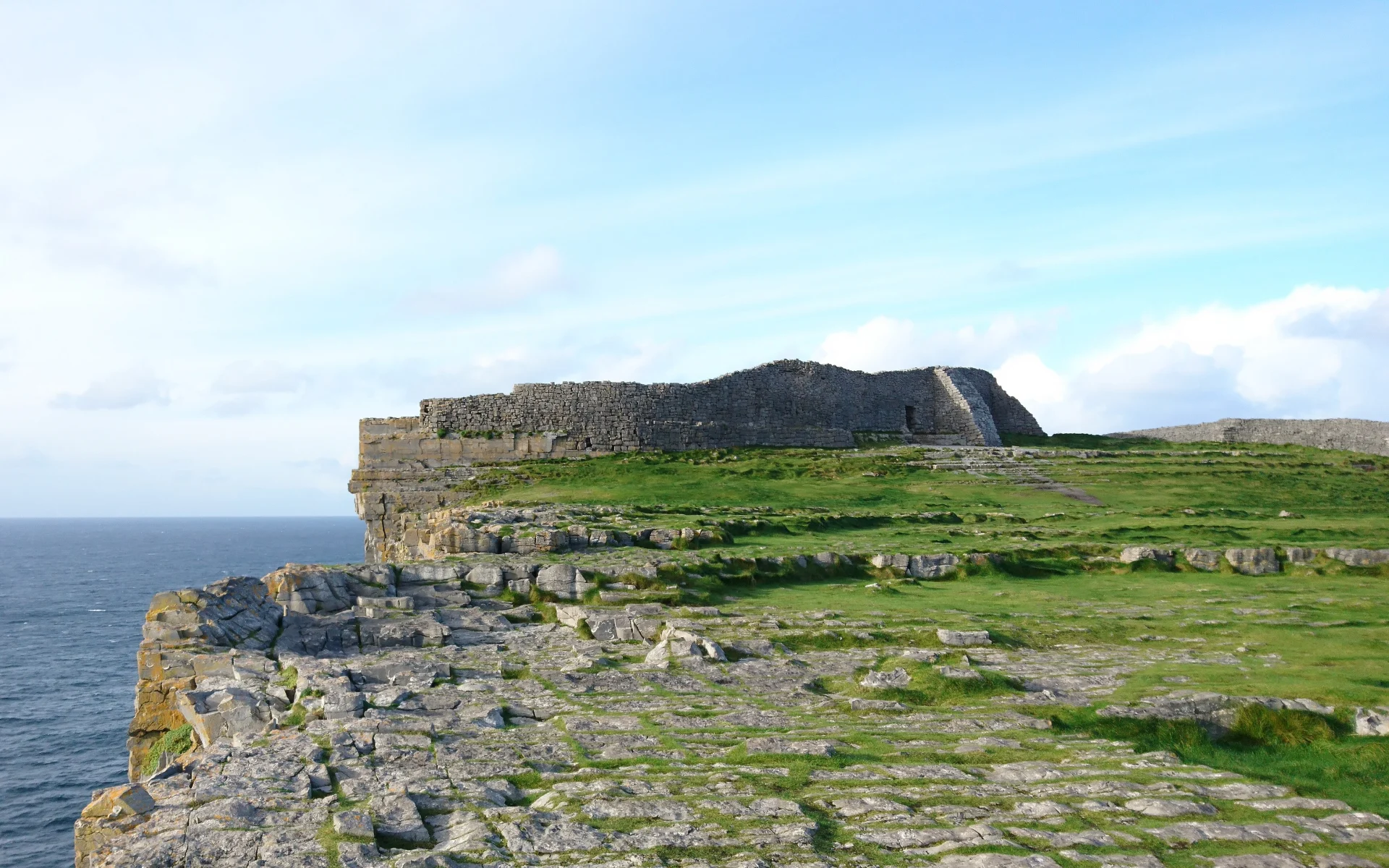
Cover photograph: “Dun Aengus 2017 - Inis Mor, Ireland” by Lorenz.12, licensed CC BY-SA 4.0. Cropped to 16:10 and converted to WebP; no generative alteration.
Why the Aran Islands matter: stone, sea and the Irish language
The three Aran Islands, Inis Mór, Inis Meáin and Inis Oírr, sit at the mouth of Galway Bay, and their story is written in limestone. On Inis Mór, Dún Aonghasa stands on the edge of a sheer 87-metre cliff. Heritage Ireland describes the fort as over 3,000 years old; excavations found evidence of prehistoric metalworking, houses and burials, and the whole complex was refortified in AD 700 to 800. A band of upright stones, the chevaux-de-frise, still surrounds it from cliff to cliff, a defence designed to slow anyone approaching on foot.
Later centuries left their own marks. Dún Chonchúir on Inis Meáin, another great stone fort, was built sometime between the 1st and 7th centuries AD, and Temple Brecan, one of the two churches that remain at the Seven Churches site on Inis Mór, dates from around 1200. The islands also shaped Irish literature: the playwright J.M. Synge first stayed at a cottage on Inis Meáin in 1898, and the experience fed his essays, The Aran Islands. That cottage, Teach Synge, has since been restored.
What visitors notice first is the landscape people built by hand: fields enclosed by dry-stone walls on bare limestone, small harbours and a working island life. Islanders speak Irish, in their own dialect, as well as English, are known as expert dry-stone wall builders, and the islands are celebrated for Aran knitwear, with handmade sweaters still sold on Inis Mór by craftspeople who live there. Islanders are proud of that continuity, of keeping language, craft and community going on rock at the edge of the Atlantic.
Reaching that world depends on boats, small planes and weather, so the visit starts with a booking chain built in the right order.
Build the booking chain in order
First choose the island. Then select the ferry or flight, confirm the mainland departure point and transfer, and only then reserve accommodation or island transport. Operators including Aran Island Ferries and Aer Arann Islands publish their own check-in and baggage rules. Read the terms for your exact service.
Allow margin between national transport and the island departure. Weather disruption can affect sea or air service, and a late arrival may not have another connection.
Decide whether the day-trip clock is honest
Write down scheduled arrival, check-in for the return and the time needed to reach the harbour or airfield. What remains is the real visit. If it cannot accommodate your chosen route without a sprint, stay overnight or remove a stop.
Overnight visitors still need a disruption plan. Confirm accommodation cancellation terms, food availability and the following day's connection. Quiet evening hours are a benefit; they do not replace preparation.
Choose movement after seeing conditions
On Inis Mór, bicycles, minibuses, walking and horse-drawn transport may be available. Compare route, duration and accessibility; a photograph says little about either. Strong wind can make cycling exhausting, while some roads and approaches are uneven. Hire only equipment you can use safely and clarify return time.
Visitors with limited mobility should contact transport providers and attractions before arrival. Island surfaces, vehicle boarding and historic sites vary; a general claim that an island is accessible is not enough.
Treat Dún Aonghasa as a landscape site
Heritage Ireland's Dún Aonghasa page should be checked for current opening and access information. The fort stands in an exposed limestone landscape. The approach and cliff environment require suitable footwear, attention to wind and close supervision of children. There is no photograph worth approaching an unsafe edge.
Allow time for the site and interpretation instead of treating it as a cycling checkpoint. Respect walls, archaeology and local directions.
Let weather cancel the ambitious version
Check Met Éireann warnings and the operator's status before leaving the mainland. When service runs but conditions are poor, shorten the island route and remain near reliable transport. When the operator cancels, follow rebooking instructions and leave unofficial alternatives alone.
Carry water, weather layers, essential medication and payment options. Some businesses close outside the main season, and mobile coverage will not resolve a missed connection.
Understand what an overnight changes
After the last day visitors leave, the island becomes quieter, but accommodation and dinner choices are limited. Confirm both before travel and ask about check-in from your actual service. An overnight allows a shorter first-day route and a weather decision the next morning; it does not justify booking a late arrival and early departure with no margin.
Keep noise low around homes and remember that island transport serves residents as well as visitors. A driver or host cannot rearrange the day around a missed connection.
Costs that need separate confirmation
Price the mainland transfer, ferry or flight, island transport, admission, food and accommodation separately. A low headline ferry fare does not describe the entire trip. Read cancellation terms for weather disruption and know whether each provider rebooks, refunds or expects you to contact them.
Bring cash only as a backup, not as an assumption that cards are unavailable. Ask businesses what they accept and use an ATM before the departure point if necessary.
Leave cultural and natural material in place
The limestone pavement, stone walls and archaeological sites are not souvenirs. Do not move stones, climb walls or create cairns. Use marked routes and follow local instructions about gates, animals and drones. Irish remains a living language on the islands; place names and conversations deserve patience and quiet attention.
Choose locally made work by asking about the maker and material. That question supports genuine island craft and helps visitors avoid generic imports without turning the visit into a shopping exercise.
Compare the three islands by scale
Inis Mór has the broadest visitor infrastructure and the best-known archaeological route, making it the simplest first choice. Inis Meáin offers a smaller, quieter environment where advance arrangements matter more. Inis Oírr is compact but still requires a realistic plan for ferry, surfaces and weather.
Choose an island for more reasons than a convenient departure. Match the island's scale to the desired walking, cycling, heritage and accommodation. Trying to visit two islands in one ordinary day creates connection risk and little time in either community.
Build an Inis Mór day around one main route
After arrival, confirm the return check-in point and time. Choose Dún Aonghasa and its western route, or a different island circuit, according to weather and mobility. A bicycle can provide independence, a minibus can reduce physical demand, and walking provides depth over a smaller area. Each choice removes some other stops.
Allow time to return hired equipment and reach the harbour without racing. An attraction closing time does not extend because the ferry arrived late. If the visit window shrinks, cut the route immediately.
Know when the sea crossing is unsuitable for you
Passengers prone to motion sickness should seek medical advice where appropriate, check conditions and follow the operator's boarding guidance. Wear practical footwear and keep hands free for boarding. Tell the operator about mobility needs before travel; vessel and pier arrangements differ.
Flights provide a different connection chain with baggage and weather considerations. You will still need island transport after landing. Compare the entire journey from accommodation to island activity.
Plan the overnight around services
Reserve accommodation before assuming an overnight is possible. Confirm dinner, breakfast, luggage and transport from the arrival point. Outside the busiest periods, choices may be limited, which is part of island scale and no sign of a service failure.
Use the quiet evening respectfully. Keep voices low near homes, avoid drones without full permission and legal compliance, and do not walk unfamiliar cliff routes after dark. A sunrise plan still needs safe access and weather.
Leave a mainland contingency
Do not place an inflexible international flight or major event immediately after the island return. Weather disruption can change the day. Know the operator's contact method, the accommodation response and the mainland alternative.
If the sailing is cancelled before departure, use Galway or the Connemara coast rather than searching for an unverified boat. If delayed on the island, follow operator and accommodation guidance. Travel insurance terms should be understood before the trip, not during disruption.
Continue through the Ireland hub, begin on the mainland with our Galway first-time visitor guide, compare another Atlantic route in the Kerry first-time guide, or choose a city-based arrival with the Dublin first-time guide.
Questions and answers
Which Aran Island should a first-time visitor choose?
Inis Mór has the widest range of services and major sites such as Dún Aonghasa. Inis Meáin and Inis Oírr offer smaller-scale experiences but require a more selective plan.
Why is Dún Aonghasa important?
Heritage Ireland describes Dún Aonghasa on Inis Mór as over 3,000 years old. Excavations found evidence of prehistoric metalworking, houses and burials, the complex was refortified in AD 700 to 800, and a band of upright stones still surrounds the fort from cliff to cliff above an 87-metre drop.
Can visitors cycle everywhere on Inis Mór?
Cycling is useful, but wind, traffic, gradients, road surfaces and personal ability matter. Confirm hire terms, wear appropriate equipment and use another transport option when conditions are unsuitable.
Sources
Dublin · 53.3498° N, 6.2603° W
This story belongs to Ireland. A country that runs on deep time, precise craft and stories told well, from a tomb older than the pyramids to a literature honoured four times.