County Kerry for First-Time Visitors: Route, Bases and Costs
A county of monks on a sea stack, the cable that joined two continents, Ireland's highest peak and the most successful football team in the country.
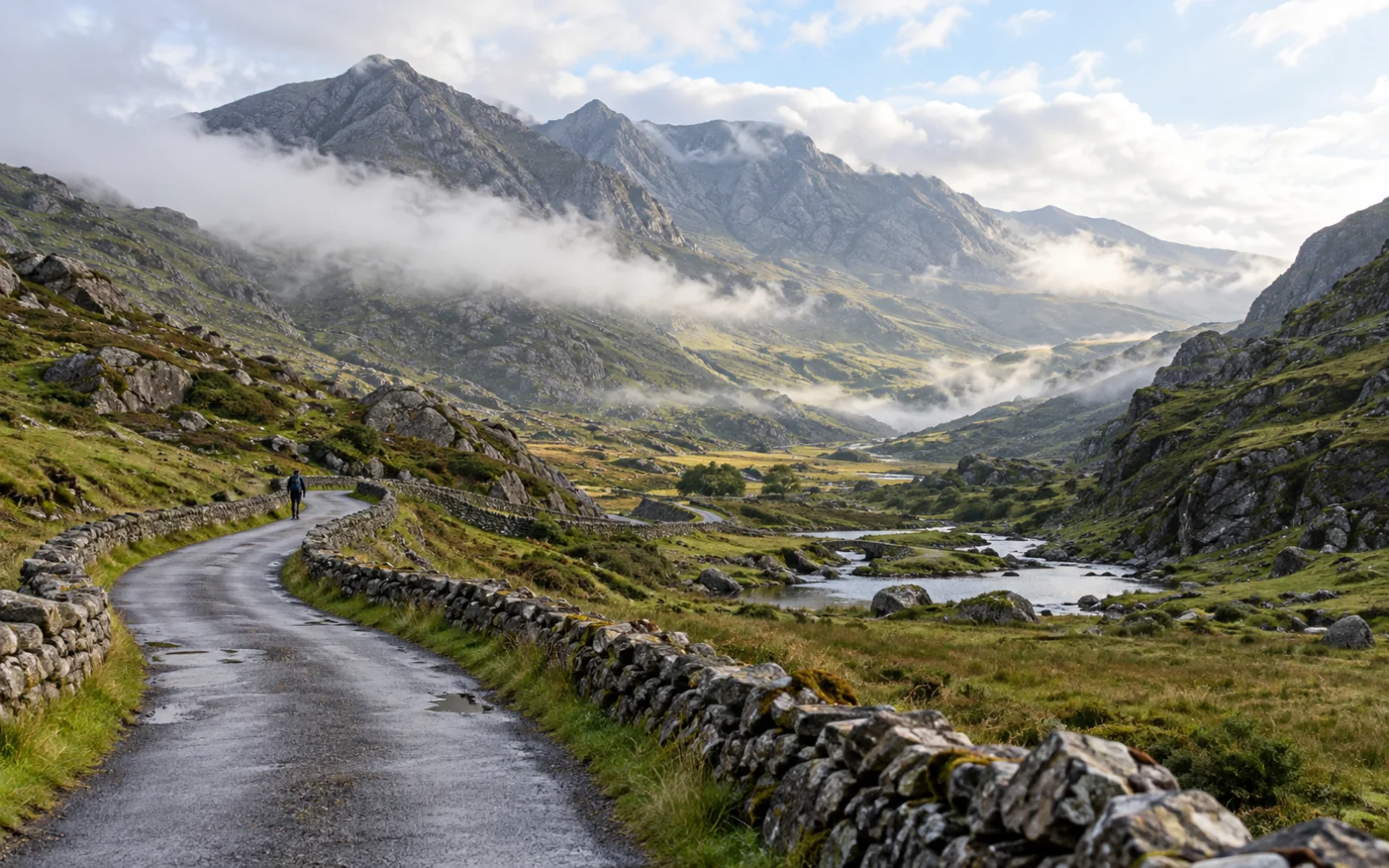
Cover: AI-generated illustration. © ANUSHKA DAHANAYAKE (PVT) LTD.
County Kerry is where Ireland looks out at the Atlantic and shows what that long exposure has produced. Monks built a monastery on a sea stack between the sixth and eighth centuries. The first permanent telegraph link between Europe and North America came ashore on Valentia Island in 1866. Carrauntoohil, at 1,039 metres, is Ireland's highest mountain. Irish is still spoken in two Gaeltacht regions, Uíbh Ráthaigh and Corca Dhuibhne. A county this layered rewards people who choose one landscape and look properly.
Monks on Skellig Michael
Skellig Michael rises from the Atlantic off the Iveragh coast, and its monastery was occupied from the sixth to eighth centuries until the late twelfth or early thirteenth century. Six drystone beehive cells survive on the saddle between the island's two peaks, reached by roughly 600 stone steps. UNESCO inscribed the island in 1996, describing the South Peak hermitage as the most spectacularly situated of all early medieval island monastic sites. Its fame widened when The Force Awakens (2015) and The Last Jedi (2017) were filmed here, but the cap of 180 visitors a day is a conservation measure, not a marketing device. Heritage Ireland publishes the current permitted landing-boat operators. Landings are often cancelled in rough seas, so travellers who cannot land can still see the islands from the mainland and learn about them in local interpretation.
Valentia and the cable that joined two worlds
Transatlantic cable attempts at Valentia failed in 1857 and 1858 before a link to Heart's Content, Newfoundland, succeeded in 1866, with signals exchanged on 24 October that year. Foilhommerum Bay is remembered as the end of the first permanent communications link between Europe and the Americas. A memorial there was unveiled in October 2002, and cable operations on the island continued until 1966. Valentia slate, from a quarry that reopened in 1998, supplied the British Houses of Parliament. In 1992 a Swiss geology student, Iwan Stössel, found tetrapod footprints about 385 million years old at Dohilla, evidence of four-legged animals that scientists still study. The island was also where Charles Lindbergh made his first European landfall, crossing over Dingle Bay and Valentia on 21 May 1927, near the end of his solo flight from New York to Paris.
A mountain, a language and a football county
The MacGillycuddy's Reeks rise to Carrauntoohil, and a bright valley forecast does not guarantee summit conditions. Hire a qualified guide if navigation skills are uncertain. Kerry people measure themselves against these mountains as readily as against the Gaelic football field: the county's footballers have won the Sam Maguire Cup more often than any other team. By contrast the county has won the All-Ireland senior hurling title just once, in 1891. Kerry's long record in football is part of everyday conversation, and visitors who ask about it are usually met with enthusiasm. The county's recent history carries sadder chapters too: in August 1922, during the Civil War, National Army troops made seaborne landings at Fenit, Tarbert and Kenmare to take Kerry for the Irish Free State.
Two Gaeltacht regions
Irish survives as a community language in Corca Dhuibhne, the Dingle Peninsula, and Uíbh Ráthaigh, around the Iveragh coast. Road signs there may show only the Irish name, so learn a few place names before driving and treat conversation in Irish as everyday life, not a performance for visitors. Buying from local shops, galleries and cafés in these areas does more to keep the language and the settlements viable than any single attraction ticket.
Killarney as the easy base
Killarney National Park, with Muckross House, Torc Waterfall, Ross Castle and the lakes, is the simplest way into the county without a long drive. It became Ireland's first national park in 1932, when William Bowers Bourn and his son-in-law Arthur Vincent gave the Muckross Estate to the Irish Free State. Torc's paths can become slick, so stay on the constructed route, and do not feed deer or block roads to photograph them. The Killarney first-time visitor guide covers the town and park in more detail, and the Dingle first-time visitor guide covers the peninsula that deserves its own base.
Building a Ring of Kerry day
The Ring of Kerry is a regional journey, not one attraction. From Killarney or Kenmare, choose several stops, not every pin: a coastal village, a beach, a stone fort and one viewpoint is plenty, because parking and weather take time. The Gap of Dunloe can be crossed on foot, by bicycle or with a licensed jaunting-car operator, and the narrow road demands patience around walkers and horses. Do not add Dingle to the same day. If the cloud closes in, a village meal or a sheltered walk is a successful alternative, not a failed day.
Practical notes for Kerry
Trains connect Dublin with Killarney and Tralee, sometimes with a change, and scheduled coaches link regional towns, though rural frequencies can be sparse. Use Transport for Ireland to check timetables and the last return. A guided tour is often more relaxing than hiring a car for one famous loop. Drivers should keep left, use designated pull-ins and never stop on a blind bend for a photograph.
Tell someone the route when walking, carry layers and keep dogs under the control required locally. Atlantic swell can reach apparently dry rocks, and cold water and currents demand respect even in summer. Accommodation is the main cost, followed by transport; book lodging and any regulated island trip first and keep ordinary viewpoints flexible. Ask operators specifically about distance from parking, surfaces and boarding, since historic steps and older boats create real barriers.
Close gates, obey farm signs, slow for animals and support small businesses with a purchase. Irish place names may appear alongside English ones, and using them respectfully is part of the courtesy.
Use our Ireland destination hub for the wider country, and read what makes Ireland special for the heritage behind the landscape. Neighbouring Cork and Limerick are the usual city stops on the way in or out of Kerry, and Donegal shows how the Wild Atlantic Way feels at its northern end.
Questions and answers
How many days do you need in County Kerry?
Allow at least three full days for one peninsula and Killarney. Five or more days lets you include both the Ring of Kerry and Dingle without spending the trip in a car.
Can you explore Kerry without driving?
Yes, if you base in Killarney or Tralee and use trains, buses and organised day tours. Rural viewpoints, trailheads and evening options are more limited without a car.
Should you drive the Ring of Kerry clockwise?
There is no universal best direction. Coach patterns, weather, road works and your starting point matter more. Use live advice and allow overtaking space rather than racing a fixed circuit.
Sources
Dublin · 53.3498° N, 6.2603° W
This story belongs to Kerry, Ireland. A country that runs on deep time, precise craft and stories told well, from a tomb older than the pyramids to a literature honoured four times.