Killarney for First-Time Visitors: National Park Without the Rush
The park given to the nation in 1932, the red deer that live nowhere else wild in Ireland, a fifteenth-century castle on Lough Leane and a rare native tree.
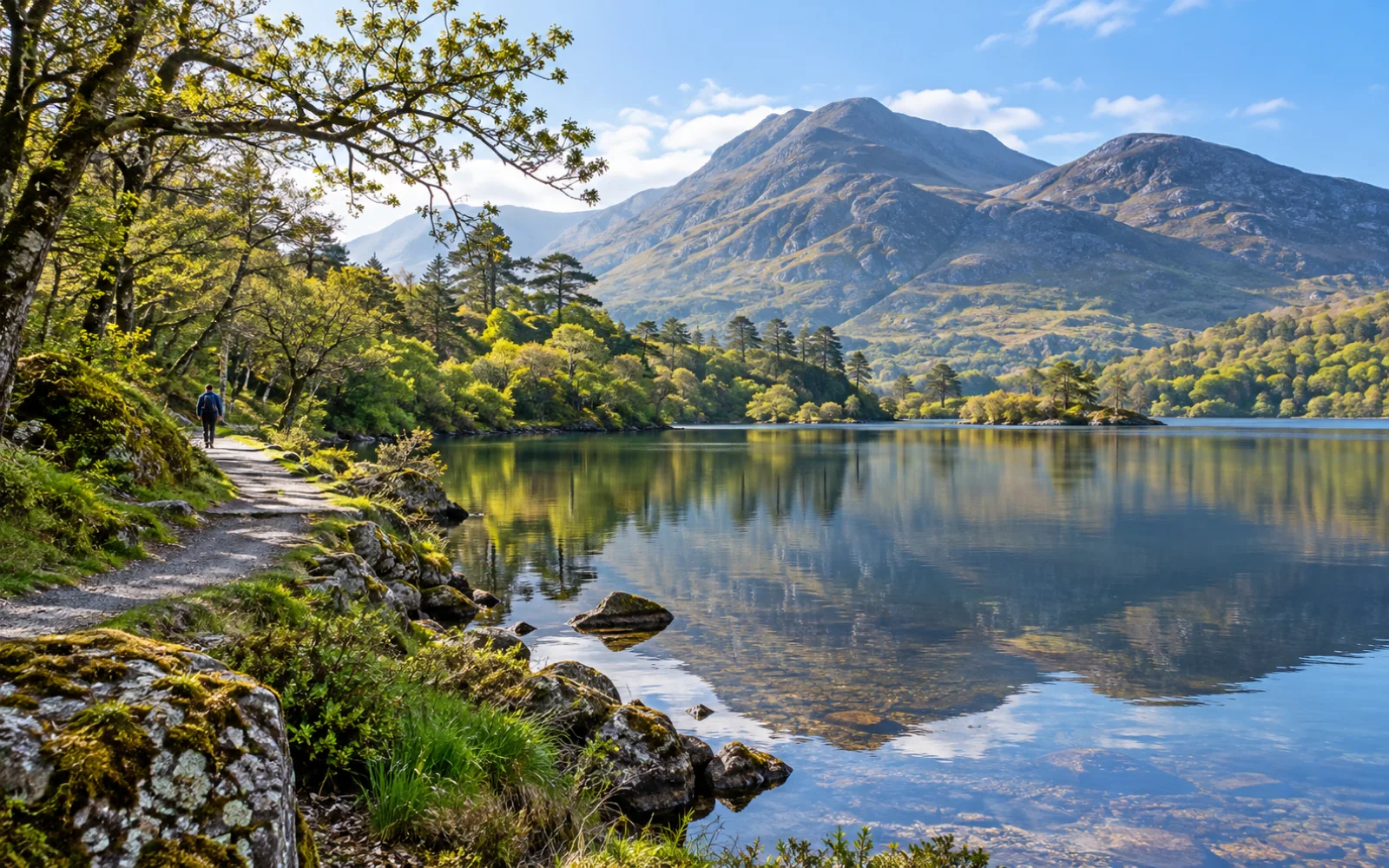
Cover: AI-generated illustration. © ANUSHKA DAHANAYAKE (PVT) LTD.
Killarney National Park began as a family gift. In 1932 the Muckross Estate, which William Bowers Bourn had bought in 1910 as a wedding present for his daughter Maud, was donated to the Irish state by her husband Arthur Vincent and her parents, in her memory after her death in 1929. The estate of about 43 square kilometres became Ireland's first national park. It has since grown to roughly 103 square kilometres, and in 1981 UNESCO designated it a Biosphere Reserve. For many Irish people it is the clearest proof that a landscape can be given to everyone.
Woods, lakes and rare life
The park contains the only remaining herd of native red deer in Ireland, about 900 animals; every other herd on the island descends from reintroduced stock. It also holds the Reenadinna yew wood, around a quarter of a square kilometre, and about twelve square kilometres of oak woodland. The arbutus, or strawberry tree, is one of Ireland's rarest native trees and is found in very few places outside Killarney. Three lakes shape the park: Lough Leane, the largest at about 19 square kilometres with more than 30 islands, Muckross Lake and the Upper Lake.
Treat the deer as wild animals. Observe from a distance, never feed them and avoid blocking roads when they appear. During the rut and calving, extra space matters.
Castles, abbeys and a great house
Ross Castle, built in the late fifteenth century by the O'Donoghue Ross clan, stands on the shore of Lough Leane. Legend says it could not be taken until a warship sailed on the lake, and it was among the last strongholds to surrender to Cromwell's forces, after artillery was brought by boat along the River Laune. Another legend says an O'Donoghue chief was drawn into the lake with his horse, table and library and still lives in a palace beneath the water. Muckross Abbey, a friary founded by Observantine Franciscans in 1448, stands in the grounds and has uneven historic surfaces. Muckross House, completed in 1843 by Henry Arthur Herbert and Mary Balfour Herbert, is the park's great house, set with gardens and traditional farm buildings.
Local transport reflects this history. Jaunting cars, horse-drawn traps, remain part of the visitor economy, so agree the route and price before departure and check whether the vehicle suits your access needs.
Why the biosphere matters
UNESCO's Biosphere Reserve designation of 1981 recognises more than scenery: it treats the park as a working relationship between people and an ecosystem. The oak woodlands, the yew wood and the lakes together make a habitat that depends on careful management, and balancing wildlife, woodland and visitor pressure is an ongoing task for the park's staff. Visitors help by staying on managed paths where requested, keeping dogs under the rules posted for livestock and wildlife, and following official notices rather than copying others.
Quieter ways to see it
The park is open to everyone, which is why timing matters. Walk early, stay overnight instead of arriving at midday, and consider late spring or early autumn for fewer coaches. Winter has atmosphere but shorter daylight and reduced services, so check which house tours, boats and cafés are operating. Pack a reusable bottle and snacks, since seasonal opening can change. Visitors with sensory sensitivities can choose quiet woodland sections away from peak coach arrivals, and those who prefer to avoid stairs can still enjoy lakeside drives, gardens and selected paths. The park itself is the reason to come, and it asks little more of visitors than patience.
A route that follows the story
Day one, near the town. Start with Ross Castle and the lake edge, where the interior and tours can be seasonal. Boats operate under conditions set by providers, so ask about lifejackets, boarding steps and cancellation. Spend the afternoon in the Knockreer woodland and do not try to cross the whole park.
Day two, Muckross and Torc. Go to Muckross House early, then continue to Muckross Lake and Torc Waterfall. The waterfall path can be slippery and busy after rain, so grippy footwear and an unhurried pace matter more than a photo position. Abbey surfaces are uneven and historic, while garden paths are easier. Do not climb ruins.
Day three, the Gap of Dunloe. The Gap can be combined with a boat across the lakes, walked or cycled, or experienced with a licensed jaunting-car operator. Confirm transfer points and what happens if wind cancels a boat. The narrow public road is shared, so drivers should not pressure walkers or horses. The Ring of Kerry is better as its own journey, as described in the County Kerry guide.
Getting there, staying safe and paying fairly
Rail and coaches link Killarney with Dublin, Cork, Limerick and Tralee, though some journeys require changes. Use the Transport for Ireland journey planner for current times. A car is unnecessary for a first town-and-park day, and if hiring one for the wider county a small vehicle suits the narrow roads. Keep left, pass cyclists carefully and never park on a verge that blocks sightlines.
Low-level walks and the Kerry mountains need different preparation. Carrauntoohil and neighbouring peaks can have cloud, wind and navigation difficulty when the town is mild, so check Met Éireann, carry a map and compass you can operate, and consider a qualified local guide. Tell someone the route and turn back before conditions become an emergency. Cold water and depth make swimming risky even on warm days.
The park supports many free hours, so budgets can focus on accommodation, one house tour or boat trip, and meals. Park access varies by route, so contact the park and operators about surfaces, gradients, toilets and boarding. Secure valuables in busy car parks, call 112 or 999 in an emergency, and take all litter away. Killarney works best when weather decides the order and the park is treated as an ecosystem, not an outdoor theme park.
Read what makes Ireland special, add the harbour town in our Dingle guide, see the national collection on our Ireland destination hub and plan a wider route with the County Kerry first-time visitor guide.
Questions and answers
How many days do you need in Killarney?
Two full days cover the town and a substantial part of the national park. Add a third for the Gap of Dunloe or a carefully paced Ring of Kerry excursion.
Can you explore Killarney without a car?
Yes. Rail and coaches reach town, and walking, cycling, seasonal shuttles, tours and jaunting cars serve key areas. Check current schedules before relying on them.
Is Killarney National Park free?
Entry to the national park and many trails is generally free, while Muckross House tours, transport, boats and other operated experiences may charge.
Sources
Dublin · 53.3498° N, 6.2603° W
This story belongs to Killarney, Ireland. A country that runs on deep time, precise craft and stories told well, from a tomb older than the pyramids to a literature honoured four times.