Dingle for First-Time Visitors: Peninsula Route and Practical Guide
A working Irish-speaking harbour town and the peninsula around it, from early Christian stone buildings to the Blasket writers and a famous dolphin.
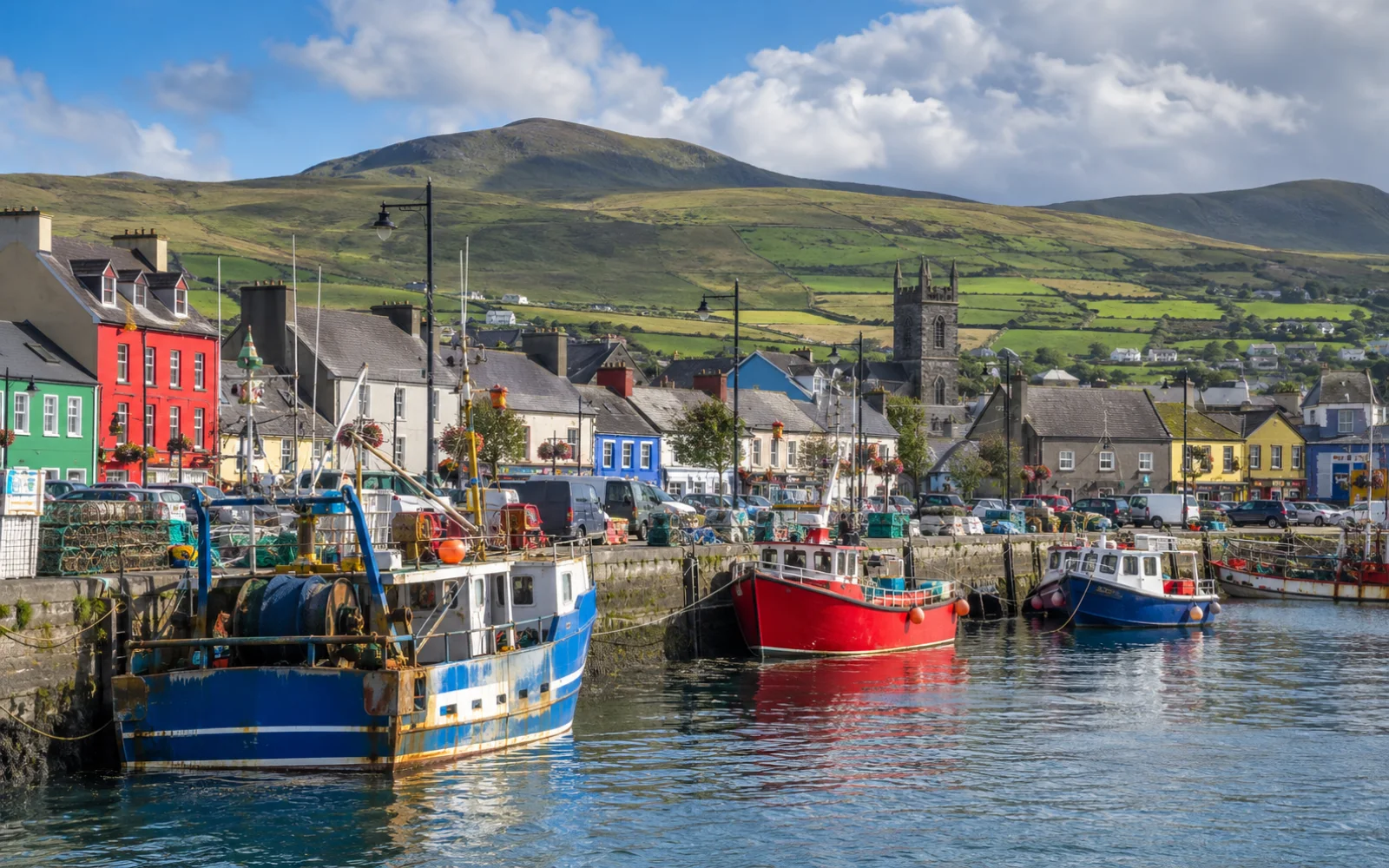
Cover: AI-generated illustration. © ANUSHKA DAHANAYAKE (PVT) LTD.
Dingle, or An Daingean, has been a port for more than seven centuries. A customs ordinance of Henry III in 1257 already taxed the harbour's exports, and James I sealed the borough charter on 2 March 1607. The town sits in the Irish-speaking Gaeltacht, in a peninsula whose stone huts, chapels and carved ogham stones are rich in early settlement. Understanding that layered past is what makes the colourful shopfronts and the cliff road worth the journey.
Stone, saints and fishermen
The Gallarus Oratory, a boat-shaped dry-stone church near the north coast, is often described as one of the best-preserved early Christian buildings in Ireland. Its date is honestly uncertain: scholars have argued for anything from the seventh century to the twelfth, and the lack of carving or finds means no exact year can be given. Nearby Kilmalkedar has an ogham stone whose inscription reads ANM MAILE-INBIR MACI BROCANN, "the name of Mael Inbir son of Brocán", a rare surviving personal name from the early Irish. On the slopes of Slea Head, the Fahan beehive huts are drystone corbelled shelters that may date from around the twelfth century.
Fishing is the second layer. The industry in its modern form dates from about 1830, and the harbour still shelters working boats among the pleasure craft. Linen was a major trade in the eighteenth century, producing cloth worth about £60,000 a year by 1755, though it had almost died out by 1837. A narrow-gauge railway, the Tralee and Dingle Light Railway, brought passengers and fish to the town from 1 April 1891 until its closure on 1 July 1953.
Art, music and a dolphin
The Chapel of the Sacred Heart, built in 1886, holds six stained-glass windows by Harry Clarke, installed in 1924. They are among the finest pieces of twentieth-century Irish church art, and entering respectfully outside services is welcome. Music and storytelling fill the pubs, and Irish remains a spoken community language to the west of the town. Dingle Distillery launched in 2012 and the town also supports galleries and craft shops that are best approached by asking about the maker and the provenance.
The town's most famous resident for decades was a bottlenose dolphin, Fungie, first seen in the harbour in 1983 and last seen on 13 October 2020. A statue now stands outside the tourist office. Boat trips still run in suitable weather, but no responsible operator can guarantee a wildlife encounter.
A name worth getting right
The town's Irish name is Daingean Uí Chúis. In 2005 the government announced that Gaeltacht places would carry only their Irish names on official signs, which left the town's tourism trade uneasy. In a plebiscite in October 2006, 1,005 of the 1,086 votes returned favoured the bilingual form "Dingle/Daingean Uí Chúis", and the Act of 2011 made "Dingle" the official English name. Locals use Irish daily to varying degrees, so a simple Dia dhuit is welcome, while mocking pronunciation is not.
The Blasket story
Looking out from Dún Chaoin, the westernmost village on the peninsula, you see the Blasket Islands, whose Irish-speaking community lived in remarkable isolation until the state evacuated the last islanders in 1953. The island writers, notably Tomás Ó Criomhthain, whose An tOileánach (The Islandman) appeared in 1929, produced one of the best-loved bodies of Irish-language literature. The Blasket Centre at Dún Chaoin tells the story with the islanders' own words. The peninsula has also been a film location: Ryan's Daughter was shot here in 1970 and Far and Away in 1992.
One day for the harbour, one for Slea Head
The town. Begin at the harbour, keeping clear of ropes and loading areas. Walk the compact streets without blocking doorways, visit the Sacred Heart chapel for the Clarke windows, and keep an evening for a seafood supper and a traditional session. Ask what has landed that day instead of expecting a fixed dish, listen during tunes and ask before recording.
The circuit. Check the Met Éireann forecast first, then drive or join a tour west through Ventry, Fahan and Slea Head to Dún Chaoin and back through Ballyferriter. Choose a handful of stops and use proper pull-ins so that local traffic can pass. Paid heritage sites help to maintain the monuments, so follow their rules and do not climb structures or cross fields without permission. Fog, wind or congestion are good reasons to shorten the loop. A Blasket boat trip depends on sea conditions, so confirm the departure port and the return time.
Dingle's climate shapes every plan: annual rainfall averages about 1,600 millimetres, so pack waterproofs in every season and treat a clear day as a gift, not a promise.
Getting there, staying safe and paying fairly
Most public-transport journeys connect through Tralee, and drivers often arrive from Killarney. Transport for Ireland lists route 275 between Tralee and Dingle, with less frequent services toward Ballyferriter and Dún Chaoin, so build the trip around the last bus. Choose a small car if driving, keep left, and expect walkers, cyclists, tractors and animals on narrow roads. Conor Pass has narrow sections and vehicle limits, so skip it in poor weather or an oversized vehicle.
Atlantic wind makes cliff edges, car doors and boat boarding hazardous. Stay behind barriers and never pose on an exposed ledge. Call 112 or 999 in an emergency; mobile coverage can be patchy, so tell someone your walking route. Dingle town has narrow pavements and slopes, and the harbour, cliff paths and ancient sites all have different access. Ask operators about gangways and surfaces rather than relying on a general "accessible" label.
Reserve beds early in summer and festival periods, since a property described as "Dingle" may be many kilometres away. Free viewpoints are not free to the communities that maintain them, so use public parking, buy food or crafts locally, close gates as found, keep dogs under control and carry rubbish back to town.
Read what makes Ireland special, explore the national context through the Ireland destination hub and continue around the wider region with the County Kerry first-time visitor guide.
Questions and answers
How long should you stay in Dingle?
Stay at least two nights for one town day and one weather-flexible peninsula day. Three nights gives room for a walk, boat trip or a rain delay.
Can you visit Dingle without a car?
Yes, using scheduled buses to reach town and a local guided tour for Slea Head. Timetables are limited, so plan the final return and evening transport first.
How long does the Slea Head Drive take?
Allow most of a day if you want walks, heritage sites and meals. The circuit is short in kilometres but slow because roads are narrow and stops deserve time.
Sources
Dublin · 53.3498° N, 6.2603° W
This story belongs to Dingle, Ireland. A country that runs on deep time, precise craft and stories told well, from a tomb older than the pyramids to a literature honoured four times.