Limerick for First-Time Visitors: A Practical Two-Day Guide
A Shannon city founded by Vikings in 812, besieged by Cromwell and the Williamites, and named Ireland's first National City of Culture in 2014.
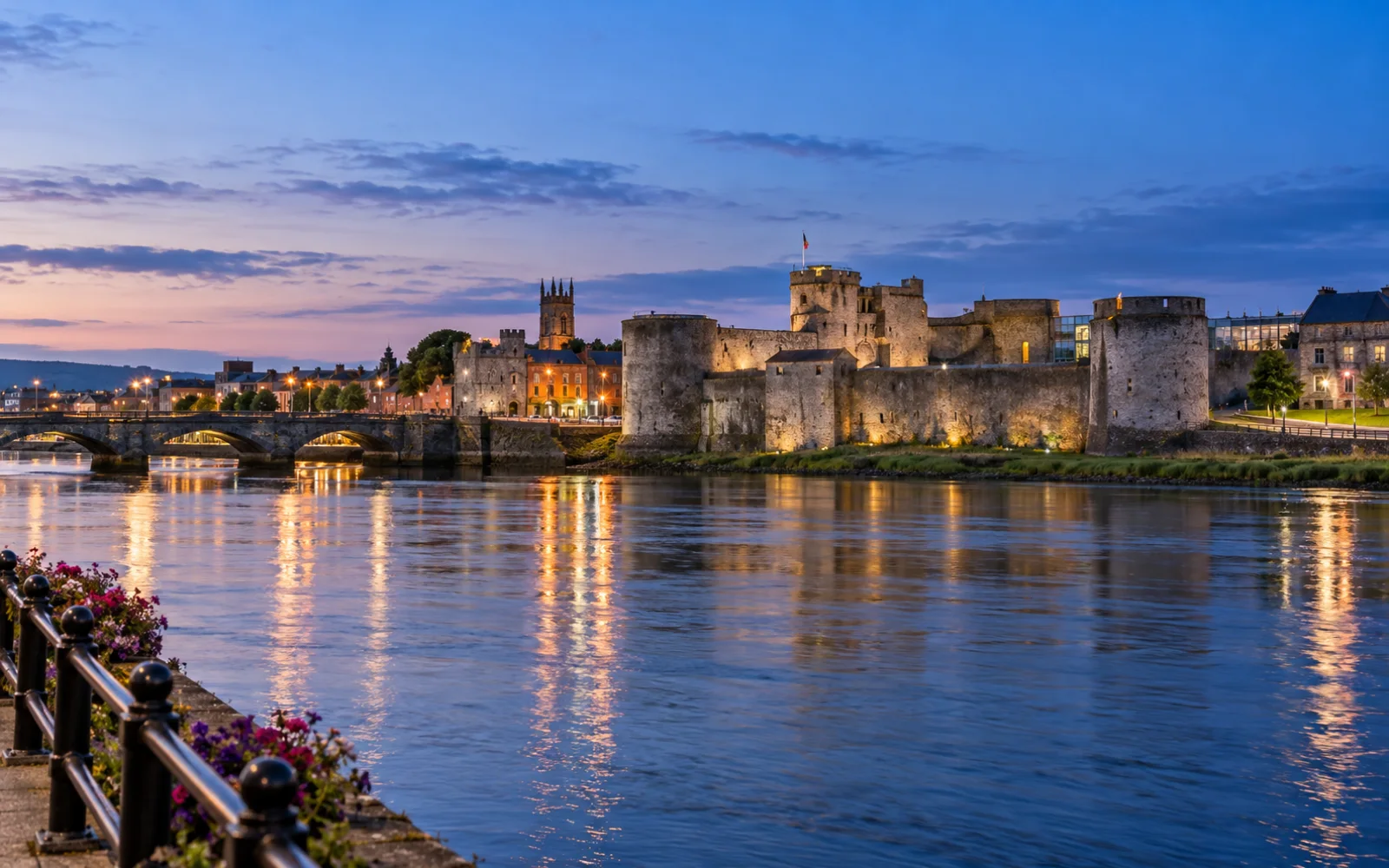
Cover: AI-generated illustration. © ANUSHKA DAHANAYAKE (PVT) LTD.
Limerick was founded by Scandinavian settlers in 812, which makes it one of Ireland's oldest urban sites. It received its first charter in 1197, and its great stone castle was in place by 1210. The Shannon that carried Viking longships also carried the commerce that made the city rich, and the same crossing made it a prize in every war. Cromwell besieged it in 1651, and the Williamites twice in the 1690s. Visitors who arrive expecting only a rugby city find a place with unusually deep layers.
The Treaty Stone and the Wild Geese
The war ended here. The Treaty of Limerick, traditionally dated to 3 October 1691, ended the Williamite war between the Jacobites and the supporters of William of Orange, and by tradition it was signed on a stone at the Clare end of Thomond Bridge in sight of both armies. Its terms promised toleration of the Catholic religion and security of Catholic land, and allowed Patrick Sarsfield and the Jacobite army to leave for France. Those who sailed became known as the Wild Geese. The promises were not kept, because the Irish Parliament of 1697 did not honour them, and Catholics lived under the Penal Laws until the early nineteenth century. The Treaty Stone, moved several times, now stands on a plinth near the bridge.
From medieval island to Georgian grid
King John's Castle on King's Island is dated to 1210 and explains how a Shannon crossing shaped the city. St Mary's Cathedral dates from 1168 and is still an active church. The medieval core on King's Island gives way to a Georgian quarter that developed from the mid-eighteenth century, and Pery Square and the People's Park, which opened in 1877, remain its pleasant public rooms. The railway linked Limerick to the Dublin-Cork line in 1848. In 1942 Shannon Airport opened, followed by the Shannon Free Zone in 1959, and the airport still shapes the region's links with the wider world.
Strikes, stories and a poem
Limerick has a record of civic drama. From 15 to 27 April 1919 the Limerick Soviet existed, an episode that remains a landmark in Irish labour history. The Limerick boycott of 1904, instigated against the city's Jewish community, is a darker chapter that the city now acknowledges. Frank McCourt's memoir Angela's Ashes made the city's poverty famous worldwide, and the Frank McCourt Museum opened in 2011. Visitors should read the book as a memoir of one childhood, not as a portrait of modern Limerick. The humorous five-line verse called a limerick takes the city's name, and the earliest known use of the word for the form dates from 1880.
A city that keeps reinventing itself
Limerick's economy has turned several times. The city was a river port, a railway junction and, after Shannon Airport and the Free Zone, a centre for international manufacturing. When Dell announced in 2009 that it would close its Limerick plant, the city had to reinvent itself again, and the university, the arts scene and the 2014 culture year were part of the answer. The city and county councils amalgamated on 1 June 2014, and the 2022 census recorded 102,287 people in the city. Limerick lies on the Shannon, Ireland's longest river, which is why its bridges, quays and weather exposure shape every walk.
A city of culture
In 2014 Limerick became Ireland's first National City of Culture. The Hunt Museum, in the former Custom House, holds art and antiquities, and the Limerick City Gallery of Art sits in the Georgian quarter. The University of Limerick, established in 1989 from an earlier institute, has made the riverside a student and arts district. Rugby is a major local passion, and tours at Thomond Park, home of Munster, are worth checking if you follow the game.
A two-day route
Day one, the medieval island. Start at King John's Castle after checking current arrangements; its FAQ lists seasonal hours and a last entry one hour before closing, so allow about ninety minutes. Continue to St Mary's Cathedral, where services come first, then the riverfront and the Hunt Museum. Cross Thomond Bridge for the Treaty Stone, and finish at dusk with the lit castle. Use lit paths and never climb railings for an angle.
Day two, Georgian Limerick. Begin around Pery Square, then visit the City Gallery and the Milk Market on an active morning. The market is a place to shop and eat, so ask before close-up photographs. Use the afternoon for one deeper interest: Thomond Park, the McCourt Museum or the university riverside.
Practical notes for Limerick
Limerick Colbert is the main rail and bus station, with services to Dublin, Cork, Galway and other points, and Shannon Airport is linked by scheduled bus. Use Transport for Ireland for the actual date. The centre is walkable, though bridges add distance and river wind can feel cold. Bring a waterproof layer all year, since stone is slippery after rain.
The Milk Market brings regional producers together, and city restaurants draw on Irish meat, dairy and Atlantic seafood, so ask what is local today and state allergies clearly. Accommodation is the main cost, and concerts, matches and university events can change availability, so book the castle and any stadium experience first and leave ordinary river walks flexible. At traditional music sessions, do not talk over a quiet song, and buying from the venue is part of being a respectful listener.
Beyond the city, Bunratty Castle and Folk Park, Lough Gur and Adare are the usual choices; an organised tour may be easier than several bus changes, and picturesque houses in Adare are homes. Keep valuables secure in busy transport areas, use well-lit routes at night and call 112 or 999 in an emergency. Ask attractions concrete questions about lifts, seating and toilets, since historic buildings differ in access.
For the wider picture, find the rest of the country's destinations on our Ireland hub and use the Dublin first-time visitor guide to compare a larger urban stop with Limerick's own scale.
Questions and answers
How many days are enough for Limerick?
Two days cover the medieval quarter, central museums, Georgian streets and a relaxed Shannon walk. Add a third for Bunratty, Lough Gur or another county excursion.
Is Limerick walkable?
The historic centre and main museums are walkable, though bridges and riverside distances add up. City buses help with outer districts and the university.
Is Limerick a good base without a car?
It is a useful rail and coach base for regional cities. Some rural attractions require careful bus planning or an organised tour, especially outside summer.
Sources
Dublin · 53.3498° N, 6.2603° W
This story belongs to Limerick, Ireland. A country that runs on deep time, precise craft and stories told well, from a tomb older than the pyramids to a literature honoured four times.