Leiden: The City of the 1574 Relief, the Oldest University and Rembrandt's Start
Leiden's 1574 relief, its 1575 university, one of Europe's earliest botanical gardens and Rembrandt's birthplace explain a compact canal city worth two days.
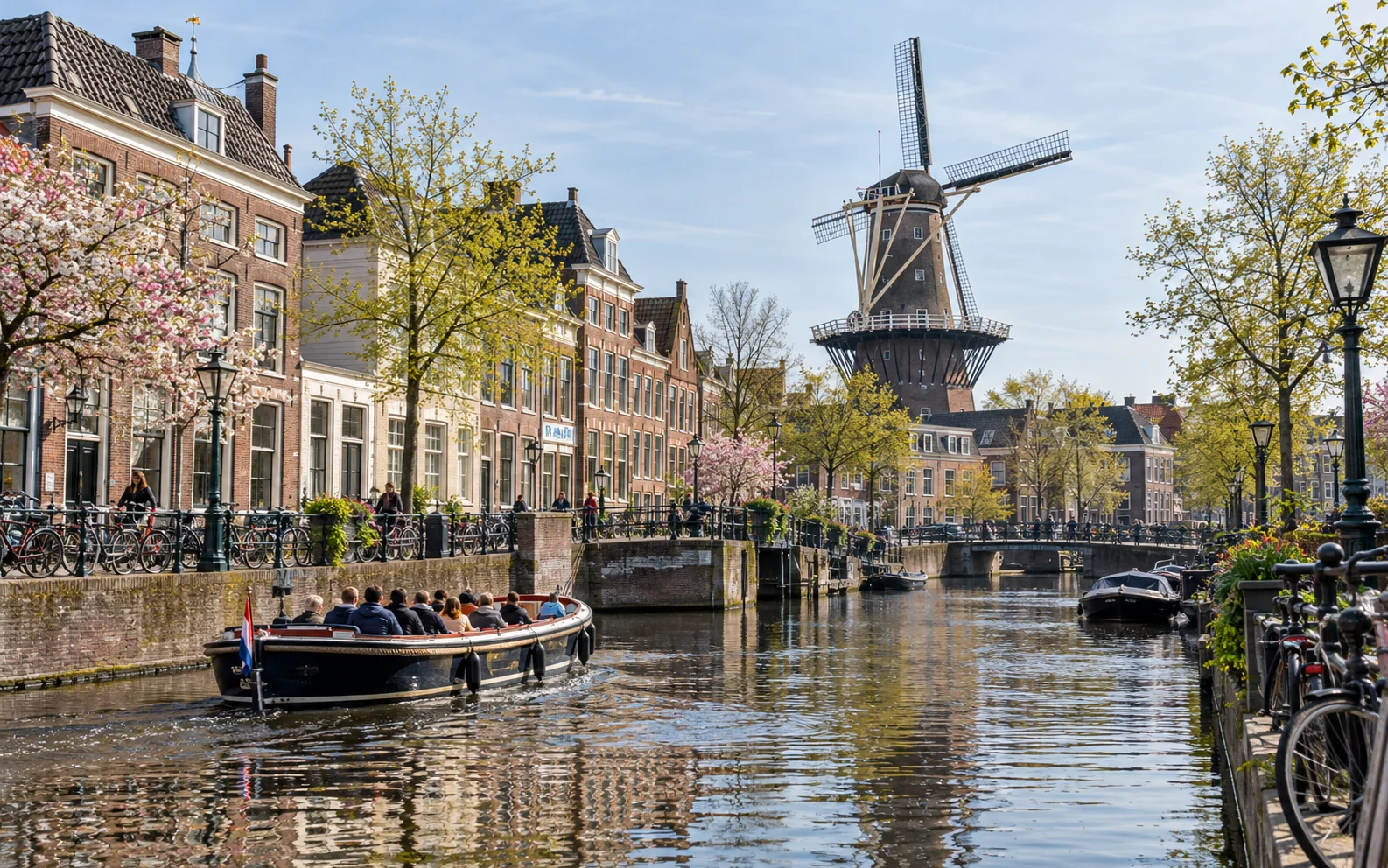
Cover: AI-generated illustration. © ANUSHKA DAHANAYAKE (PVT) LTD.
Leiden's identity rests on a single autumn day. On 3 October 1574, after a long Spanish siege, the Sea Beggars arrived with food for a starving population, and the city has marked the date ever since. A year later it received a university, and the scholars, collectors and gardeners who followed gave a small canal city an influence far beyond its size. The streets, museums and traditions that visitors see today all trace back to that moment of survival.
The siege, the herring and the oldest university
The siege and relief of Leiden is the founding story of the city. The relief is commemorated every year on 2 and 3 October, and the festival's oldest parts, free herring and white bread and a memorial service in the Pieterskerk, go back to the first 3 October in 1574. Hutspot, a stew of carrots, onions and parsnips, is traditionally eaten the evening before; the story that a cauldron of it was found in the abandoned Spanish camp may well be myth, but the dish is part of the ritual. Free herring and white bread are handed out at De Waag on the morning of 3 October, with prior registration required. If you visit around that date, book accommodation early and expect crowds and altered transport.
Leiden University was founded on 8 February 1575 and is the oldest in the Netherlands. Tradition presents it as a gift to the city for its resistance, although historians treat the exact choice offered to Leiden as uncertain. Whatever the details, the university shaped the town: it brought scholars, printers and botanists, and its buildings are still working institutions, so avoid restricted spaces and do not interrupt teaching for photographs.
The Pieterskerk, where the first memorial service was held in 1574, is the natural place to begin a walk that follows these events. From there, the canals and gates show the scale of the town the Spanish besieged: small enough to cross in minutes, which helps explain why a siege touched every household. Visiting outside the festival days gives the same streets with more room to read the plaques and look up at the gables.
Gardens, collections and a famous painter
The Hortus botanicus Leiden began as a medicinal herb garden proposed in the 1580s, and the botanist Carolus Clusius became its first director, widening its aims well beyond medicine. He is credited with introducing tulips to Leiden, a story that links the garden to the Dutch bulb trade even though the exact date of the first bloom is not firmly established. Leiden University's account of the garden describes how it grew from herb garden to crown jewel. Glasshouses make it useful in uncertain weather.
Rijksmuseum van Oudheden was founded in 1818, originally as the university's archaeological cabinet, and traces part of its collection to a 1743 bequest from Gerard van Papenbroek. Its Egyptian wing includes the Temple of Taffeh, an Augustan-era temple from Nubia given to the Netherlands by Egypt as part of the UNESCO Nubian Monuments campaign. Rembrandt was born in Leiden and trained there before moving to Amsterdam, but his birth house does not survive as a domestic museum, so treat any claim of a preserved childhood home with caution. Museum De Lakenhal tells the city's art, textile and civic story, and Rijksmuseum Boerhaave connects science and medicine with the university tradition.
Two days that follow the story
Day one, archaeology and the university quarter. Begin at Rijksmuseum van Oudheden and choose galleries rather than reading everything; check bag and ticket arrangements on the museum page. Continue through the university quarter, where poems painted on walls form an informal route spread across neighbourhoods, so select a few. The Hortus is the restful afternoon. Finish at the Burcht, the raised medieval fortification in the centre, if the steps and opening allow; the view explains Leiden's compact geography.
Day two, one major museum. Naturalis Biodiversity Center is a strong choice for families, natural-history enthusiasts and wet days. Naturalis recommends booking an online start time, especially in holidays, and it sits close to the station, so group it with arrival or departure. De Lakenhal suits visitors who want the city itself, while Boerhaave rewards an interest in instruments and medicine. Entering all three in one day is poor planning. Afterwards take a canal walk or seasonal cruise; De Valk windmill near the station is the obvious landmark, and its museum hours should be checked before planning an interior.
Getting there, costs and care
Leiden Centraal has direct trains to Amsterdam, Schiphol, The Hague, Rotterdam and Utrecht, and the historic centre begins about five minutes' walk away. Check NS departures during engineering weekends. A bicycle is unnecessary in the centre, where narrow streets and parked bikes make a first hour stressful, though it becomes useful for the coast or the surrounding polders.
Many canal streets, wall poems and public spaces cost nothing, so budget for rail, one major museum per half-day and meals. A Museumkaart pays off only when its inclusions match a realistic schedule, so total individual admissions first. Markets make an inexpensive lunch, with opening days varying.
The historic centre has cobbles, bridges and narrow pavements, and the Burcht and windmill include stairs, so do not describe the city as uniformly accessible because it is flat. The city's accessibility page is the place to start, and canal operators should confirm boarding steps. Watch for bicycles at crossings, keep bags close, and supervise children near unguarded canal edges. In university courtyards and hofjes, enter only when signs permit and do not photograph through windows.
Flower season brings crowded buses and accommodation if Leiden is used as a base for Keukenhof. Buy tickets only through official channels, never enter bulb rows for photographs, and remember that the Hortus offers a botanical alternative. Spring suits flowers, summer suits cruises and terraces, autumn suits museums and university atmosphere, and winter is quiet with short daylight. Keep the two days interchangeable so the forecast does not dictate the trip.
Continue through the Netherlands destination hub, read what makes the Netherlands special, or browse all countries to extend the journey.
Questions and answers
How many days should visitors spend in Leiden?
Two days allow two well-chosen museums, the canals and university quarter without rushing. One day is enough for a focused walk and one major museum.
Which Leiden museum is best for a first visit?
Choose by interest: Rijksmuseum van Oudheden for archaeology, Naturalis for biodiversity and families, Museum De Lakenhal for art and city history, or Boerhaave for science and medicine.
Is Leiden easy to reach without a car?
Yes. Leiden Centraal has direct rail connections and the historic centre begins a short walk away. A car is unnecessary for central museums and canals.
Sources
Amsterdam · 52.3676° N, 4.9041° E
This story belongs to Leiden, Netherlands. A country that exists in its present shape because people kept the water out, then chose to live beside it on their own terms.