Canberra First-Time Visitor Guide: Museums, Lake and Bush
Canberra was designed on paper in 1912 and built around a lake, two hills and national institutions, so a visit works best grouped by side of the water.
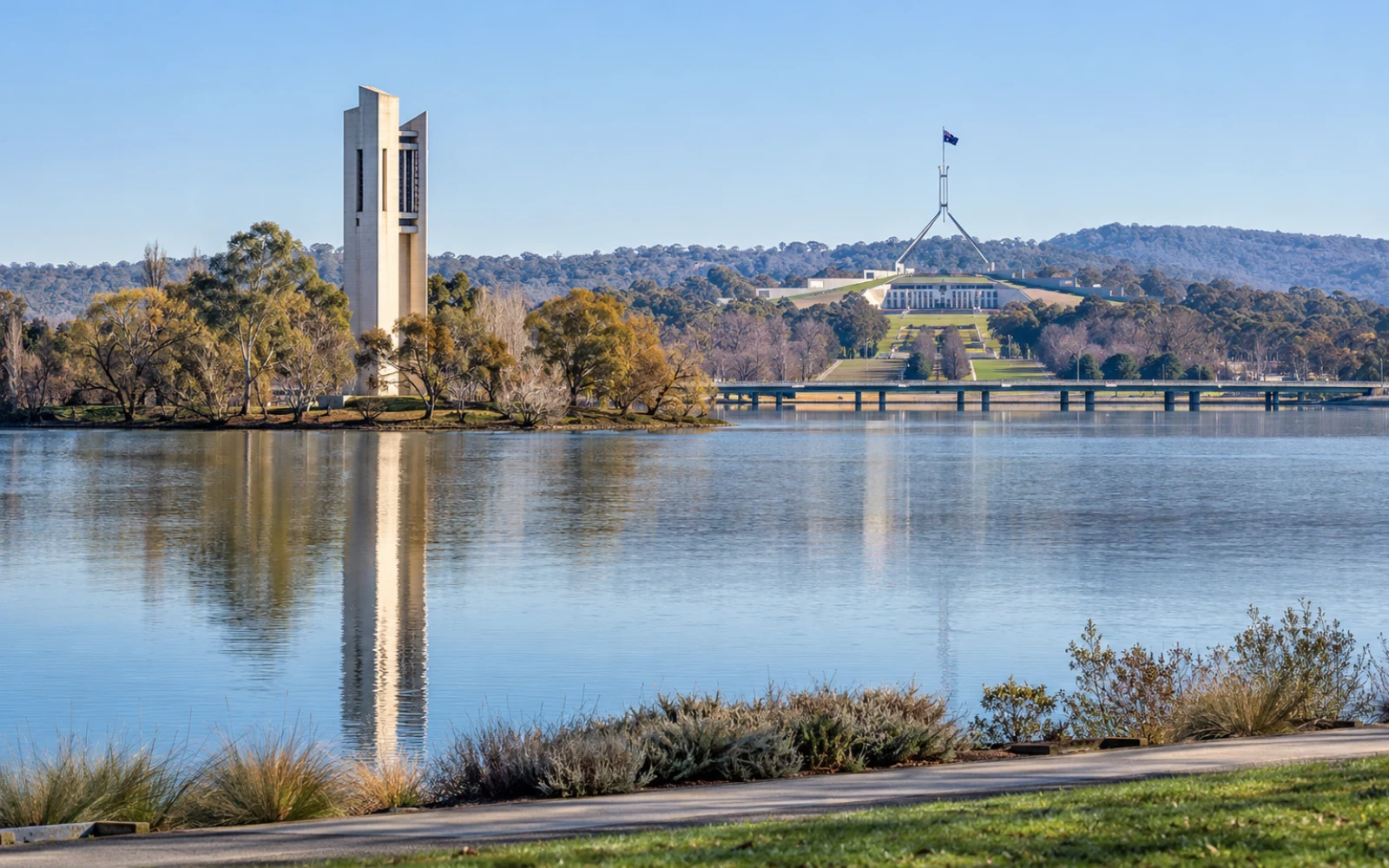
Cover: AI-generated illustration. © ANUSHKA DAHANAYAKE (PVT) LTD.
Canberra is a capital that began as a drawing. The international design competition opened on 30 April 1911 and closed on 31 January 1912, and the winning entry came from the Chicago architects Walter Burley Griffin and Marion Mahony Griffin. Their plan was influenced by the garden city movement and set geometric axes between landmarks such as Black Mountain and Mount Ainslie, with a Parliamentary Triangle at its centre and major roads following a wheel-and-spoke pattern rather than a conventional grid. The name was announced on 12 March 1913 by Lady Denman on Kurrajong Hill. It comes from the Ngunnawal language of a local clan, and the popular translation "meeting place" is only a proposed meaning.
The pieces that made the plan real arrived over decades. Parliament moved to Canberra on 9 May 1927, with the opening of the Provisional Parliament House, today Old Parliament House. The Australian War Memorial opened on Remembrance Day, 11 November 1941, and its Roll of Honour bronze plaques list more than 100,000 Australians killed in conflict, listed by name only. Lake Burley Griffin, the water that completes the Griffins' design, was finished in 1964 after four years of construction. Parliament itself relocated to Capital Hill, and Queen Elizabeth II opened the new Parliament House on 9 May 1988 as part of the bicentenary.
That building is the clearest statement of what Canberra values. The Philadelphia firm Mitchell/Giurgola & Thorp won a competition of 329 entries from 29 countries to design it. Its grass-covered roofs let visitors walk above the chambers, a deliberate image of citizens standing over their representatives. An 81-metre flagpole rises above the roof. Inside, the Great Hall holds a 20 by 9 metre tapestry based on an Arthur Boyd painting of the Shoalhaven landscape, and the forecourt mosaic, Possum and Wallaby Dreaming, was designed by the Indigenous artist Michael Nelson Jagamara. Locals take pride in the fact that the country's laws, its national collections and its war memorial all sit within a few kilometres of each other, and general entry to many of them is free.
Parliament, galleries and the lake in two days
The first day belongs to the parliamentary triangle. Parliament House lists separate architecture, history, family, Indigenous and sensory-friendly tours, and security screening takes time, so choose a tour that suits the group and check sitting days. Continue to the National Gallery of Australia or the National Portrait Gallery, not both; choose priority collections and leave time to sit. Walk beside the lake if weather allows, because the lawns and sightlines are the design, not dead space between attractions. Finish in Kingston, Manuka or Barton, where evening dining is easier than inside the triangle.
The second day pairs memory with landscape. Give the Australian War Memorial a focused half-day, with attention to the daily Last Post Ceremony, which tells the story of one person named on the Roll of Honour, and keep voices low in the commemorative spaces. Mount Ainslie lookout explains the land axis better than another gallery does, and the Memorial, the lake and Parliament House line up from the top. The direct walking track is steep and exposed, so a taxi or drive is a fair alternative. The National Museum of Australia, on the lake's Acton peninsula, merits several hours, and the National Arboretum on its hill suits a clear afternoon.
Tidbinbilla Nature Reserve and Namadgi National Park belong to extra days. Carry water, check fire and road conditions and do not rely on mobile service.
Choosing a base and a third day
Kingston and Barton put the parliamentary triangle within walking range, NewActon suits the National Museum side of the lake, and the city centre is best for buses and restaurants. Check the route between the stop and the hotel, not the straight-line distance, because wide roads and large blocks lengthen every walk.
A third day lets the lakeside National Museum, a lake cruise, a defined cycle section or the National Arboretum fit without rushing. The full lake circuit is longer than it looks and exposed in places, so hire a bicycle only when the weather and the rider suit it. The Arboretum crowns a hill with broad views, and it is worth arranging transport instead of assuming an easy walk from the water.
Getting around, seasons and access in one place
Transport Canberra buses and light rail cover the territory, though light rail serves the northern corridor and not the parliamentary triangle. Use the official journey planner, since weekend frequency drops. Walking works within an attraction cluster, but the lake's bridges create long detours, and the railway station is in Kingston, not the city centre. Many visitors arrive by coach, train or car from Sydney, and the Sydney guide covers that end of the journey.
Winter mornings can fall below freezing even when afternoons are bright. Spring brings blossom and pollen, summer can be hot with bushfire smoke, and autumn gives the best leaf colour. Switch to an indoor plan when air quality is poor. Many national institutions have free general admission, but special exhibitions, tours and parking add cost, so book Parliament tours and popular exhibitions through official sites.
The parliamentary triangle has fewer casual evening choices than Kingston, Braddon or the city, and kitchen hours differ between weekdays and weekends, so decide on dinner before leaving the triangle. Large buildings mean long indoor distances even when they are step-free, so ask about wheelchairs, quiet times, hearing systems and the usable drop-off point. Observe photography and bag rules at memorial and parliamentary spaces. Two days before arrival, reopen tour confirmations, check any sitting or ceremony schedule and map one indoor alternative for poor weather. Keep one half-day flexible for a collection or landscape that deserves longer, since the national institutions reward lingering more than a checklist, and remember that Canberra's roads and roundabouts confuse first-time drivers, so set a route before moving off.
Read what makes Australia special, use the Australia destination hub to compare routes, and read the Melbourne first-time visitor guide when deciding whether to combine Canberra with another museum-rich Australian city.
Questions and answers
How many days are enough for Canberra?
Two full days suit a focused first visit; three allows major museums, Parliament House, the lake and one bush or neighbourhood experience without rushing collections.
Can you explore Canberra without a car?
Yes with careful grouping, buses and walking, but attractions are spread around the lake. A bicycle, taxi or car can help specific routes, especially with limited time or mobility.
Do Canberra museums need advance tickets?
Many national institutions offer free general entry, but tours, exhibitions and parliamentary sittings may require timed booking. Always check the official venue page.
Sources
Melbourne · 37.8136° S, 144.9631° E
This story belongs to Canberra, Australia. A continent of the world's oldest continuing cultures, a World Heritage reef and cities that each began for different reasons.