Karlovy Vary: Charles IV's Springs, Glass and Film
Charles IV, tsars, glassmakers and a film festival shaped Karlovy Vary. This guide covers the springs, colonnades and UNESCO status first, then helps plan two days.
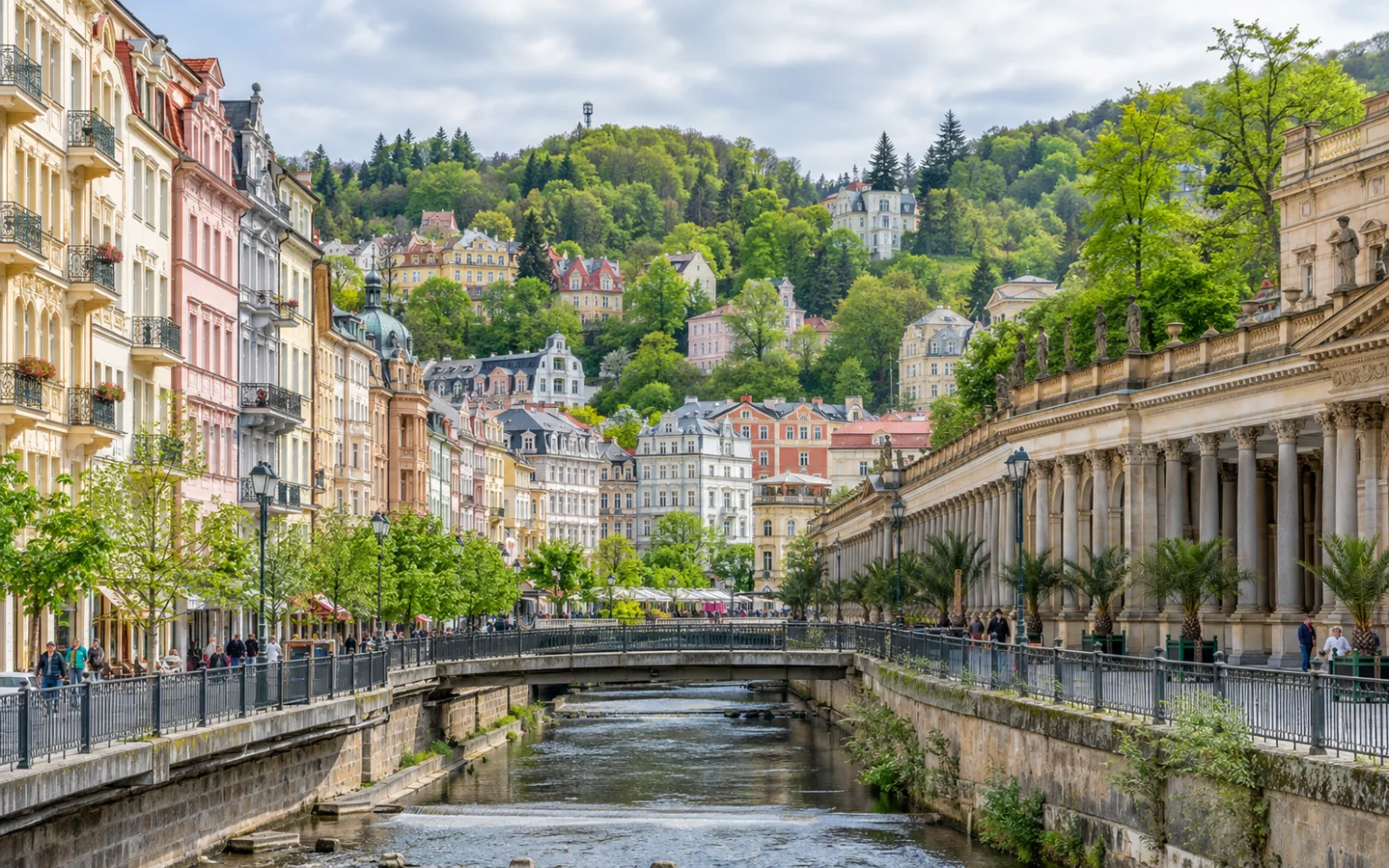
Cover: AI-generated illustration. © ANUSHKA DAHANAYAKE (PVT) LTD.
Karlovy Vary, known in German as Carlsbad, grew from hot water that rises from deep in the earth. Around 1349 a small spa settlement appeared near the springs, and on 14 August 1370 Emperor Charles IV granted the town its privileges. Local tradition ties the springs to a hunting party of the emperor, but the legend carries no firm date, and the privilege charter is the verifiable start. Over the following centuries the water drew royalty, aristocrats and writers, and the town became a European meeting place.
Guests who made the town famous
In 1711 Tsar Peter the Great visited, and the list of later guests became part of civic pride. The Baroque Church of St Mary Magdalene, built between 1732 and 1736, and the elegant terraces on both sides of the river Teplá show how a spa town used wealth to create civic space. In 1819 diplomats met in the town to pass the Carlsbad Decrees, a conservative German measure that tightened censorship. The railway from Prague to Cheb was completed in 1870, and by 1911 the town recorded its tourist peak with some 70,956 visitors.
The colonnades are the heart of the town. The Mill Colonnade was built between 1871 and 1881, the Market and Park colonnades between 1880 and 1883, and the Castle Colonnade between 1910 and 1912. The modern Hot Spring Colonnade, housing the main geyser, dates from 1975. Their different styles record changing tastes, from nineteenth-century stone to a mid-twentieth-century geyser pavilion.
Craft and taste
Karlovy Vary's industries grew from its guests. The Moser glassworks was founded in 1857 and became known for fine glass. Karlovy Vary wafers, the round filled oplatky sold warm in boxes, first appeared in 1867. Becherovka, a herbal liqueur, has been produced in the town since 1807 and remains a well-known Czech herbal liqueur, though tasting is optional and unsuitable before treatments, driving or steep walks. All three are souvenirs with real stories behind them.
The twentieth century brought upheaval. The town was incorporated into Czechoslovakia in 1918 and 1919, was annexed by Nazi Germany in 1938 and revived as a spa destination after the Velvet Revolution of 1989. Those turns explain why some villas and hotels carry layered histories, and why the region invests so heavily in restoration. Wafers deserve a note for allergy sufferers, since labels differ by maker, and bakeries and weekday lunch menus are a cheaper way to eat than spa-hotel dining rooms.
Film, forests and a UNESCO label
The film festival gives the town a second identity. It was first held in 1946, with films from seven countries shown in Mariánské Lázně and Karlovy Vary, and after its first two years it moved permanently to Karlovy Vary. Its grand prize, the Crystal Globe, has been awarded since 1948, and Hotel Thermal is the festival's main centre. During the festival, rooms, traffic and venues operate differently. Book far ahead or choose another week if the festival is not the purpose.
In 2021 UNESCO inscribed the spa centre as part of the Great Spa Towns of Europe, a serial listing that includes Mariánské Lázně and Františkovy Lázně, and in 2018 the spa centre had been protected as an urban monument reservation. The forested hills around the town form part of the historic spa landscape because physicians prescribed graded walks alongside water and rest.
Two days with the water
Day one: the colonnades. Begin at the Hot Spring and move gradually through the Market, Mill and Park colonnades. Do not try every outlet. Water temperatures and mineral composition vary, and the town's spa authorities advise consulting an experienced spa doctor to choose a spring and a drinking regimen. A traditional porcelain cup is worth buying only if it will be used. Never put hands into outlets, block regular spa patients or refill bottles for later. The Castle Colonnade is only partly public, so read the official site for the accessible spring. After lunch, choose the Karlovy Vary Museum for town history or the Moser visitor centre for glassmaking; factory tours need their own booking.
Day two: forest and one spa session. Take the Diana funicular if operating, then walk a signed route suited to weather and mobility. Return for one properly researched spa experience. Ask what the price includes, how long it lasts, whether a medical consultation is required and whether the water is thermal. Disclose pregnancy, heart conditions and mobility limits, and leave a gap between treatments, since heat and dehydration are tiring. For a non-spa alternative, visit the art gallery or the Imperial Spa cultural complex when open.
Getting there, paying and behaving
Karlovy Vary has more than one rail stop, so check the actual station and route with the operator before travelling. The main (upper) station serves many rail arrivals, while the lower station is a separate stop, and buses may arrive closer to Tržnice. Use a city bus into the spa quarter rather than dragging luggage along steep streets. Hillside hotels have fine views but require steps, bus use or a funicular, so confirm lift arrangements.
Springs and public colonnades are generally free. The Karlovy Vary Region Card covers selected admissions, and its current benefits are worth checking before buying. Loket, with its castle and compact centre, is a practical extension, but trying all three UNESCO spa towns in a day creates more transit than understanding, so give each town its own purpose. Pay in koruna, confirm the total before any treatment and decline card-terminal conversion to another currency. Late spring and early autumn suit both promenades and forest walks, summer can be crowded, and winter brings short days and potentially icy slopes. Pack a waterproof layer in every season.
The spa district is also residential, so keep evening noise low, avoid photographing patients closely and dress appropriately inside treatment buildings. Hot water can burn, forest weather changes quickly, and 112 is the emergency number. Ask spas for exact door widths, changing arrangements and pool entry before accepting a vague accessibility claim.
Read what makes Czechia special, add the brewing city in our Plzeň guide, continue through the Czechia destination hub, combine the trip with the Prague first-time visitor guide, or browse more practical country guides.
Questions and answers
How long should a first visit to Karlovy Vary be?
One day shows the central colonnades, but two days allow a measured spring walk, a museum or spa booking and time in the forest without rushing.
Can anyone drink the thermal spring water?
The springs are mineral-rich and hot. Small tastes are part of the visit, but therapeutic drinking regimes should be prescribed by a qualified spa physician, especially for anyone with health conditions.
Do you need a car in Karlovy Vary?
No. Buses serve the rail and bus terminals, the spa centre is largely walkable and funiculars or trails reach hillside viewpoints.
Is the spa centre accessible?
The river promenade is comparatively level, but hills, historic thresholds and some forest paths create barriers. Ask each facility about step-free treatment rooms and use buses to avoid steep climbs.
Sources
Prague · 50.0755° N, 14.4378° E
This story belongs to Karlovy Vary, Czechia. Two historic lands, Bohemia and Moravia, with castles on almost every hill, a UNESCO puppet-theatre tradition and a lager that spread worldwide.