Graz First-Time Visitor Guide: Armoury, Clock Tower, Design
A UNESCO old town, a clock tower saved by ransom in 1809, a vast armoury and a design-led riverfront give Graz one of Austria's most layered city stories.
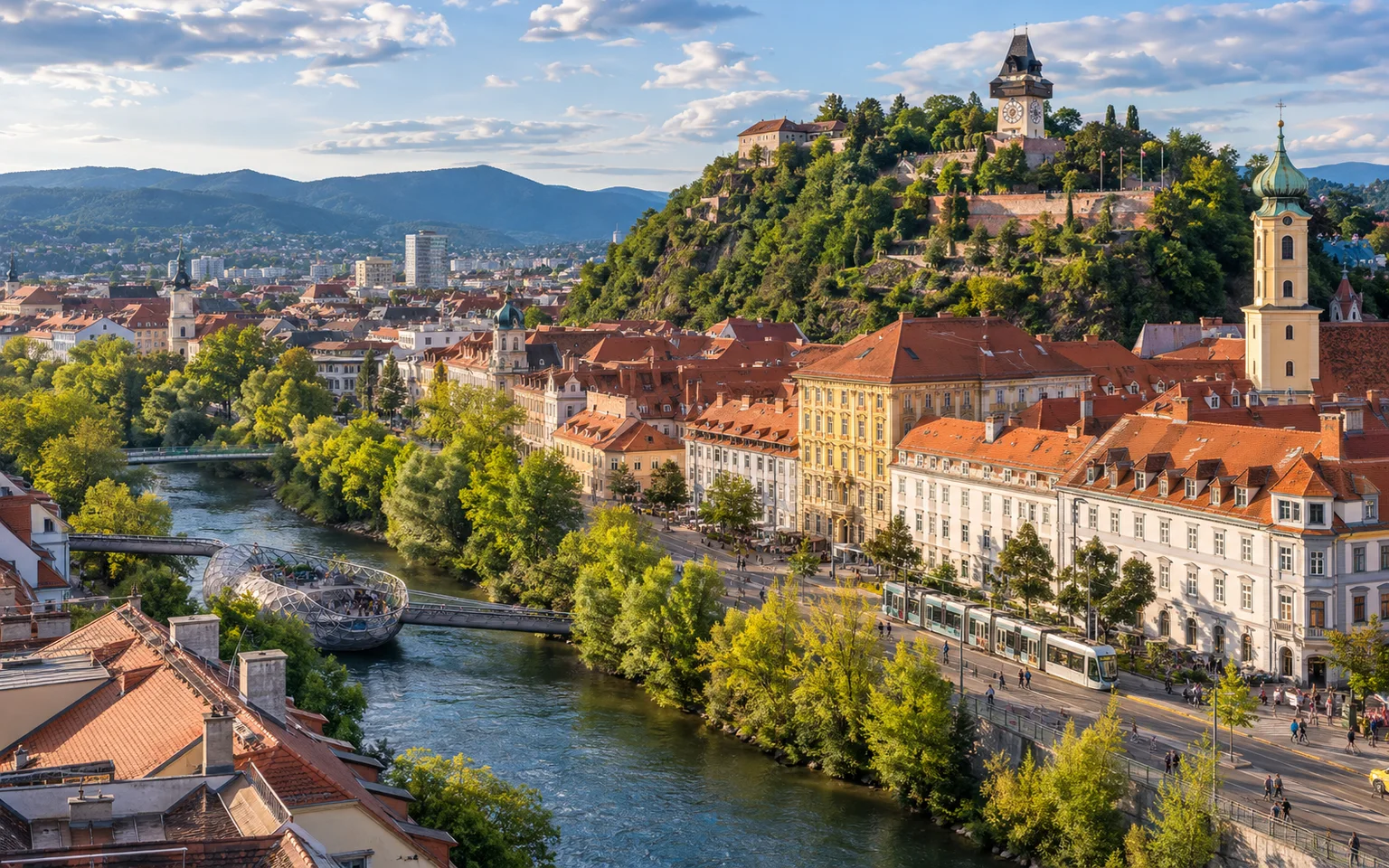
Cover: AI-generated illustration. © ANUSHKA DAHANAYAKE (PVT) LTD.
Graz is Austria's second-largest city and the capital of Styria, and its pride rests on a rare combination of survival and invention. The Inner Austrian line of the Habsburgs resided here from the 14th century, and Archduke Karl II founded the University of Graz in 1585, still the city's oldest university. The astronomer Johannes Kepler lived in the city from 1594 until 1600, when Protestants were banned. In 1809 Napoleonic forces demolished the fortifications on the Schlossberg, but the Uhrturm, the clock tower that now symbolises the city, was spared after citizens paid a ransom. The tower's survival is among the best-known stories in the city, and the view from the plateau shows why a ransom was worth paying.
UNESCO inscribed the historic centre in 1999 and extended the listing in 2010 to include Schloss Eggenberg. The inscription recognises the whole townscape, with Italian-influenced facades, medieval plots and later commercial streets side by side, not merely the clock tower view. The Landeszeughaus, built in 1642-47 as Styria's weapons depot, has kept its stock since 1551 and displays more than 30,000 items, making it the largest historical armoury of its kind in the world. The weapons stand in racks largely as they were stored, which makes it a rare chance to see a whole arsenal rather than a curated selection. Allow at least an hour, and check whether a guided visit is offered on the day.
Modern Graz has been just as deliberate. The city was a European Capital of Culture in 2003, and two structures from that year, the Murinsel, an artificial steel platform in the Mur designed by Vito Acconci, and the Kunsthaus Graz, designed by Peter Cook and Colin Fournier and nicknamed the Friendly Alien, still define the riverfront. Graz joined UNESCO's Creative Cities Network as a City of Design in 2011, and it was named Austria's Capital of Culinary Delights in 2012. Together they explain why a visit mixes Renaissance courtyards, a futuristic art museum and a farmers' market on the same walking route.
Old town to Schlossberg, then the Mur
Begin at Hauptplatz and look past the square towards the arcaded courtyards around Herrengasse and Sporgasse. Visit the Landeszeughaus if material history interests you, and check seasonal access and guided-visit arrangements first. Continue through the cathedral precinct and the Mausoleum of Emperor Ferdinand II, respecting worship and photography rules.
Climb Schlossberg by path, stairs, funicular or the lift inside the hill. The plateau's gardens and sightlines explain the Mur, the railway corridor and the surrounding hills, and visitors with limited mobility should verify which approaches are step-free. Descend by a different route before dinner.
On day two, start beside the Mur at the Murinsel and Kunsthaus. The Joanneum's museums use separate locations and changing displays, so identify the exact building and ticket before walking. Cross back through Lend, where Kaiser-Josef-Markt and Lendplatz support a food-focused morning, though opening is strongest earlier and varies by day. Use the afternoon for Schloss Eggenberg, west of the centre, where its state rooms require a guided tour and room access differs from garden access in winter, or stay central for the Neue Galerie, the natural-history museum or the university streets.
Where to stay and how to pace two days
The inner centre minimises transport, Lend and Gries offer local character that varies street by street, and the station area favours early departures. Two days cover the UNESCO old town, Schlossberg and one substantial museum, and a third allows Eggenberg or a slower design route. Check museum closing days and Eggenberg's seasonal room access, and leave a buffer before last admission because multi-site ticket wording can confuse. Reserve a palace tour or festival event ahead, though most restaurants need no formal booking outside weekends. Tap water is drinkable, and rounding up for good service is customary.
Families can pair the hill with one hands-on or natural-history collection. A playground or market break helps more than a third interior, and shade on exposed summer routes matters as much as distance.
Pumpkin-seed oil and Styrian taverns
Graz's food identity is regional. Pumpkin-seed oil, scarlet runner beans, apples and Styrian wine appear across menus, and genuine pumpkin-seed oil is intensely nutty and used as a finishing ingredient, even on vanilla ice cream. Ask about nuts and seeds when managing allergies. Buschenschank wine taverns lie mainly outside the centre with limited, seasonal hours, and reaching one safely often requires a designated driver or a taxi.
Transport, seasons and access in one place
Graz Hauptbahnhof is west of the centre and linked by frequent trams. The Altstadtbim fare-free zone covers only designated central stops, not the station-to-centre journey, so check the boundary and validate the correct ticket outside it. The core is walkable, though trams and cyclists share space with pedestrians. A car adds little to a two-day visit.
April to June and September to October suit walking, July and August can be hot, and Advent fills the main squares. Rain makes polished stone and Schlossberg paths slippery, and storms can arrive quickly after hot days, so leave the hill when thunder threatens. Museums make winter and wet days workable, and Monday closures are common but not universal.
Before leaving, confirm the Joanneum branches you chose, the Schlossberg transport status and the palace-room season, and save tram information offline. Build one indoor alternative for rain, not a separate itinerary. Graz is often gentler on a budget than Salzburg. Free pleasures include courtyards, markets, much of Schlossberg and riverside walking. Paving mixes smooth stone, cobbles and tram rails, so ask each museum about its accessible entrance. Courtyards may be residential, so enter only where public access is clear. Reserve a desired Eggenberg tour or major exhibition ahead, and treat Sunday retail hours as limited. Call 112 in an emergency, and keep children away from the fast Mur embankments.
Continue via the Austria destination hub, compare another Austrian city in our Vienna visitor guide, read what makes Austria special, contrast Graz with the baroque old town in what makes Salzburg special, or browse all country guides.
Questions and answers
How many days are enough for Graz?
Two full days cover the UNESCO old town, Schlossberg and one substantial museum. A third allows Eggenberg Palace, a food-focused outing or a slower design itinerary.
Can Graz be explored without a car?
Yes. Trams connect the station and outer sights, and the central old town is highly walkable. Driving adds parking and restricted-zone concerns.
What is the easiest way up Schlossberg?
Options include the funicular, a lift through the hill and walking routes. Accessibility, ticketing and operating hours differ, so check the current combination before setting out.
When is the best time to visit Graz?
Late spring and early autumn favour walking and outdoor dining. Summer can be hot, while Advent is lively but crowded; museums make wet or winter days workable.
Sources
Vienna · 48.2082° N, 16.3738° E
This story belongs to Graz, Austria. A country whose best-known exports are carried in the head: a carol, a waltz rhythm, Mozart and an hour over one coffee.