Málaga: A Phoenician Port, a Moorish Fortress and Picasso's Home Town
From a Phoenician settlement of about 770 BC to the Alcazaba and the Museo Picasso, Málaga holds among the longest continuous histories in Western Europe.
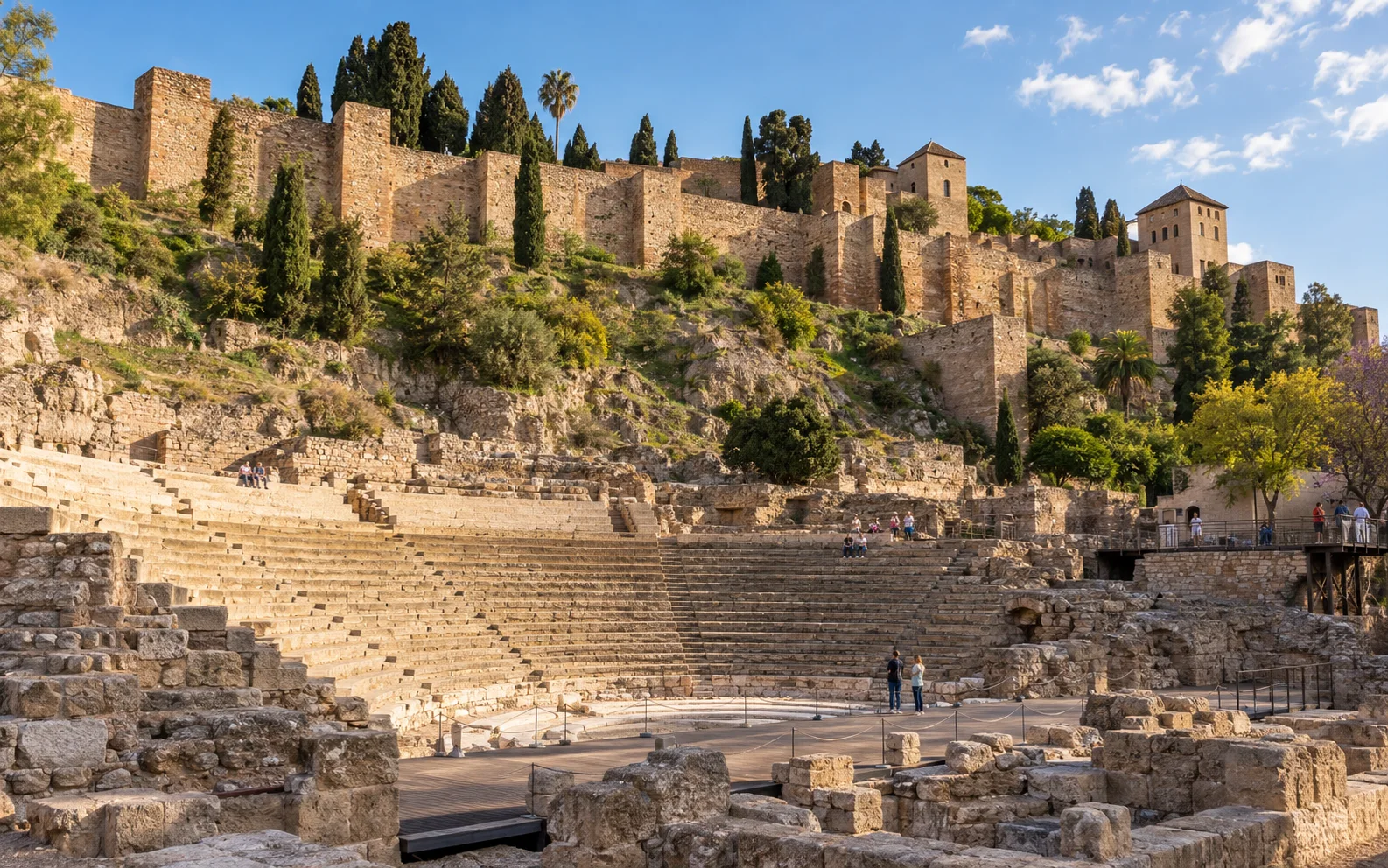
Cover: AI-generated illustration. © ANUSHKA DAHANAYAKE (PVT) LTD.
Málaga is among the oldest continuously inhabited cities in Western Europe. Phoenician traders from Tyre founded the settlement around 770 BC, and later layers of Rome, Islamic al-Andalus and Castile sit on top of one another within a few hundred metres of the port. Few cities let a visitor stand in front of a Roman theatre, climb through a medieval fortress and then walk to a museum of twentieth-century art in the space of a morning.
Roman stone and a Moorish fortress
Rome took the city after the Punic Wars, and Málaga grew prosperous partly on garum, the fermented fish sauce traded across the empire. The Roman Theatre at the foot of the Alcazaba dates from the Augustan period. It lay buried for centuries until builders working on foundations for a cultural centre uncovered it in 1951. In the Middle Ages its stone and columns were reused in the fortress above, which is why the Alcazaba contains pieces of Roman construction.
The Alcazaba began in the early eleventh century under the Hammudid dynasty, probably under Yahya I (who reigned from 1021 to 1036). After the Zirids captured the city in 1056, additions followed under Badis, possibly including the double-walled defences. Much later, the Nasrid emir Yusuf I (r. 1333–1354) built Gibralfaro Castle on the higher hill to the east and joined the two with a walled corridor. From 1933, the architect Leopoldo Torres Balbás led a restoration that moved residents out of the fortress and rebuilt much of the Nasrid palace from archaeological remains.
Picasso, a cathedral and a city of sardines
Pablo Picasso was born on the Plaza de la Merced, and the Museo Casa Natal stands on that square. The Museo Picasso Málaga opened on 17 October 2003 in the Palacio de Buenavista, a sixteenth-century palace built over Nasrid remains, around 200 metres away. Its collection came from the artist's family: Christine Ruiz-Picasso, widow of Picasso's eldest son Paulo, and his grandson Bernard Ruiz-Picasso. The Centre Pompidou Málaga followed in 2015 in the glass cube on the port.
The cathedral, known locally as La Manquita ("the one-armed lady") for its unfinished second tower, was planned in the Renaissance style but finished in Baroque when money ran short. Holy Week has been observed for five centuries, with large thrones (tronos) carried through the streets from Palm Sunday to Easter Sunday. On the beach, espetos, sardines grilled on skewers over open fires at the chiringuitos, are a Málaga tradition proposed for UNESCO intangible cultural heritage status. Sweet local wine, fried fish and porra antequerana, a thick chilled tomato soup, complete a food culture that is Andalusian but unmistakably coastal.
One morning, one afternoon, one sunset
Start early at the theatre and Alcazaba, before heat and queues. The city monument site lists separate and combined tickets and last entry times, which change. The fortress climbs through gates, courtyards and gardens, so wear shoes with grip and carry water. Gibralfaro is worth the climb only when energy and weather allow; a city bus removes most of the ascent, and the ramparts give the clearest view of the port, bullring and old centre. In the afternoon, choose one museum rather than three: the Picasso for the family collection, or the Pompidou for a different century.
The theatre is a useful first stop because reading it correctly changes the rest of the walk. Sources say it was in use until about the third century, then served as a quarry: the same stone that seated Roman audiences is now part of the Moorish walls above. Seen from the public approach, the two monuments share a single slope, and the contrast in construction (cut stone below, layered fortress above) is easy to read without a guide. The Picasso museum rewards the same attention to setting: Buenavista was built in the first half of the sixteenth century on top of a Nasrid palace, so the galleries are also a lesson in how the city reuses its past.
A final hour on the beach at La Malagueta suits an espeto dinner. Order seafood by asking whether the price is per portion or by weight, and confirm allergies, especially around shared fryers. Lunch and dinner run later than in many countries, so save two alternatives near the end of the day.
Reading the layers on foot
A walking order helps: after the Alcazaba, drop down through the lanes of the Centro Histórico to the cathedral, where the unfinished tower explains the nickname at a glance, then continue north-east to the Plaza de la Merced for Picasso's birthplace. From there the Museo Picasso is a short walk through streets that were already old when the Buenavista palace was built. Allow time for a pause in a shaded square, because the sequence from Roman to Moorish to Renaissance to modern art is dense and easier to absorb in a slow afternoon than in a rush between ticket slots. Evening is when the old centre fills with residents, and the port promenade and Soho murals suit the cooler hours.
Heat, access and getting in
Cercanías trains connect the airport with central stations, and the old centre is compact enough to walk. Soho has murals and galleries, La Malagueta is close to the beach, and Centro Histórico is convenient but noisy on weekends; ask about street-facing rooms and air conditioning. Spring and autumn are comfortable; in summer, start early, rest in the afternoon and check official weather advice, because a hot wind can raise temperatures sharply. Holy Week and the August fair change prices, noise and transport, so travel for them deliberately.
The centre has many level pedestrian streets, but the Alcazaba and Gibralfaro have gradients and irregular surfaces. Each monument publishes its own accessibility information, and city buses reduce the climbs. Wear a hat and sun cream on the ramparts, where there is little shade, and stop at once if anyone feels dizzy. Keep bags closed in crowds, use licensed transport and never leave valuables on the beach. Spain's emergency number is 112. A greeting in Spanish before ordering goes a long way.
Compare other places on the Spain destination hub, and read what makes Spain special for the wider picture. Granada, with its own Moorish citadel, is covered in what makes Granada special, and the heat-smart Seville guide suits the same season. Day trips from Málaga look short on a map, so choose one and book its headline monument separately.
Questions and answers
How many days are enough for Málaga?
Three days cover the Alcazaba and old centre, one or two museums, the waterfront and a beach or neighbourhood day without treating the city only as an airport.
Is Málaga easy without a car?
Yes. Airport trains, city buses, the metro and walking cover the main visitor areas. A car is unnecessary unless Málaga is a base for rural Andalusia.
What should be booked before visiting Málaga?
Reserve a priority exhibition or Picasso Museum slot in busy periods and book accommodation early for Holy Week, the August fair and major events.
Sources
Madrid · 40.4168° N, 3.7038° W
This story belongs to Málaga, Spain. A peninsula of strong regional cultures, from Altamira's cave art and the Alhambra to Gaudí's Barcelona and a pilgrim road walked for a thousand years.