Nantes Without a Car: Castle, Loire Island and Creative Quarter
A practical linear Nantes route from the railway station and ducal castle to the Loire's former shipyards, with one deliberate museum choice and realistic transport exits.
Nantes is easiest to understand as a one-way journey from the railway station to the Loire, not as repeated tram rides between isolated attractions. Begin with the former seat of the dukes of Brittany, cross the old centre at walking pace, then let tram line 1 or the river crossings carry you towards the repurposed shipyards. The route explains the city's shift from fortified capital and trading port to a contemporary cultural centre without requiring a car.
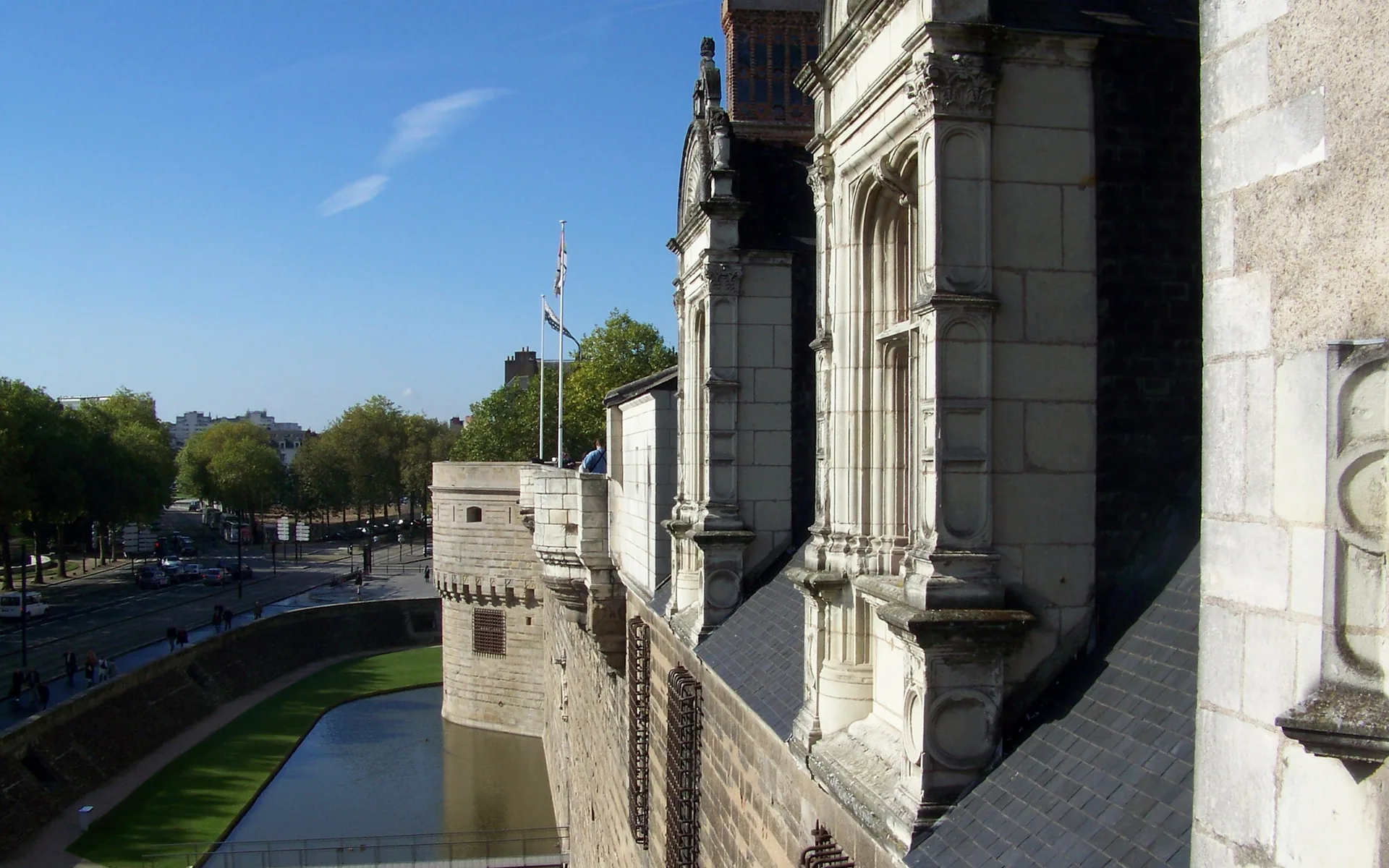
Cover photograph: “Nantes - rempart sud du château” by Eusebius, licensed CC BY 3.0. Cropped to 16:10 and converted to WebP; no generative alteration.
Why Nantes matters: a Breton ducal capital that faces its past
Nantes sits where the Loire widens towards the Atlantic, and for most of its history that position made it a capital and a port. Its castle, the Château des ducs de Bretagne, keeps parts dating from the 13th century, but its present form belongs to the 15th, when Duke Francis II made it the seat of the Breton court. His daughter, Anne of Brittany, was born there; she continued the building and was twice crowned queen of France through her marriages to Charles VIII and Louis XII. For many people in Nantes, that Breton ducal identity is still a point of pride. Later, Henri IV signed the Edict of Nantes at the castle, and a room of today's history museum is devoted to it.
The river also brought wealth of a darker kind. Nantes was France's leading port for the Atlantic slave trade, a fact the city has chosen to confront in public. On 25 March 2012 it inaugurated the Memorial to the Abolition of Slavery on the Quai de la Fosse, designed by the artist Krzysztof Wodiczko and the architect Julian Bonder. In its first ten years it welcomed about 1.6 million visitors, including 60,000 schoolchildren, and each 10 May it hosts the national day of remembrance of the slave trade, slavery and their abolition.
Nantes is also a city of imagination. Jules Verne was born here in 1828, and a museum in a 19th-century townhouse on the Butte Sainte-Anne traces his work through manuscripts, models and objects. That spirit carries on across the river, where the former shipyards of the Île de Nantes now hold the Machines de l'île and their giant mechanical creatures.
What ties these layers together is a city that keeps its history visible: ducal stone, an honest memorial and industrial land given a new purpose. The good news for visitors is that all three lie on one walkable line from the station to the river.
Leave the station in the direction of the story
Nantes station has north and south exits, so orient yourself before following a map pin. The castle and historic centre are on the north side. Travellers arriving with luggage should store it at their accommodation or a verified facility before entering museums; dragging cases over paving and through security wastes the most useful first hour.
Walk to the Château des ducs de Bretagne; it is only one stop by transport. The exterior walls and moat establish the medieval and early-modern city, while the museum inside gives the longer history. Check the official castle site for current exhibition access, closure days and accessibility. A free exterior circuit and a paid or ticketed interior visit are different decisions; poor weather may justify moving the museum earlier, while clear weather favours the ramparts first.
Do not describe the castle simply as a French royal monument. Nantes was a principal city of historic Brittany, and the building's ducal identity matters. Later rooms address the port, colonial commerce, enslavement and industrial change. Give difficult material enough time instead of racing to the photogenic courtyard.
Cross the centre by choosing one spine
From the castle, use a clear line through the Bouffay area, towards the cathedral surroundings when open, then west through the commercial centre. Streets diverge quickly; trying to collect every covered passage, square and church creates backtracking. Pick either an architecture-and-history spine or a slower food-and-market spine.
For architecture, continue towards Place Royale and Passage Pommeraye. The passage includes stairs and level changes, so visitors needing step-free access should check the entrances and use parallel streets where necessary. For food, choose a market or one independent lunch over grazing at every popular counter. Nantes' position near the Loire and Atlantic shapes local menus, but a regional label does not guarantee local sourcing.
The green line painted through central Nantes is a useful orientation device associated with the city's cultural route. It is not a command to complete every stop. Follow it selectively, and use Le Voyage à Nantes to distinguish permanent places from seasonal installations and events.
Make the memorial a deliberate stop
The Memorial to the Abolition of Slavery beside the Loire should not become a quick photo break between shopping and the Machines. Nantes was deeply involved in the French slave trade; the memorial uses the riverfront to confront that history. Enter quietly, read the interpretation and avoid posed photographs that turn names and quotations into a backdrop.
Allow emotional space after the visit. A riverside walk can provide it, but do not immediately reduce the subject to a sentence about how much the city has changed. Visitors travelling with children should review the interpretation in advance and answer questions honestly at an age-appropriate level.
When river levels, events or works affect the promenade, follow barriers. The Loire is a working tidal river, not a decorative canal edge.
Cross to the island with a ticket decision already made
The western Île de Nantes contains the former shipyard landscape, the Machines de l'île and Parc des Chantiers. Tram line 1 to Chantiers Navals leaves a short walk across the river; current works around Pont Anne-de-Bretagne can alter pedestrian and vehicle circulation. The Machines' official access page should be checked shortly before the visit, since an old route screenshot may be out of date.
Decide whether the priority is the Galerie des Machines, the Grand Éléphant experience, the Carrousel des Mondes Marins or simply the public industrial landscape. These are not one interchangeable ticket. Operating conditions, maintenance and special events can change what moves on a particular day. Reserve when the official system recommends it, and do not promise children a ride until the booking is confirmed.
The creative achievement is more interesting when read against the shipbuilding site: cranes, slipways and vast sheds were not built as a theme-park stage. Look for interpretation of labour and river industry alongside the mechanical creatures.
Shorten the island without losing its meaning
The island is larger than it appears on a central tourist map. A sensible first visit uses the former shipyard west and leaves the rest of the redevelopment zone for another time. Walk from the Nefs towards the river, choose one indoor attraction, then pause at a public viewpoint or garden before deciding whether energy remains.
Naolib tram, bus and Navibus routes can prevent a long return walk. Check current Naolib information, including validation and disruption rules. Do not assume a river service runs at the same frequency or season every year.
Visitors with limited mobility should read the Machines' attraction-specific guidance. Priority access and adapted tools exist, but individual machines have distinct transfer and boarding constraints. A companion, mobility device or assistance dog may be treated differently between spaces; contact the venue instead of generalising from the outdoor site.
Use rain to change depth, not direction
In steady rain, keep the same east-to-west logic but spend longer at the castle museum and one covered central interior. Move to the island by tram and choose the Gallery or another confirmed indoor space. Strong wind can affect exposed river walking and machine operation, so outdoor plans need a real substitute.
On hot days, reverse the emphasis: begin early at exposed castle walls, take a shaded central lunch, and reach the island later. Carry water, because former industrial surfaces can feel hotter than the forecast suggests. The most photographed mechanical attractions may also have queues with little shade.
If travelling during the major summer cultural programme, verify which works require tickets and which streets have temporary controls. A festival day is not an ordinary itinerary with extra decoration.
Finish from the nearest useful stop
Do not automatically walk back to the castle. From the shipyard area, use Chantiers Navals or the most relevant current bus or river stop. Travellers continuing by train should build a disruption buffer and return to the station before collecting luggage. Those staying overnight can finish with dinner on the island or in the centre, but should check the late route, as daytime frequency may not continue.
The compact version is castle exterior and museum, one central spine, the slavery memorial, then one Machines experience. The longer version adds deeper museum time and an island walk. Both tell a coherent Nantes story; neither needs a car or a checklist of every green-line stop.
Continue through the France hub, browse more country guides, compare another creative Atlantic city with the Bordeaux guide, or plan the capital using the Paris first-time guide.
Questions and answers
What is Nantes known for?
Nantes is known for the Château des ducs de Bretagne, seat of the Breton court under Duke Francis II and birthplace of Anne of Brittany; for the Memorial to the Abolition of Slavery, opened in 2012; as the birthplace of Jules Verne in 1828; and for the Machines de l'île in its former shipyards.
Do the Machines de l'île need advance booking?
Treat each ticketed component separately and check the official calendar before travelling. Opening days, ride operations and timed visits vary, so seeing the outdoor site does not guarantee a place on a machine.
Is the Nantes route accessible?
Much of the route uses level streets and former industrial land, but distances are substantial and individual attractions have different conditions. The castle and Machines publish detailed accessibility information; confirm the exact spaces you want to enter.
Sources
Paris · 48.8566° N, 2.3522° E
This story belongs to France. A country that sends people to the baker twice a day, protects a cheese by law and refuses to be averaged into one postcard.