Montpellier Weekend Guide: Medieval Lanes, Trams and Mediterranean Day Trips
A city-first Montpellier weekend that keeps the historic centre and contemporary districts coherent, then adds the coast only when transport and weather make it worthwhile.
Montpellier should be planned as a city weekend with an optional coast day, not sold as a beach town. Its medieval Écusson, major art museum and modern tram-connected districts fill two thoughtful days. The Mediterranean becomes a worthwhile extension only when the weather is suitable and the chosen bus, tram or cycle connection has a dependable return.
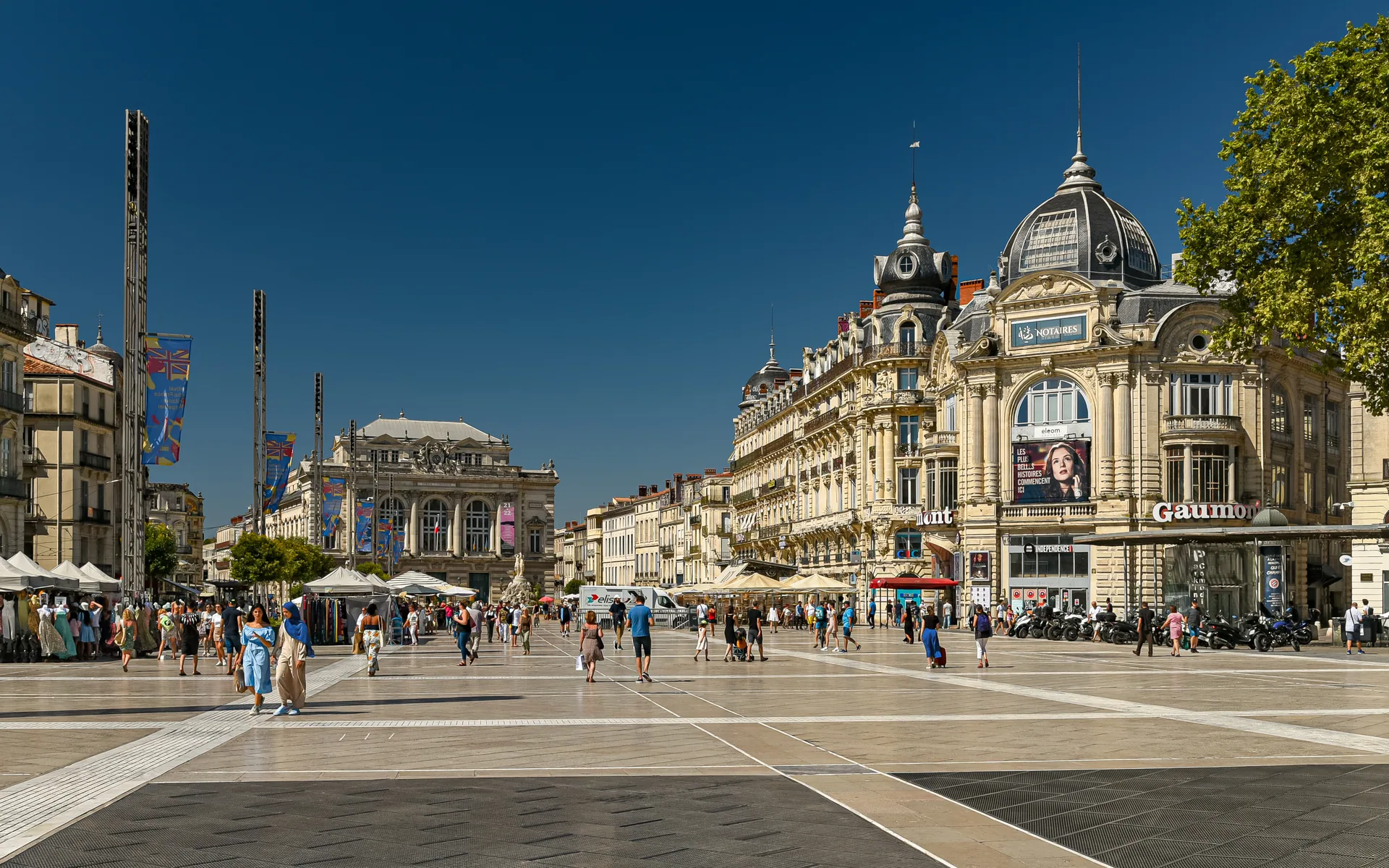
Cover photograph: “Montpellier- Place de la Comédie - 52262234358” by Jorge Franganillo, licensed CC BY 2.0. Cropped to 16:10 and converted to WebP; no generative alteration.
Why Montpellier matters: eight centuries of medicine and learning
Montpellier's reputation was made in lecture halls before it was made on tram lines. In 1181 an edict by the city's lord, Guilhem VIII, proclaimed the freedom to teach medicine here. By 1220 the Cardinal Legate Conrad of Urach had granted the Universitas medicorum its first charter, and on 26 October 1289 Pope Nicholas IV issued the constitution Quia Sapientia from Rome, formally recognising Montpellier's university. The Faculty of Medicine counts itself among the very small group of Europe's four or five oldest universities, alongside Bologna, Salerno, Paris and Oxford.
The school still teaches in the same quarter. Since 1795 it has occupied the former Saint-Benoît Monastery, so a walk through the Écusson passes buildings where medicine has been taught for more than two centuries, on a tradition reaching back more than eight. That continuity is a large part of the city's identity, and it explains why the faculty and medical quarter are worth a deliberate stop.
Montpellier's second great institution is its art museum. The Musée Fabre was founded in 1828 thanks to a donation from the painter François-Xavier Fabre, and later gifts from collectors built it into a collection of European art from the fourteenth to the twenty-first century, including more than four thousand drawings shown in rotation. Its renovation in 2007 shaped the galleries visitors see today.
What people here tend to be proud of is that mix of old learning and a living university city: medieval lanes in the Écusson, a museum created by a painter's gift, and new districts built with confidence on the city's edge. The practical question is how to see all three without wasting time, which starts with the station you arrive at.
Resolve the two-station problem before arrival
Montpellier Saint-Roch sits beside the historic centre and several tram lines. Montpellier Sud de France serves high-speed trains on the bypass and is outside the central walking area. A low fare to the second station is not automatically a bargain when a timed onward connection, family luggage or late arrival is involved.
Check the exact station and current transfer on the TaM network before buying a rigid ticket. If arriving at Saint-Roch, walk or take one short tram journey to accommodation. If arriving at Sud de France, preserve a connection margin and do not assume every tram or shuttle shown in an old blog still operates unchanged.
Stay near the Écusson, Saint-Roch or a direct tram line. Historic buildings can have narrow stairs and little sound insulation; ask about lifts, air conditioning and street noise instead of choosing only by façade.
Give the first morning to the Écusson's irregular shape
Begin at Place de la Comédie, then enter the old centre without trying to march down every lane. The Écusson is named for its shield-like outline, and its street pattern rewards a loose loop: central squares, the Saint-Roch area, faculty and medical quarter, cathedral surroundings, then the Arc de Triomphe and Peyrou.
Use one historical question to guide the walk. You might follow medieval religious and university sites, trace the city's relationship with medicine, or compare intimate lanes with the ceremonial seventeenth- and eighteenth-century western edge. This produces more understanding than a list of photogenic doors.
Trams cross pedestrian spaces, including near Place de la Comédie. A car-free square is not a track-free square: look both ways and keep children close. Cobbles, slopes and heat also affect mobility. Montpellier Tourism publishes adapted-tourism information and a flatter historic-centre route; use it, since not every lane is equally accessible.
Choose shade before lunch chooses it for you
Summer heat changes the useful order of the day. Put exposed Peyrou and the aqueduct approach early, then move into shaded lanes and an indoor lunch. Carry water and use a hat; pale stone and large plazas intensify glare. During a heat alert, reduce walking; midday discomfort is a signal to stop, not part of southern travel.
Markets and small food businesses can provide a better lunch than chasing one famous terrace. Ask about allergens and ingredients, especially in prepared dishes. Regional food identity includes produce, seafood connections and Languedoc influences, but the city is diverse; no single menu represents it.
After lunch, decide between deep museum time and a contemporary-district walk. Doing both fully in one afternoon usually means rushing the museum.
Let Musée Fabre anchor a weather-proof afternoon
The Musée Fabre deserves a planned selection. Check current galleries, temporary exhibitions, admission conditions and closure days. Choose a period or collection in place of attempting every room, and keep the final hour flexible if museum fatigue arrives.
Visitors needing step-free access should check the official route and available assistance. Security and bag rules can affect travellers between hotels or stations, so store luggage first. Families can choose a small number of works and use the museum's current learning material instead of demanding silence and endurance from children.
If the museum is closed, do not substitute several lesser interiors merely to fill a list. Use the afternoon for the botanical garden when open, the university quarter or a tram journey towards Antigone and the Lez.
Read Antigone as a designed contrast
Walk or take the tram east from the centre to Antigone. Ricardo Bofill's large-scale neoclassical planning contrasts sharply with the Écusson's compressed lanes. Continue towards the Lez and Port Marianne only as far as time and heat allow. The value lies in seeing how Montpellier expanded, not in photographing every axis.
This is a useful evening route because trams offer exits. Confirm the nearest stop before committing to a long riverside stretch. Cyclists and runners share parts of the public realm; keep to the appropriate side and do not block paths for symmetrical photographs.
Restaurants in newer districts may suit travellers who want space, step-free entrances or later service, but verify before relying on it. Return frequency can thin at night.
Make a coast decision with three honest options
Montpellier is not on the beach. Car-free visitors have several possible connections, and each creates a different day.
The Pérols and Palavas direction can combine tram line 3 with a local bus, seasonal link, bicycle or a substantial onward walk depending on the current network. Carnon and La Grande-Motte may be reached through regional connections such as liO services. Sète is a separate coastal city reached efficiently by regional train and suits travellers who prefer a harbour, museums and food alongside the sea.
Use Montpellier Tourism's current car-free beach guidance and the relevant operator for the return. Do not copy a fare or last-bus time into a permanent itinerary. Beach shuttles can be seasonal, and a convenient outward connection may have a poor evening return.
Match the coast to conditions, not a postcard
Choose a beach day only after checking heat, wind, storm and bathing information. The lagoons and dunes between city and sea are sensitive landscapes, not empty land awaiting development. Stay on marked access, keep out of protected vegetation and carry rubbish away.
Strong offshore wind, rough water or jellyfish information may make swimming unwise. Supervised zones and lifeguard periods vary. Never assume a calm photograph describes the day's sea. Travellers with reduced mobility should identify an adapted beach facility and confirm its operating season before leaving the city.
If weather is poor, keep the city day: add museum time, a documented historic interior, a café break and the contemporary architecture route. A forced beach visit in rain and wind provides little value and consumes transport time.
Build the weekend around reversibility
On day one, use Saint-Roch, Place de la Comédie, the Écusson, Peyrou and Musée Fabre. Finish through Antigone if energy remains. On day two, choose either a well-researched coast connection or a deeper city day with the botanical and university quarters, Port Marianne and one market.
The sequence can reverse for weather, but the principle stays fixed: the city is the reliable core and the Mediterranean is the conditional extension. Check tram works, the exact railway station and return transport each morning. That produces a weekend shaped by Montpellier rather than by the misleading promise that the beach begins at the end of a tram platform.
Continue through the France hub, compare a true coastal base with the Nice guide, or extend into a wider southern landscape with the Provence guide. For another southern city built in brick, read the Toulouse two-day guide.
Questions and answers
Is Montpellier itself on the Mediterranean coast?
No. Montpellier is inland, although beaches are reachable by combinations of tram, regional bus, bicycle or seasonal services. Choose a beach only after checking the current connection and return timetable.
What is Montpellier known for?
Montpellier is known for one of Europe's oldest schools of medicine: an edict of 1181 allowed medicine to be taught freely here, its medical university received a charter by 1220, and a papal constitution of 1289 recognised the university. It is also known for the Musée Fabre, founded in 1828, and its medieval Écusson.
Can Montpellier be explored without a car?
Yes. The Écusson is mainly pedestrian and the tram network reaches contemporary districts and interchange points. A car is unnecessary for a city weekend and can complicate parking in the historic centre.
Sources
Paris · 48.8566° N, 2.3522° E
This story belongs to France. A country that sends people to the baker twice a day, protects a cheese by law and refuses to be averaged into one postcard.