Jasper After the Journey North: Rail, Wildlife and Current Access Planning
A practical Jasper plan built around the railway, current post-wildfire access, wildlife-safe choices and enough time for mountain conditions to change.
Treat Jasper as a mountain stay with live conditions, not as a fixed list of famous stops. The 2024 wildfire changed parts of the town and park, recovery work continues, and an attraction remembered from an older itinerary may not have the same access now. Reserve three nights, check the official open-area information immediately before travel, and build each day from what is safe and operating then.
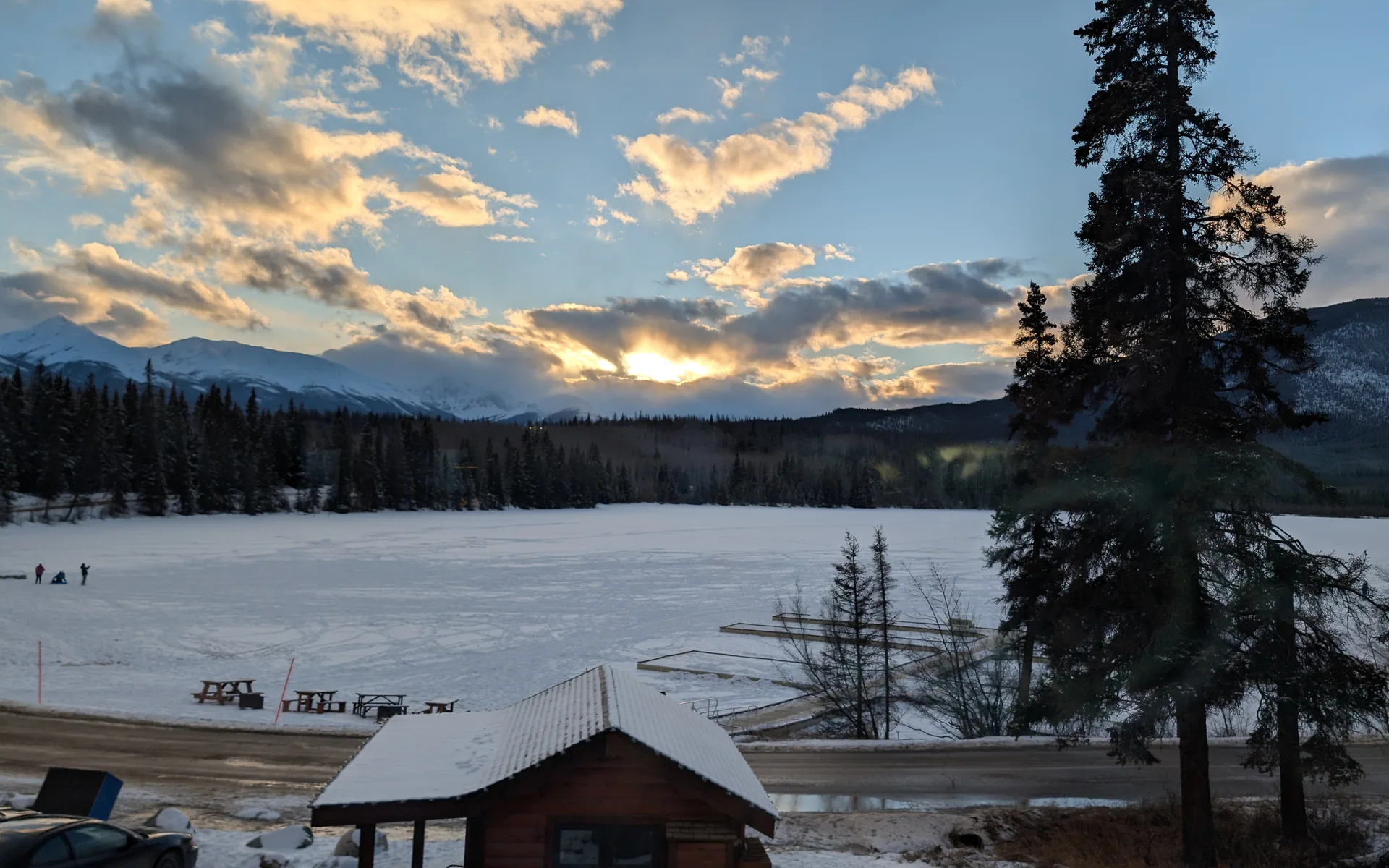
Cover photograph: Pyramid Lake in winter by Joli Rumi/Wikimedia Commons, licensed CC BY-SA 4.0. Cropped and converted to WebP.
Why Jasper matters: homeland, fur-trade route and dark-sky park
Long before there was a park or a railway, these valleys and mountains were home to many peoples. Parks Canada names the area as part of Treaty 6 and Treaty 8 territories and the traditional lands of the Anishinabe, Aseniwuche Winewak, Dene-zaa, Nêhiyawak, Secwépemc, Stoney Nakoda, Mountain Métis and Métis.
Europeans arrived in the early 1800s with the fur trade, and the trading post known as Jasper House was painted by Paul Kane in 1846. In the late 1800s several Indigenous families homesteaded near what is now the town. When the Jasper Park Forest Reserve was created in 1907, First Nations and Métis peoples were forcibly removed and excluded from this part of their territories, and three years later families with homesteads inside the boundaries were forced to leave. The National Parks Act of 1930 formally designated Jasper National Park. Today Indigenous partners, including the Simpcw Nation, the Aseniwuche Winewak Nation and Métis Nation British Columbia, take part in the Jasper Indigenous Forum.
The park protects a remarkably intact mountain ecosystem: elk, moose, caribou, bighorn sheep, grizzly and black bears, wolves, cougars, lynx and wolverines all live here, even as wildlife has declined across much of North America. On March 26, 2011, the Royal Astronomical Society of Canada designated the park a Dark-Sky Preserve. At over 11,000 square kilometres, it is the second-largest such preserve in the world, and on clear nights the sky over the valley is part of what the park protects.
Jasper is also a working town with a railway station at its centre and a community still rebuilding after the 2024 wildfire. Knowing that history makes the practical choices below, from arriving by train to keeping distance from wildlife, feel less like rules and more like part of the place.
Make the recovery map the first booking document
Parks Canada's live map of what is open lists current facilities, roads, trailheads and wildfire-related closures. Read it before buying a non-refundable activity, then read the important bulletins again a day before departure. A seasonal reopening, wildlife closure, prescribed fire or hazardous-tree operation can affect a small area without closing the whole park.
This distinction matters. “Jasper is open” does not mean every pre-fire route has reopened, and an image on an accommodation page is not proof that a nearby trail is accessible. Choose two or three possible day areas and let the official notice decide which one is appropriate. Do not cross a barrier because other visitors are doing it; burned slopes can hold unstable trees, loose rock and damaged drainage long after smoke has gone.
Recovery is also a community reality, not a sightseeing theme. Spend with locally operating businesses, follow signed diversions and do not enter residential rebuild areas for photographs. Ask businesses what they can currently provide instead of expecting a version of Jasper from an older guidebook.
Decide whether the railway is the experience or only the arrival
Jasper station sits in the town centre, which makes rail a genuine car-free arrival with no transfer from an outskirts terminal. VIA Rail serves the station, but long-distance passenger trains share a vast working network and can run late. Confirm the service and baggage rules on the official Jasper station page, keep the first evening unbooked, and leave a wide gap between the advertised arrival and any timed excursion.
Rail works best when the journey itself is part of the trip and the Jasper stay has slack. Carry medication, a warm layer and one night's essentials in hand luggage. Tell the accommodation if arrival may be late and check how reception works after hours. The station is central, but ice, snow or luggage can make a short walk difficult; arrange a taxi in advance when mobility or weather requires it.
Driving gives more control over trailheads but creates other obligations. Check Alberta 511 and Parks Canada as well as any consumer map. Fuel before remote sections, slow down for wildlife and treat Highway 93 North as a daylight drive, not a hurried transfer after dark. Winter mountain driving needs the right tyres, skills and a conservative weather decision.
Build a three-night stay from flexible zones
Arrival night: stay in town. Walk only as far as light, weather and energy allow. Use the information centre to confirm the next day's conditions. A delayed train should cost an evening, not an essential booking.
First full day: town and lower valley. Choose accessible paths, lakes or viewpoints near town according to the current trail report. Pyramid Lake can be a useful direction when access is open, but the cover photograph shows winter conditions, not a promise that a frozen surface is safe. Never step onto lake ice without current local confirmation. Keep an indoor or town-based option for smoke, hard rain or severe cold.
Second full day: one wider excursion. Pick Maligne Lake, the Icefields Parkway corridor or another operating area through a current local transport provider or a carefully planned drive. One distant corridor per day is enough. Mountain roads, wildlife stops and parking make map estimates optimistic, while a one-zone day leaves time to walk as well as photograph pullouts.
On the departure morning, keep the plan close to town. A long trail before a train encourages unsafe rushing and leaves no margin for transport disruption.
Separate seeing wildlife from pursuing it
Elk, bighorn sheep, bears and other animals may appear near roads and town, but proximity is not permission. Parks Canada's current wildlife guidance requires at least 100 metres from bears, cougars and wolves, and 30 metres from elk, moose, caribou, sheep and goats. If an animal approaches, it is the visitor's job to move away and restore that distance.
Do not create a wildlife jam. On major roads, continue to a legal pullout rather than stopping in a driving lane or on an unsafe shoulder. Stay inside the vehicle when that is the safer viewing position, keep the encounter brief and follow staff instructions. Never feed an animal, imitate calls or place a child between a camera and wildlife.
For trails, carry bear spray where it is accessible and know how to use it before leaving town. Make noise, remove headphones in low-visibility sections and keep food and scented items secure. Pets must be physically controlled and are restricted on some trails. Current closures protect both people and animals, especially during calving, berry and rutting seasons.
Let weather cancel the right part of the day
Mountain weather can bring snow in any month. Parks Canada's trail safety advice calls for checking forecasts, trail conditions, warnings and closures, then carrying extra food, water and clothing. Cell coverage is unreliable beyond town, so a downloaded map does not replace telling someone the route and return time.
Use clear thresholds. If smoke makes breathing uncomfortable, choose indoor time or leave the affected area instead of pushing a view-driven hike. If wind threatens trees in a burned area, avoid it. If ice, avalanche information or road conditions exceed the driver's experience, cancel the drive. Travel insurance and flexible reservations are more useful than a tightly optimised schedule.
Visitors with limited mobility should ask about the exact surface, gradient, washroom access and transfer from parking, not whether a site is simply described as “easy”. Wildfire repairs can change a previously familiar route. Confirm equipment availability early and keep a town day that does not depend on one lift, boat or trail.
Choose the onward direction without backtracking
A Jasper trip can continue west towards British Columbia or south towards the Icefields Parkway and Banff, but those are different journeys. Rail travellers should confirm which long-distance service matches the wider route before choosing accommodation dates. Drivers heading south need a full daylight travel day, current road information and room for stops; the parkway is not a quick connector.
If Banff is next, the Banff without a car guide explains its separate shuttle decisions. A city stay before or after the mountains is easier to shape with the Calgary first-time guide or Vancouver first-time guide. The Canada destination hub connects the current regional guides.
Confirm Jasper in this order
First confirm that accommodation exists for three nights. Second, secure the train or choose a road arrival with the right seasonal equipment. Third, check current open areas and select flexible day zones. Only then reserve one weather-sensitive excursion with workable cancellation terms. Repeat the Parks Canada and road checks immediately before travel. That order protects the visit from a late train, a changed closure and the temptation to treat recovery as a minor footnote.
Questions and answers
Is Jasper open after the 2024 wildfire?
The town and much of Jasper National Park welcome visitors, but recovery continues and individual roads, trails or day-use areas can remain closed. Check Parks Canada's What's Open map, bulletins and trail report for the exact day of your visit.
What is the history of Jasper National Park?
The valleys are the traditional lands of several First Nations and Métis peoples. The fur-trade post Jasper House stood here in the 1800s, the Jasper Park Forest Reserve was created in 1907, and the National Parks Act of 1930 confirmed Jasper National Park. In 2011 it was designated a Dark-Sky Preserve.
How much time does a first Jasper visit need?
Three nights is a sensible minimum. It gives two usable days and leaves some room for a late train, mountain weather or a changed trail plan without turning the visit into one rushed circuit.
Sources
Toronto · 43.6532° N, 79.3832° W
This story belongs to Canada. The second-largest country by area, shaped by Indigenous nations, two official languages, newcomers from every continent and a national park system begun at Banff.