Oslo: From Viking Trading Place to Opera House on the Fjord
Akershus Fortress, Christian IV's 1624 rebuild, the Fram polar ship, the 2008 Opera House and MUNCH show how Oslo's waterfront tells its history.
Oslo is a city that was founded, burned, moved and renamed, and the waterfront is where those chapters sit within a short walk of each other. Trading started here around the year 1000 to 1050, a medieval fortress went up around 1300, a seventeenth-century king rebuilt the town after a fire, and a modern opera house now rises from the harbour at Bjørvika. Seeing that sequence in order is the best reason to follow the shore.
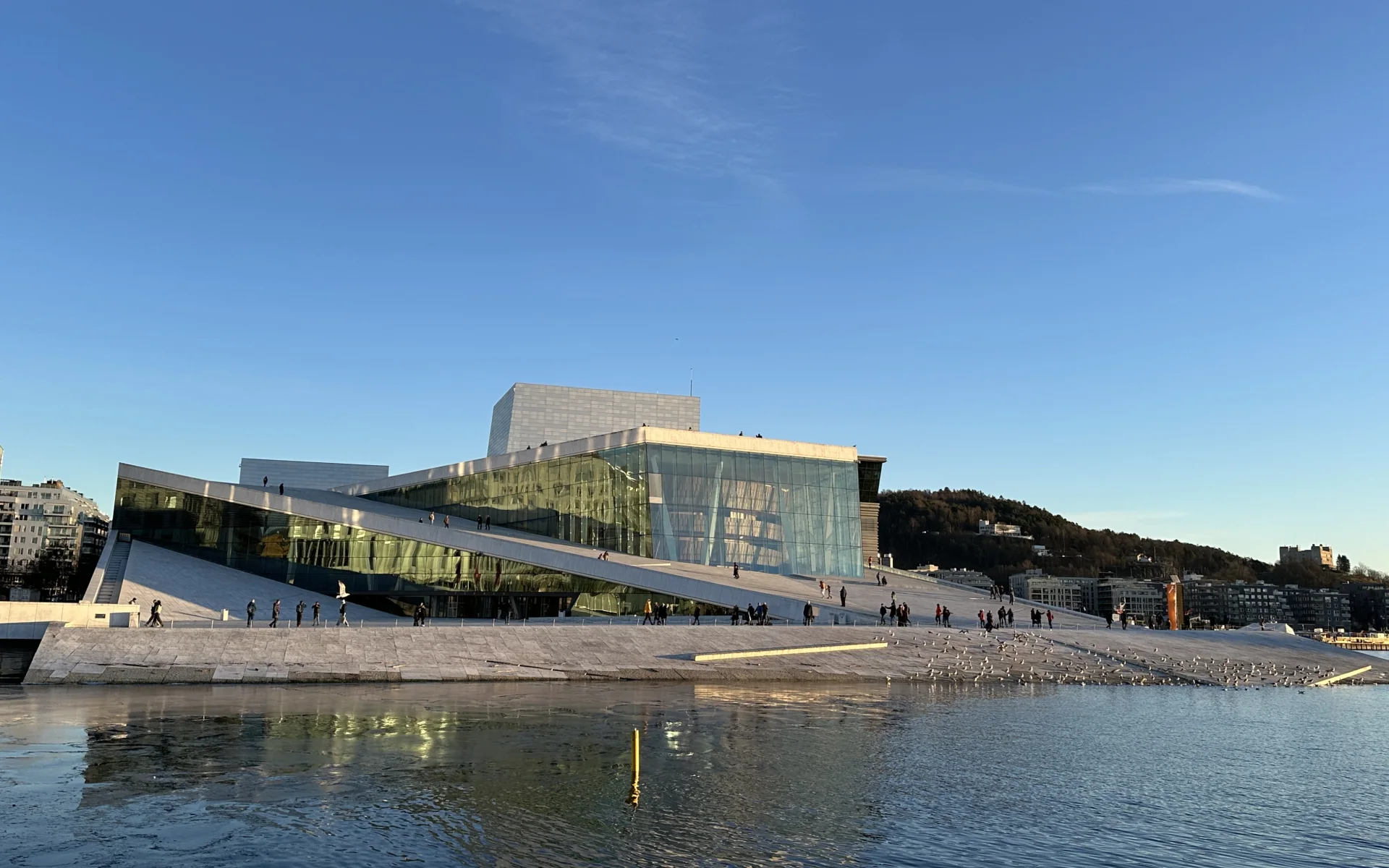
Cover photograph: Ssu, “Operaen i Oslo, 2024,” 18 November 2024, own work under CC BY-SA 4.0. Cropped from the top and bottom to a 16:10 frame and converted to responsive WebP sizes; no landmarks were added, removed or relocated.
A trading place, a fortress and a king's grid
Sources date Oslo's founding differently. Some give 1040 under the name Ánslo and a formal trading place about 1048 under Harald Hardrada, while archaeology suggests an urban structure forming around the year 1000. By around 1299 the capital had moved to Oslo from Bergen, and Akershus Fortress dates from the 1290s, with Haakon V credited with ordering it. After a fire in 1624, Christian IV of Denmark-Norway built a new town farther west, under the walls of Akershus, and called it Christiania; Oslo stayed the name of a village outside it. The straight streets of Kvadraturen are his grid, and the name Oslo has been used for the city again since 1925. At the fortress, distinguish open grounds from museums and interiors, follow temporary military or ceremonial restrictions and do not climb walls for photographs.
The modern waterfront: Opera, Munch and the National Museum
The waterfront looks new because it largely is. Snøhetta designed the Oslo Opera House, which opened in 2008, and its lobby has stayed open to visitors since; the building draws about 1.7 million people a year. MUNCH opened beside it on 22 October 2021 in a 13-storey tower that leans toward the Opera House and holds several versions of The Scream. The National Museum opened on 11 June 2022 and is billed as the largest art museum in the Nordic region, merging four Norwegian art and design institutions under one roof. Walk the Opera roof only when the surface and your footwear suit it, since rain, frost and snow turn pale stone slippery; the building is also an active venue with separate rules for interiors and tours.
Polar ships and Viking boats on Bygdøy
Bygdøy holds the maritime story. The Fram Museum's centrepiece is the polar ship Fram, which carried Nansen, Sverdrup and Amundsen on their most ambitious expeditions. Next to it, the Kon-Tiki Museum displays Thor Heyerdahl's balsa raft, on which he and a multinational crew travelled about 4,300 miles from Peru to Polynesia in 101 days. The Viking ship collection nearby is commonly dated to the Gokstad ship found in 1880 and the Oseberg ship found in 1904, and the Norwegian Museum of Cultural History covers social and architectural history. Choose according to a genuine question, and check each institution for the current entrance, temporary exhibitions and renovations.
One, two or three days
One day, inner harbour. Start outside the Opera House, continue past Deichman Bjørvika and MUNCH, cross Kvadraturen to Akershus, and continue towards City Hall and Aker Brygge. Choose one interior from MUNCH, the National Museum and Akershus rather than all three. In winter, use the brightest hours for outdoor sections and put a collection or café break after dusk.
Two days, add Bygdøy or a central collection. On day two, take the Bygdøy museums or one major central collection, then finish with Grünerløkka and the lower Akerselva, which connect food, independent shops and industrial history. Bygdøy plus several central museums is not a sensible single day. Ruter boats are public transport within the zones printed on a valid ticket, but the seasonal museum ferry to Bygdøy has its own operator and conditions; Ruter publishes boat timetables and notices, and a bus is the alternative when the ferry is not operating.
Three days, make the third conditional. In settled weather, take a Ruter boat to a fjord island; Hovedøya combines public paths, beaches and historic ruins. Verify the live route and final return, stay on public paths, protect nesting birds and carry waste back. In rain or strong wind, switch to an interior or a neighbourhood tram ride. The Norwegian Meteorological Institute links to official warnings.
Practical ground in one place
Oslo Airport Gardermoen has airport express and ordinary trains plus buses; Avinor lists the current operators. Plan the whole origin-to-destination journey in the Ruter app, since a valid ticket is needed before boarding and an airport trip crosses more zones than central sightseeing. Oslo S suits a short waterfront stay, and Grünerløkka offers more neighbourhood life. Check the final 200 metres to your accommodation for gradient and steps.
Most buses, metro trains, newer trams and boats are accessible, but tide can make some boat ramps steep and several island paths are unsuitable for wheelchairs or pushchairs, as Ruter's accessibility guidance notes. Check each museum's accessible entrance and the vessel before setting out.
Swim only at a designated bathing place, after checking the City of Oslo's bathing-water monitoring. Cold water can trigger an involuntary gasp even when the air is warm, so enter gradually, stay with someone and avoid alcohol. For urgent police help call 112, for a life-threatening medical emergency 113, and for urgent but non-life-threatening help 116 117; the police also publish a non-emergency route.
Oslo is expensive, but the harbour, fortress grounds, parks and neighbourhood walks cost nothing. Use a bakery or supermarket for one meal, carry a refillable bottle, and state allergies exactly. Sunday and public-holiday opening varies, so buy supplies in advance. An Oslo Pass is a calculation, not a saving by default: list the admissions and journeys you will actually use before buying.
Continue through the Oslo place page and Norway destination hub, compare a rain-aware coastal route in the Bergen guide, head north with the Trondheim river heritage guide, or plan another Nordic capital with the Copenhagen first-time visitor guide.
Questions and answers
How many days do first-time visitors need in Oslo?
Two full days cover a coherent central waterfront route, one major museum choice and one neighbourhood. A third day creates room for the fjord islands, Bygdøy or a forest walk without rushing.
Does an Oslo public-transport ticket include ferries?
A valid Ruter ticket covers Ruter boats in the zones printed on that ticket. The seasonal museum ferry to Bygdøy can have separate ticket conditions, so verify the named operator and route before boarding.
Can you swim anywhere along Oslo's waterfront?
No. Use a designated bathing place, check the city's latest water-quality and local safety notices, and stay outside working harbour and ferry areas. Cold-water risk remains even on a warm day.
Is Oslo accessible for wheelchair users?
Many public-transport vehicles are accessible, but stop design, lift status, tides, island paths and individual historic entrances can change the practical route. Check the exact journey and venue before setting out.
Sources
Oslo · 59.9139° N, 10.7522° E
This story belongs to Oslo, Norway. A long coastal country where Viking-age towns, Hanseatic wharves, fishing islands and Arctic cities each hold a different history.