Roskilde for First-Time Visitors: Cathedral, Vikings and Fjord
Roskilde was Denmark's capital until 1443. Its brick cathedral, Viking ships and charity festival explain why locals still call it the old heart of the kingdom.
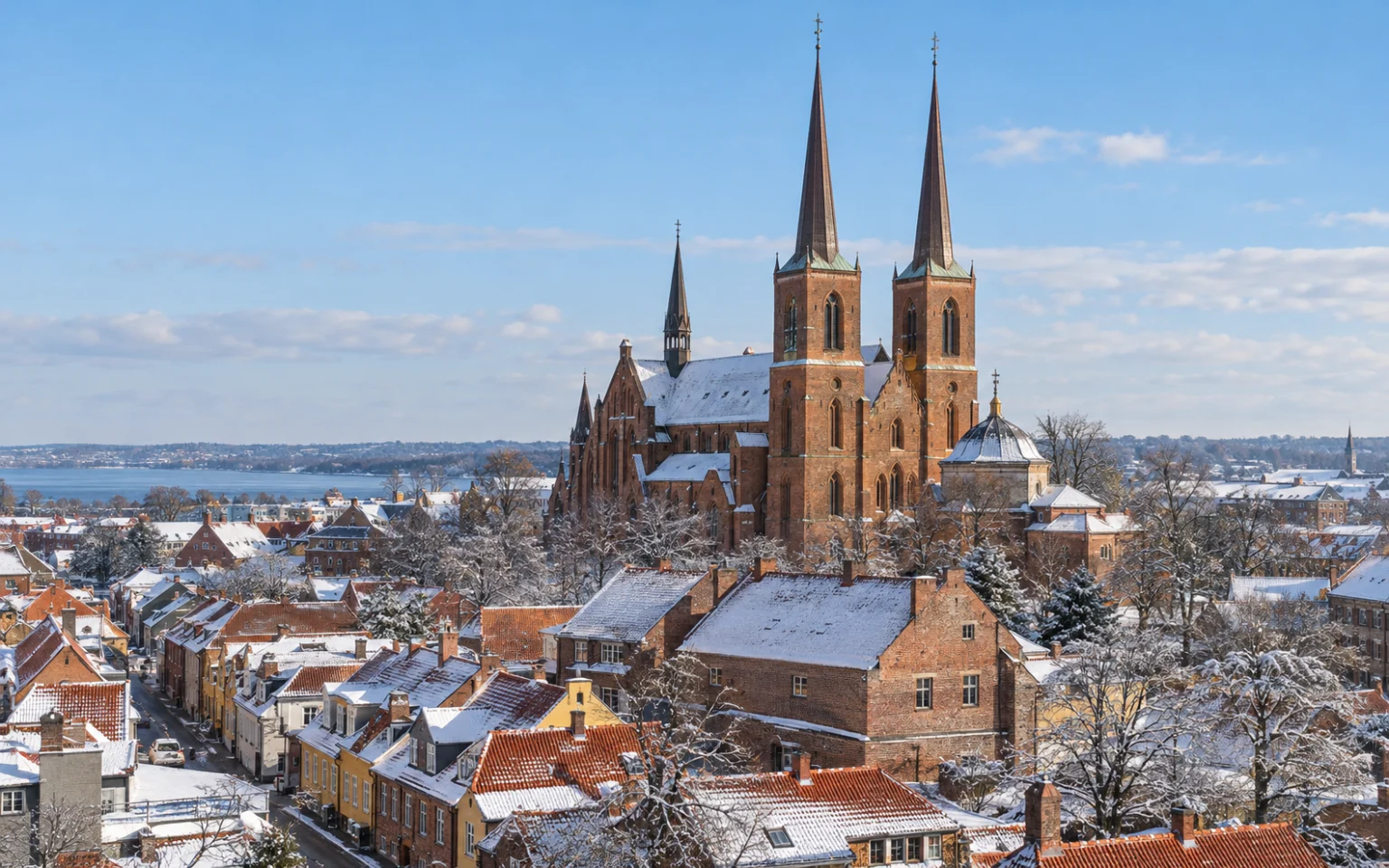
Cover: AI-generated illustration. © ANUSHKA DAHANAYAKE (PVT) LTD.
Before Copenhagen mattered, Roskilde did. For roughly four centuries, until 1443, it was the capital of Denmark, and the town still holds the country's royal graves, the ships that once guarded its fjord and a music festival whose profits go to charity. That layered record is the reason to come, and the practical side of the visit follows from it.
A capital older than Copenhagen
Medieval chroniclers, Adam of Bremen and Saxo Grammaticus, credited King Harald Bluetooth with founding Roskilde in the 980s, with a wooden church and a royal residence on the rise above the harbour. No trace of those buildings has been found, so the date is tradition rather than excavation. What is certain is the town's political weight: from the eleventh century until 1443 the kings governed from here, and bishops built on a scale that matched the role.
The Reformation of 1536 closed most of the town's religious houses; at that point Roskilde had twelve churches and five monasteries. The cathedral survived as the burial church of the monarchy. In 1658 the Treaty of Roskilde ended the Dano-Swedish War of 1657-58, a reminder that the town's name appears in textbooks well beyond Denmark.
The brick cathedral and its royal chapels
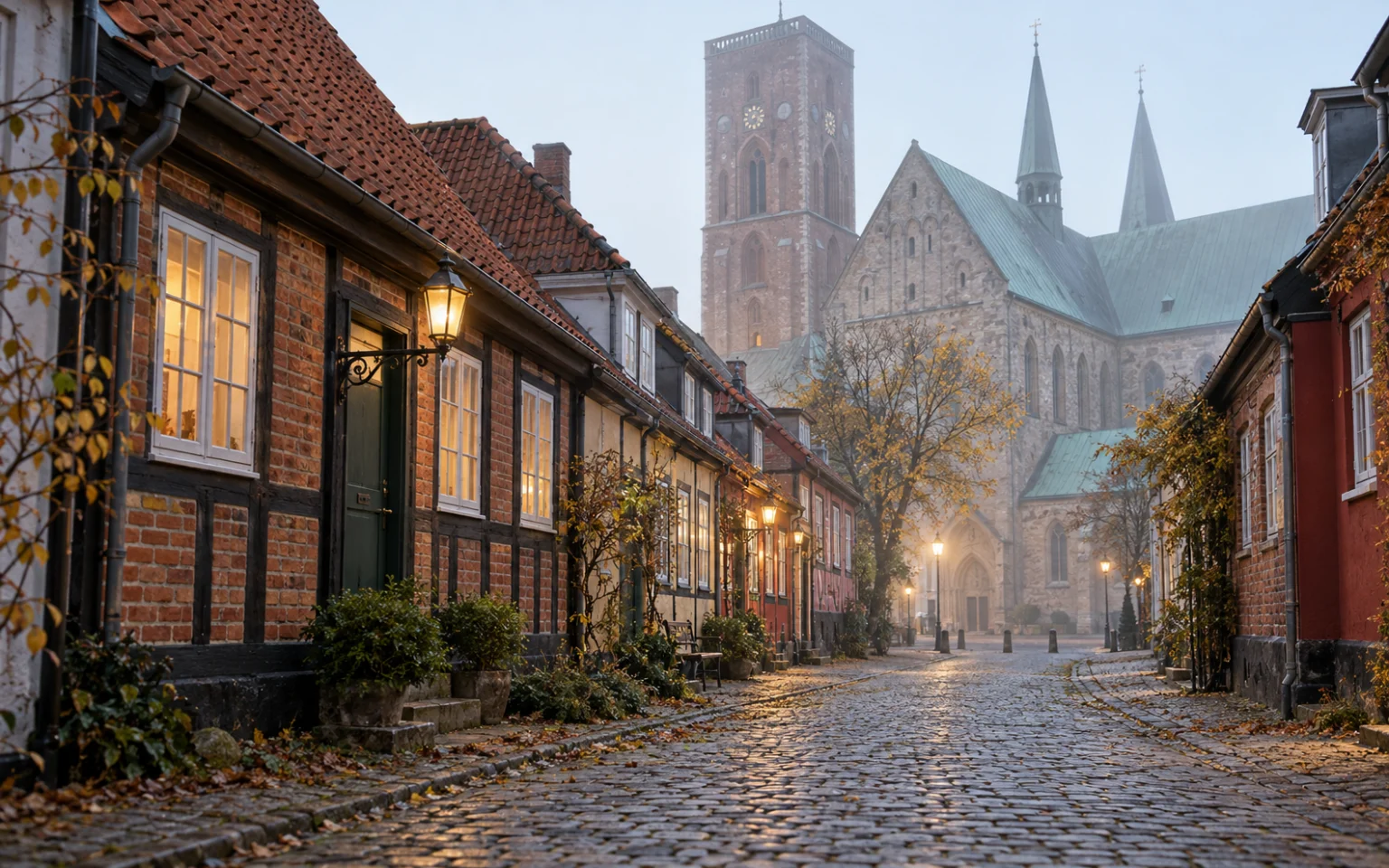
Bishop Absalon began enlarging an earlier travertine church after 1157, and bricks were first fired in Denmark around 1160, which is why the cathedral is such an important document of early brick Gothic. Work on the present building began around 1170, the choir was inaugurated in 1225 and the towers were finished in 1405. The two spires are later, added in 1633. UNESCO inscribed Roskilde Cathedral in 1995.
The interior reads as a family archive. Queen Margrethe I died in 1412 and her body was moved here the following year; her sarcophagus stands in the choir area. The Chapel of the Magi, founded by Christian I in 1459, has frescoes from about 1460. Christian IV ordered his own chapel in 1613, the exterior was finished in 1641, and the interior was only completed in 1870. The newest additions are modern: Frederik IX's burial site opened in 1985, and a monument for Margrethe II was installed in 2018 with its sarcophagus left covered. Around twenty monarchs lie in the building in total, a figure that depends on whether disputed remains such as Harald Bluetooth's are counted.
Five ships sunk to protect a town
Around 1070, five ships were deliberately sunk at Skuldelev to block the main channel into Roskilde Fjord and shield the town from seaborne attack. They lay under the water for nine centuries. In 1962 they were excavated, and in 1969 the Viking Ship Museum opened beside the fjord to display them. The five are different types, from a cargo carrier to a warship, which makes them a rare cross-section of what Scandinavian shipbuilders could produce.
A second discovery came in the late 1990s, when digging for the museum's boatyard expansion uncovered nine more medieval vessels. One of them, Roskilde 6, dates from about 1025 and at roughly 37 metres is the longest Viking ship ever found. The museum now keeps more than forty vessels, ranging from original timbers to sailing replicas, and its boatyard on Museum Island, reached by a drawbridge, builds reconstructions using evidence from the finds. Visitors can watch the craft as well as the results.
A town that still hosts
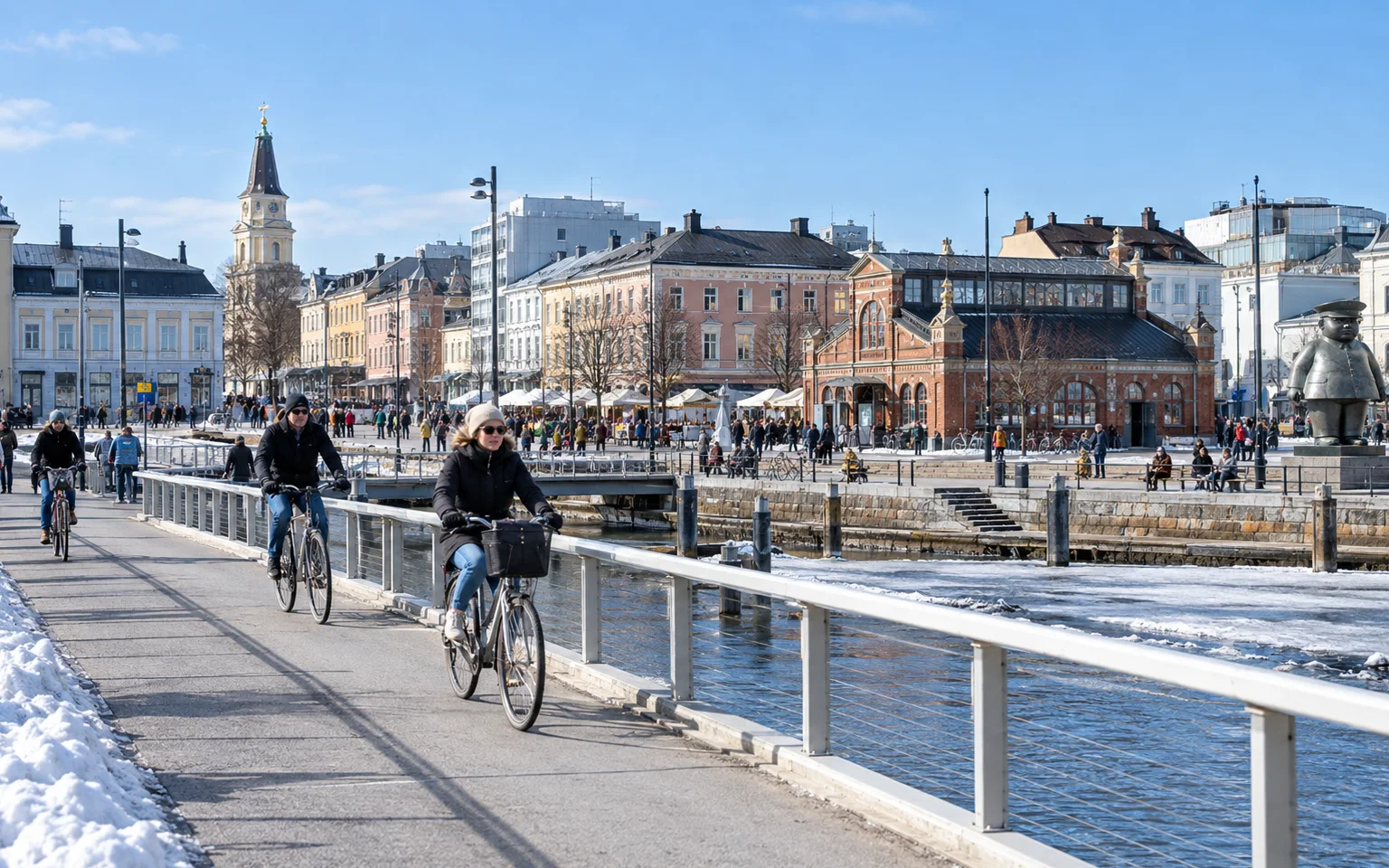
Roskilde Festival began in 1971, draws around 80,000 people a year and donates all its profits to charity, a model locals mention with pride. Roskilde University was founded in 1972, so the old royal town now has a student population that keeps cafés and bicycle lanes busy outside the summer season. Roskilde Palace, built in 1733-36 on the site of the bishops' former residence, now houses the Museum of Contemporary Art.
A day in order: hill, centre, harbour
Regional and intercity trains link Copenhagen with Roskilde; check the stopping pattern, since it changes travel time. The cathedral is a short walk from the station, and the Viking Ship Museum is downhill beside the fjord. Walking down is easy; the return climb is the effort, so a local bus for one direction helps when schedules suit.
Visit the cathedral at opening time. It is an active church, so check the cathedral's date-specific visitor calendar for services and closures, keep voices low and follow the photography rules. Read the chapel labels, starting with Margrethe I and the Chapel of the Magi; without them the interior becomes a sequence of ornate rooms. Lunch in the centre before heading down, because harbour cafés may not suit every diet.
Spend the afternoon at the museum and boatyard. Allow two to three hours even without sailing. Seasonal sailing trips run on the fjord, but they depend on wind and booking, so treat them as an extra and never assume a ride. Late spring to early autumn gives the fullest boatyard programme; winter makes the cathedral atmospheric but cuts outdoor activity and hours. An overnight stay adds time for the palace gallery and a longer fjord walk, and avoids the day-tripper rush.
Practical notes for the whole stay
Budget for return rail, two admissions, meals and perhaps a bus; ticket rules and guided-tour availability change, and sailing is booked separately. Danish tap water is safe, a bakery breakfast keeps costs down, cards are widely accepted and tipping is optional because service is included. During the festival, prices, traffic and accommodation change completely, so book far ahead or pick different dates.
Roskilde is generally safe; the usual risks are slippery cobbles, harbour edges, wind and pickpockets on crowded trains. Ask each venue about step-free entrances, lifts and toilets, since the route to the harbour is not level and historic floors vary. Do not touch ship timbers or historic surfaces, stay clear of working boatyard areas, keep to paths beside the fjord to protect birdlife and take litter away.
Continue through the Denmark destination hub, read what makes Denmark special, compare another chapter of early Danish history in our Ribe guide, plan the rail connection with our Copenhagen first-time guide, or explore all countries for a longer itinerary.
Questions and answers
Can Roskilde be visited as a Copenhagen day trip?
Yes. Frequent trains make a day trip practical, but start early if you want meaningful time at both the cathedral and Viking Ship Museum.
How much time does the Viking Ship Museum need?
Allow at least two to three hours for the original ships, boatyard and seasonal activities. Sailing experiences require separate timing and suitable conditions.
Is Roskilde only worthwhile during the festival?
No. The cathedral, Viking ships, historic centre and fjord form a strong year-round visit, while the festival is a major separate event with different logistics.
Is Roskilde accessible?
The town has manageable distances, but the route to the harbour slopes and historic surfaces vary. Confirm step-free access and facilities with each museum.
Sources
Copenhagen · 55.6761° N, 12.5683° E
This story belongs to Roskilde, Denmark. A small kingdom whose pride runs from a tenth-century rune stone to fairy tales, furniture and a kitchen revolution.