Sigiriya First-Time Visitor Guide: Lion Rock and Royal Gardens
King Kassapa's palace city, its frescoes, the verse-covered Mirror Wall and gardens laid out 1,500 years ago, plus how to climb and visit Sigiriya well.
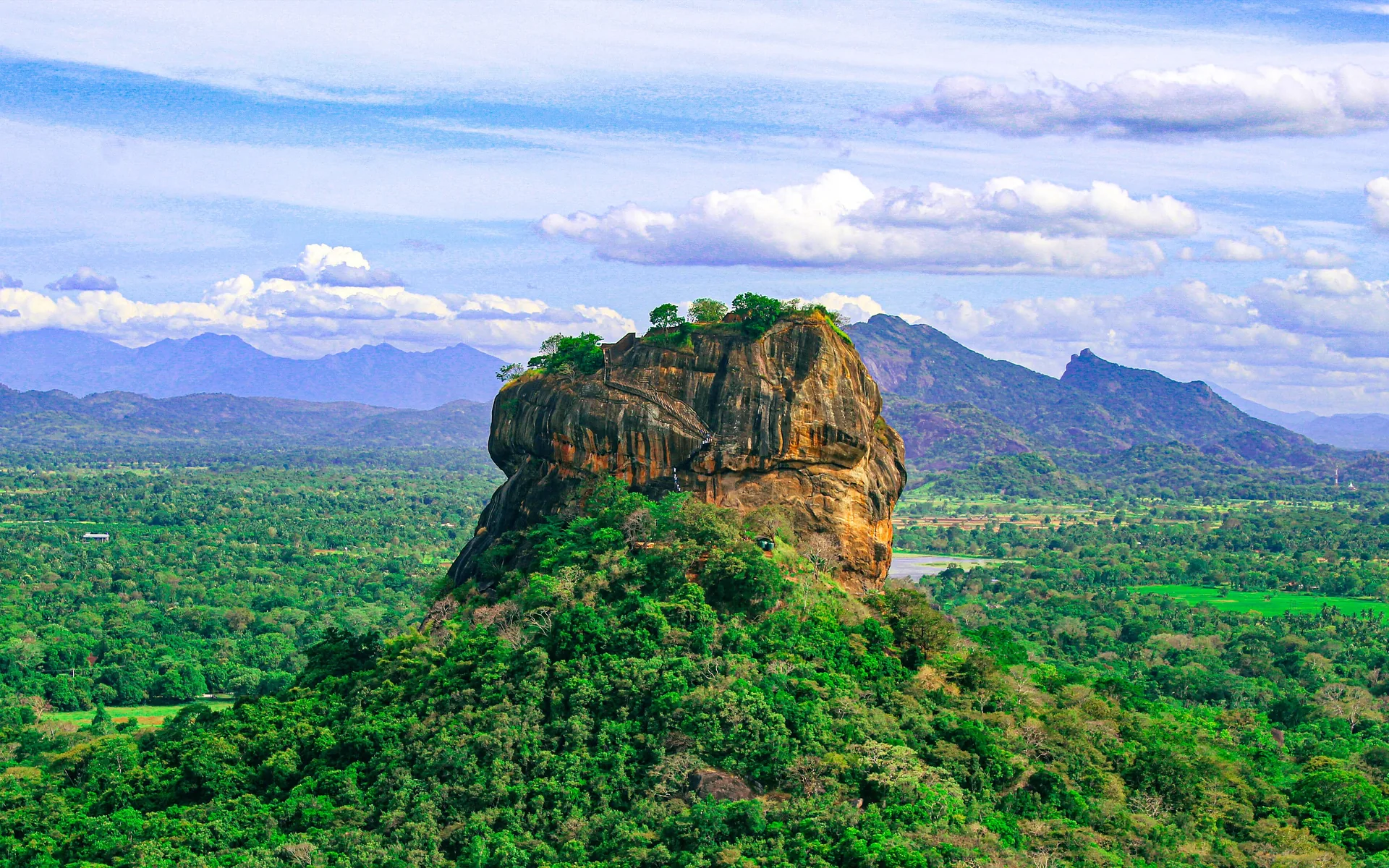
Sigiriya is a column of rock rising from the dry-zone plain of central Sri Lanka, and in the fifth century a king built a palace on top of it. Around the base he laid out symmetrical water gardens, halfway up painted women appear on a sheltered rock face, and visitors for centuries scratched poems about them on a polished wall. It is the image many Sri Lankans choose for their country.
Cover photograph: Sigiriya Rock Fortress with Pidurangala and the surrounding landscape, photographed in September 2023 by Chamixth / Wikimedia Commons, CC BY-SA 4.0. Cropped and converted to WebP.
A king's capital on a rock
Kassapa I ruled from about 477 to 495 CE (sources differ by a few years). He is said to have moved his capital from Anuradhapura to the rock out of fear that his half-brother Moggallana would return to claim the throne. After Kassapa's death, Moggallana took back the kingdom, moved the capital back to Anuradhapura and turned Sigiriya into a Buddhist monastery. In about eighteen years a palace, ramparts and a planned city had been built. The Central Cultural Fund calls the frescoes proof of the sophistication of fifth-century Sinhalese art. Sigiriya was inscribed on UNESCO's World Heritage List in 1982.
Painted women and a wall of poems
In a sheltered pocket of the western face, reached by a spiral stair, the frescoes show women painted in the fifth century, in colors that remain vivid. Photography is restricted there. Below runs the Mirror Wall, once polished to reflect the paintings. Visitors scratched verses on it over many centuries; sources date the graffiti from roughly the sixth to the fourteenth century, with the busiest period in the eighth to tenth. Many of the verses respond to the painted women and are valued as early records of written Sinhala. Do not touch or lean on the wall.
The lion's paws and the gardens
The final ascent begins between two enormous brick paws, all that remains of a lion-shaped gateway; the name Sigiriya is usually read as Sinhagiri, Lion Rock. Local guides count about 1,200 steps to the summit, where the palace foundations, rock-cut pools and a long view over forest and tank survive.
The gardens at the foot fall into three linked forms: water gardens, boulder gardens and terraced gardens. The water gardens' straight paths, pools and channels make the rock part of a designed royal landscape, and sources describe them as among the oldest landscaped gardens known. In rainy weather more of the hydraulic system shows. In the boulder gardens, paths pass between and beneath huge stones, and one rock overhang resembles a cobra's hood.
A wider heritage circuit
Dambulla's cave temple, inscribed by UNESCO in 1991, holds a collection of painted caves with more than 150 Buddha statues by most counts, and sits within easy reach. Anuradhapura and Polonnaruwa, each an old royal capital, make fuller days. Pairing Sigiriya with Dambulla keeps the story continuous, from the fortress-palace on its rock to the painted caves, while the two old capitals show where the island's kings ruled from. Our Sri Lanka destination hub and what makes Sri Lanka special place Sigiriya within the island's story.
Tickets, timing and the climb
The CCF runs official online ticketing. An online order is valid for 90 days, but the receipt number must be presented at Sigiriya's counter to get a single-entry ticket; check ticket information and the price list before travelling. Carry the original passport or identity document for any relief category. Pages differ on whether the site ticket includes the museum, so ask the counter exactly what you are buying.
Start close to opening. The upper route is exposed, metal stairs heat up and shade is limited later in the day. Wear shoes with grip, covering clothes and a hat that can be secured, and carry water. Do not carry loose food, because monkeys may approach. Wasps can become active around the rock; if staff ask visitors to stay quiet, wait or turn back, follow that instruction at once. Take the gardens first, then climb, and keep the museum for afterward, when the layout is fresh. Anyone uneasy about heights should look at photographs of the final stair before buying: turning back is reasonable, and the gardens and museum still explain much of the site.
At the top allow at least half an hour, stay inside barriers and avoid posing on fragile walls. Descending is where tired climbers slip, so wait on a landing instead of overtaking on a narrow flight.
Pairing Sigiriya with Dambulla or Pidurangala
After a hot climb, lunch and rest are better than another steep walk. Dambulla Cave Temple is both a climb and a living place of worship: dress respectfully, remove footwear where required and confirm its separate ticket. Pidurangala is a separate temple and hike with rough scrambling near the top; do not attempt it in darkness without preparation. Doing both after Sigiriya turns a plan into three demanding climbs.
Sigiriya village is closest to the entrance, Dambulla has broader transport, and Habarana suits visitors combining heritage with a wildlife trip. Avoid arriving the same day from the south coast and climbing in the afternoon; roads take longer than the map suggests. Spend at least one night nearby.
Weather, health and protection of the site
The site is hot and humid. Rain makes stone and metal slippery, and thunderstorms make the summit a poor place to wait. Check the Department of Meteorology's forecasts, but follow staff over any app. Drink regularly, take breaks early, and turn back if dizziness or chest pain develops. Travelers with heart, balance or mobility concerns should consult a clinician and consider the lower site.
Stay on marked routes and never remove stone or plants. CCF terms prohibit drone filming without its written approval, and the Civil Aviation Authority's drone portal requires its own checks. Save 119 for police, 1990 for the Suwa Seriya ambulance service and 1912 for Sri Lanka Tourism help, as documented in the short-code register, 1990 service page and SLTDA hotline page. Alert CCF staff immediately to a fall or wasp incident. Licensed local guides and small businesses keep the visit's benefit in the community.
Continue with a slower hill-country leg in Kandy without the rush, or head north with the Jaffna visitor guide.
Questions and answers
How long should you allow for Sigiriya?
Allow roughly three to four hours for the museum, gardens and climb, with more time if you stop often or travel with children. Begin near opening time so the exposed upper stairways are cooler and less congested.
Can you visit Sigiriya without climbing to the summit?
Yes. The water gardens, boulder gardens, museum and lower archaeological landscape still explain much of the site. Ask staff about current step-free access because the summit route itself involves many stairs and is not wheelchair accessible.
Should you choose Sigiriya or Pidurangala?
They are different experiences. Sigiriya is the managed World Heritage archaeological site with gardens, frescoes and palace remains; Pidurangala is a separate religious and hiking site with a view toward Sigiriya. Do not treat one ticket or route as covering both.
Sources
Colombo · 6.9271° N, 79.8612° E
This story belongs to Sigiriya, Sri Lanka. An island of ancient capitals, irrigation tanks, hill-country tea and colonial harbours, where continuity runs unbroken across two thousand years.