What Makes Trincomalee Special: A Great Harbour, a Clifftop Temple and the East Coast Sea
A deep-water harbour admired by admirals for centuries, a Hindu temple on a clifftop, white beaches, a coral island and blue whales offshore. A guide to what makes Trincomalee special.
Cover: AI-generated illustration. © ANUSHKA DAHANAYAKE (PVT) LTD.
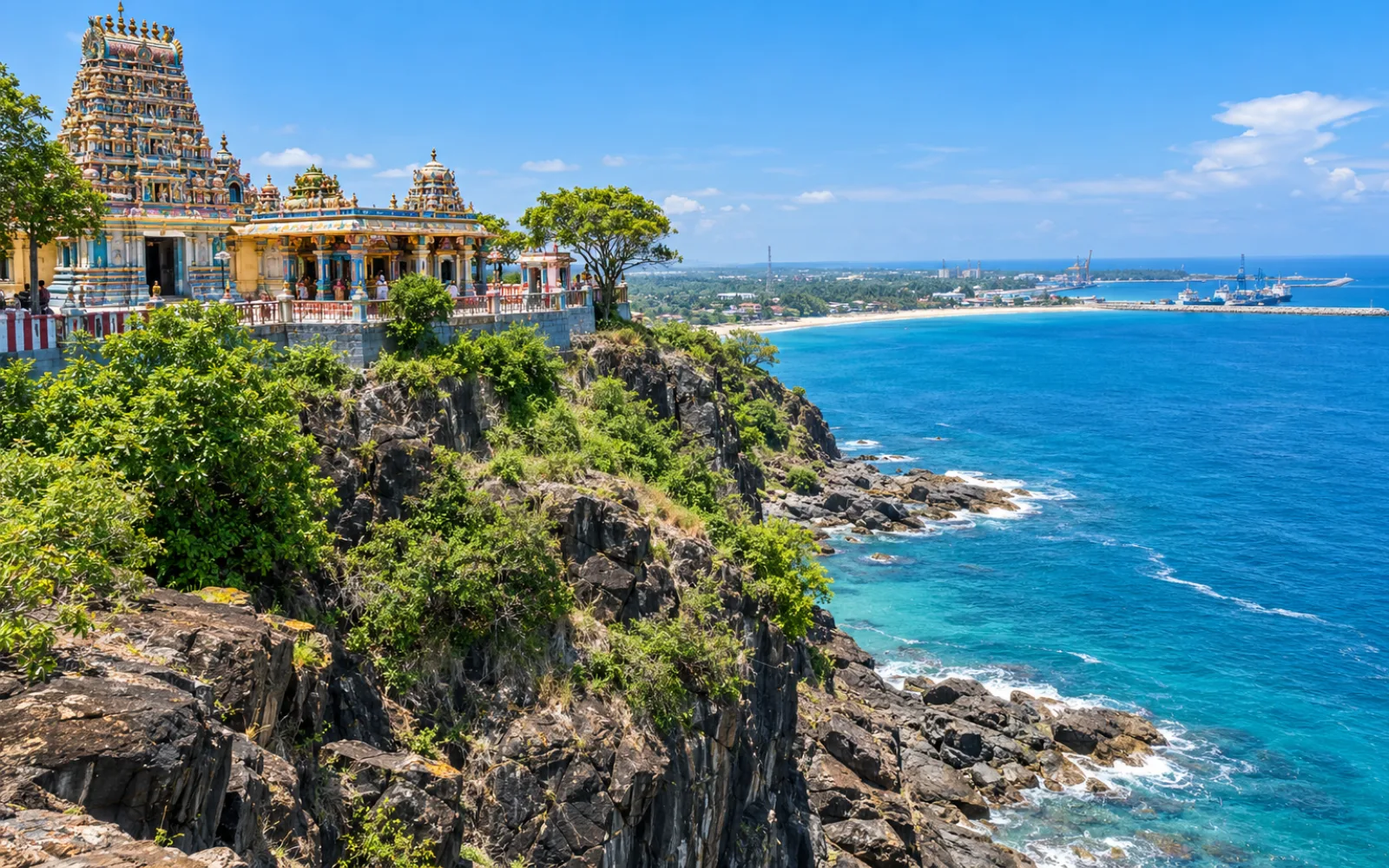
Ships have been turning into Trincomalee's bay for as long as there are records of trade in the Bay of Bengal. The Central Cultural Fund notes that classical geographers, Ptolemy among them, knew the port as Gokanna, and it describes the harbour as one of the finest natural deep-water harbours in the world: sheltered from the monsoons, deep close to shore and sitting on the sea lanes between India, the Malay world and the Arabian Sea. Everything that makes the town distinctive, from a clifftop Shiva temple to a fort built from that temple's stones, grows out of that piece of geography.
A harbour that empires queued for
Control of the bay changed hands repeatedly once European powers arrived. The Portuguese fortified the headland in 1622, calling it the Fort of the Bay of Trincomalee. The Dutch took it in 1639 and held it, apart from a brief French occupation in 1672, until the British captured it in 1795 and renamed it Fort Frederick after Prince Frederick, Duke of York; the British coat of arms still sits over the gateway. Horatio Nelson is reported to have called it the finest harbour in the world, a line the town repeats with understandable pride.
The harbour's value was tested again in the Second World War. On 9 April 1942, days after the Easter Sunday raid on Colombo, Japanese carrier aircraft attacked Trincomalee. Much of the British Eastern Fleet had been warned and had left the harbour the night before, but the aircraft carrier HMS Hermes and the Australian destroyer HMAS Vampire were sunk off the coast as they withdrew. The Sri Lanka Navy's dockyard still occupies much of the inner harbour, which is why parts of the shoreline are closed to visitors and why the view from Fort Frederick's headland is the best way to understand the bay's shape.
Koneswaram on Swami Rock
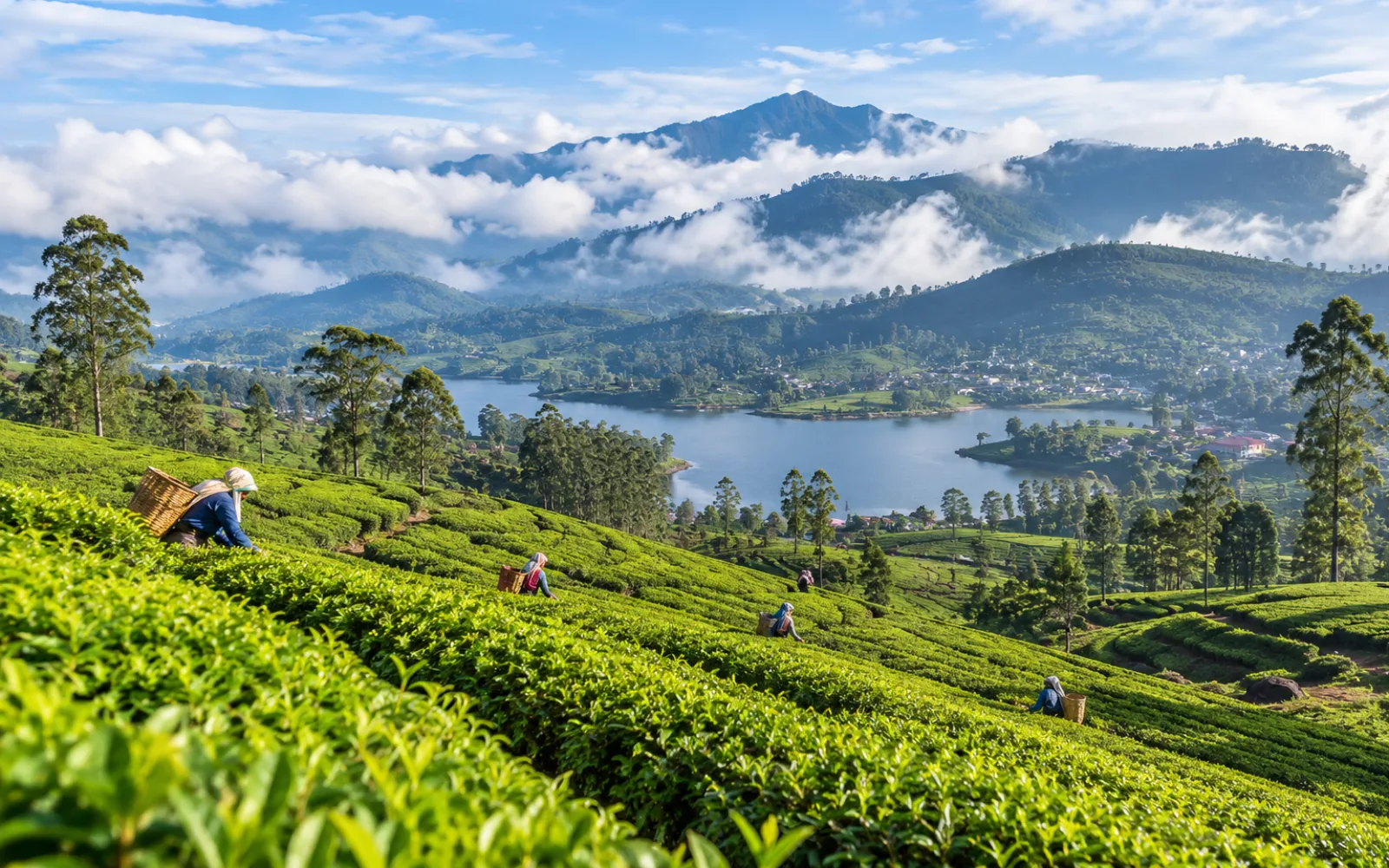
At the tip of the headland, on the cliff known as Swami Rock or Konesar Malai, stands Thirukoneswaram, a temple to Shiva that Tamil Hindus count among the Pancha Ishwarams, the five ancient Shiva shrines of the island. Its standing in the wider Tamil world rests on the Tevaram, the devotional hymns of the Shaiva poet-saints: Sambandar and Sundarar both sang of Koneswaram, making it one of the Paadal Petra Sthalams, the shrines praised in that canon, alongside Ketheeswaram near Mannar on the opposite coast.
The temple's modern history is one of loss and return. Portuguese forces under Constantino de Sá de Noronha attacked the shrine in April 1622, and its demolition ran from 1622 to 1624. Carved pillars and dressed stone were carried into the new fortifications, so parts of the old temple survive inside the very walls that replaced it. Bronze images that had been hidden were found in the twentieth century, and the Central Cultural Fund records that reconstruction on part of the original site began in 1963. In the 1950s the writer Arthur C. Clarke and the diver Mike Wilson explored the sea below the cliff and photographed fallen masonry on the seabed, an episode Clarke described in The Reefs of Taprobane.
Today the temple is busy, colourful and very much in use. Priests perform pujas through the day, families arrive with offerings of flowers and coconut, and the drop known as Lover's Leap falls straight to the water. Spotted deer graze the fort grounds on the way up.
Three communities in one town
Trincomalee is home to Tamil, Muslim and Sinhala families, and its sacred places reflect all three: Hindu kovils, mosques near the market, churches from the Dutch and British periods and Buddhist sites on the hills above the bay. That mix shapes the food. A Tamil vegetarian lunch on a banana leaf, Muslim biryani and watalappam, and Jaffna-style crab and prawn curries are all part of eating here, and the market sells dried fish, palmyra sweets from the north and east. Arts and lettering made for this town belong in Tamil and Sinhala together; if a design uses either script, a fluent reader should check it.
Kanniya's seven wells
Inland, the Kanniya hot springs are seven shallow, square-built wells, each fed by water at a slightly different temperature. Local tradition ties them to King Ravana of the Ramayana. The wells, the remains of a Buddhist monastery and a stupa mound beside them were gazetted as protected archaeological monuments in 2011, so the site is heritage as well as a bathing spot. Visitors pour buckets over themselves; nobody swims.
Reef and open sea
North of town the shore runs through Uppuveli to Nilaveli, long pale beaches facing the Bay of Bengal. A short boat ride from Nilaveli, Pigeon Island National Park protects a shallow coral reef. The Department of Wildlife Conservation manages entry, and the reef is one of a very small number of marine national parks in the country. Reef fish, turtles and reef sharks are often seen, though water clarity and sightings change from day to day. Further out, whale-watching boats run in the calmer months; good operators will say plainly that a blue or sperm whale is possible, never promised.
Getting to the east coast
The Sri Lanka Railways timetable lists a Colombo Fort to Trincomalee night-mail service, and seats can be reserved through the official reservation site. Check departure times and classes for your date and arrange the onward transfer to Uppuveli or Nilaveli before arriving at dawn. Buses and road transfers via Dambulla are an alternative; journey times depend on traffic and stops. Many travellers arrive from the Cultural Triangle, so Trincomalee pairs well with Sigiriya or with the ruins described in what makes Anuradhapura special, and the coast road north continues towards Jaffna.
Season, sea and respect
The east coast usually has its calmer, drier months from about May to September, the reverse of the west and south. The north-east monsoon brings rain and rough sea from roughly November to January, when some beach hotels close. A clear forecast is not the same as a safe sea, so swim where locals do and follow lifeguard or operator advice.
At Koneswaram, remove shoes, cover shoulders and knees and leave space for worshippers. Fort Frederick is an active military area: obey signs and photograph only the temple and the views. At Pigeon Island, pay the park permit, never stand on coral or chase turtles, and go early before boats crowd the reef. Do not feed the deer. Carry cash, since card machines are patchy away from larger hotels, and agree tuk-tuk fares in advance.
Three days, one coast
Give the first morning to Fort Frederick, Koneswaram and the harbour view before the stone heats up, then the market and town in the afternoon. Use the second day for Uppuveli or Nilaveli, choosing a base by the beach you want and the real transfer time to town. Keep the third day for Pigeon Island or a whale-watching trip if the operator confirms conditions, with Kanniya's wells or the Maritime and Naval History Museum as the rough-sea alternative.
Where Trincomalee fits
The bay, the temple and the reef make Trincomalee the east coast's story in a single place, and the wider island is covered in what makes Sri Lanka special. The Sri Lanka collection gathers the towns, from Colombo to Jaffna, that Ceylon Trends draws on. The natural harbour, Koneswaram temple on Swami Rock and Pigeon Island's reef are the places to start, before moving on to Nilaveli beach and the whales offshore.
Questions and answers
When is the best time to visit Trincomalee?
Usually May to September, when the east coast tends to be drier and calmer while the south and west have their monsoon. Whale-watching trips mostly run in these months, but sea conditions still vary by day.
How do I get to Trincomalee from Colombo?
Sri Lanka Railways lists a Colombo Fort–Trincomalee night-mail service with reservable classes. Check its current timetable and seat availability before relying on it. Buses and road transfers also run, but journey time depends on route, stops and traffic.
How many days are enough for Trincomalee?
Three nights allow the fort and temple, a beach day and one weather-dependent sea excursion without forcing everything into a single day.
Is Pigeon Island suitable for every visitor?
No. Boat conditions, reef entry and currents can be difficult. Use a licensed operator and ask honestly about swimming ability, flotation and weather.
Sources
Colombo · 6.9271° N, 79.8612° E
This story belongs to Trincomalee, Sri Lanka. An island of ancient capitals, irrigation tanks, hill-country tea and colonial harbours, where continuity runs unbroken across two thousand years.