Darwin First-Time Visitor Guide: Monsoon City and Top End
Darwin has been bombed, flattened and rebuilt, and it is the gateway to Kakadu, a World Heritage area listed from 1981 for both nature and Aboriginal culture.
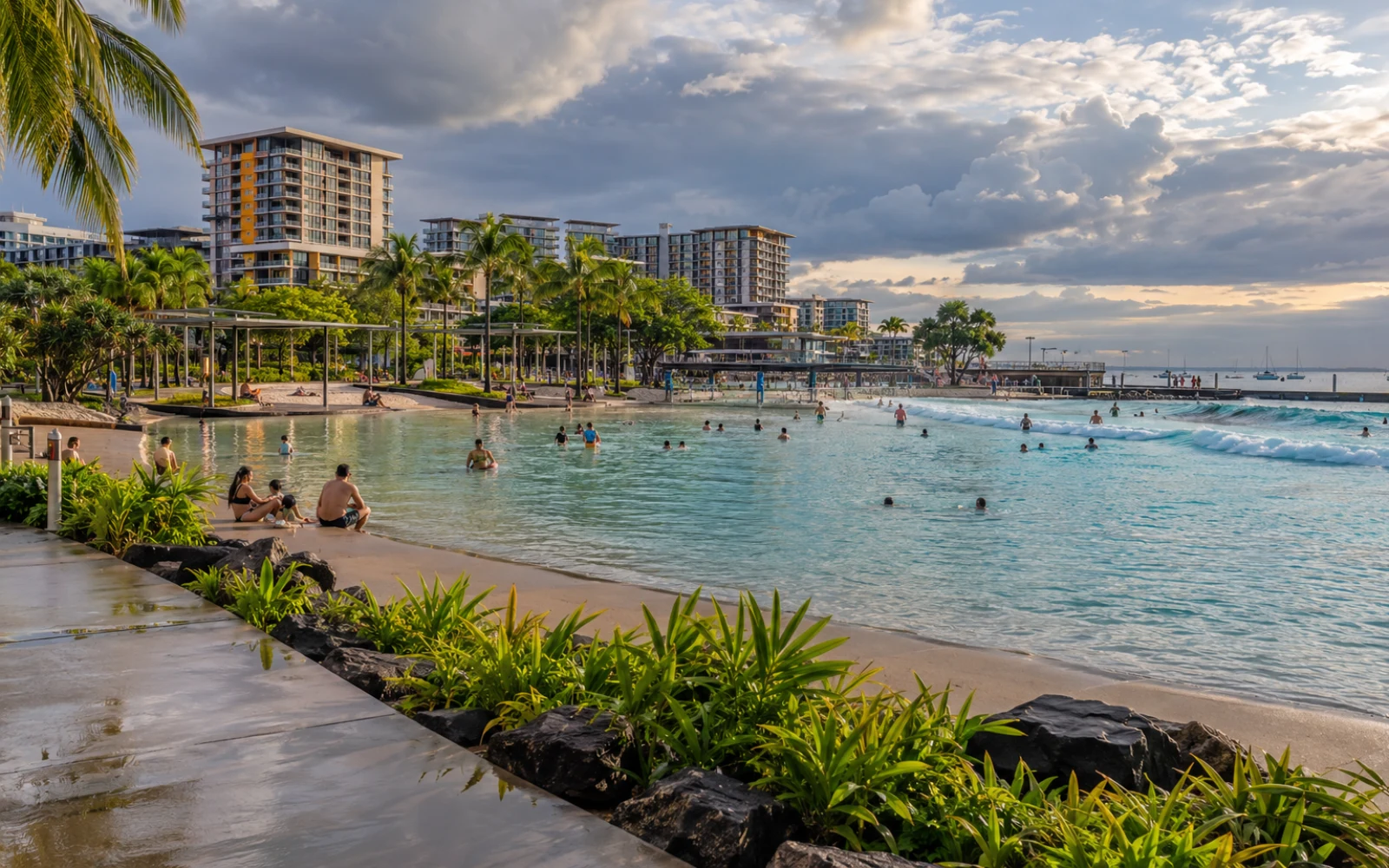
Cover: AI-generated illustration. © ANUSHKA DAHANAYAKE (PVT) LTD.
Darwin sits on Larrakia country, and the Larrakia name for the area, Garramilla, means "white stone". The harbour was named Port Darwin in 1839 after Charles Darwin, when HMS Beagle's officer John Clements Wickham surveyed it. A settlement called Palmerston followed in 1869, and the town took the name Darwin in 1911. Few Australian capitals have been rebuilt as often. Japanese aircraft attacked on 19 February 1942, killing at least 243 people, and the raid razed Darwin's Chinatown, which was never rebuilt. Cyclone Tracy struck on 25 December 1974, killing 71 people and destroying more than 70 per cent of the city's buildings. About 30,000 residents left in the largest airlift in Australian history, and many came back to rebuild.
The city that returned has the highest share of Indigenous residents of any Australian capital, alongside a mix of newer communities. At the 2016 census, 10.4 per cent of residents were Indigenous Australians, the highest share of any capital, and 38.3 per cent were born overseas. Early Chinese settlers came mainly from Guangdong, Italian and Greek communities grew in the 1960s and 1970s, and East Timorese residents add another strand. The result shows on a Darwin plate and at its markets far more than in any single monument.
Beyond the city, the Top End holds some of Australia's oldest cultural landscapes. Kakadu National Park was first inscribed on the World Heritage List in 1981 and extended in 1987, with a later addition of the Koongarra area in 2011, and it carries both natural and cultural criteria. It is jointly managed by Traditional Owners and the Australian Government through a Board of Management with an Aboriginal majority, and its rock art galleries record tens of thousands of years of Aboriginal occupation. Litchfield National Park, much closer to Darwin, is known for waterfalls and plunge pools. Darwin is where these places connect to a harbour city, which is why the museums and markets here are worth the first two days.
Two days in the city
Begin at the Museum and Art Gallery of the Northern Territory, which places Cyclone Tracy, Aboriginal art, natural history and the region's maritime story in one building. Choose sections, not every gallery, then allow time for Fannie Bay or the George Brown Darwin Botanic Gardens if the heat allows. Move to the Waterfront later in the day. The managed lagoon and wave pool have their own hours and safety rules, and nothing about them applies to the harbour or open beach. Walk the waterfront heritage trail, where the 1942 attack, in which 188 Japanese aircraft struck in the first raid, is explained alongside the wartime oil-storage tunnels.
Market choice depends on the day and season. Mindil Beach Sunset Market, Parap Village Markets and Rapid Creek Markets keep published schedules, so go to eat and buy, keep pathways clear and ask before photographing vendors or performers. The sunset at Mindil does not make the adjacent sea safe to swim. For Aboriginal art, choose Indigenous-owned galleries, tours and businesses where possible, ask permission before photographing people or restricted places and do not reproduce designs as decoration.
Kakadu, Litchfield or the Tiwi Islands
Treat these as separate decisions. Litchfield can work as a long day when roads and swimming sites are open. Check the NT Government's site-by-site Litchfield status before travel, since one waterfall may be open while another track is closed, and never enter water unless signs explicitly permit it.
Kakadu is vast and should not be treated as a single stop just outside Darwin. Two or more nights allow time for rock-art sites, wetlands and ranger information without driving exhausted. Some routes need high-clearance four-wheel drive, permits or seasonal access, so use a qualified tour if remote-area experience is limited. Tiwi Island visits depend on ferry or flight schedules, permits and community arrangements, and they are cultural visits, not improvised beach days.
Choosing a base and what to budget
Staying near the city centre or the Waterfront cuts transfers for museums, dining and lagoon time, while Parap and Fannie Bay suit travellers with a car and a market plan. Reliable air conditioning matters more than a view. Regional tours, car hire and fuel dominate the budget, and the museum, gardens and city walks keep urban days affordable. Compare tours by inclusions, driving time, group size and cancellation terms rather than the number of named stops, because a cheap trip is poor value if most of the day is spent in a vehicle. Book dry-season accommodation, Kakadu lodging and small-group wildlife cruises early, and keep the last day local before a flight in case storms or road delays disrupt the return.
Season, heat and water safety together
The dry season brings lower humidity, cooler nights and the broadest tour schedule, while the wet season brings storms, green landscapes and possible access changes. Schedule exposed walks for early morning, rest through the harshest hours and carry sun protection and insect repellent year-round.
NT Government swimming guidance says Top End beaches and estuaries are not advised for swimming, and park swimming belongs only in managed, signed areas. Saltwater crocodiles can inhabit both salt and fresh water, so stay back from the water's edge where advised and camp only in designated areas. Marine stingers and large tides add further risk.
Never drive through floodwater, because depth and current cannot be judged from the vehicle. Rental agreements may exclude unsealed roads or certain parks, so read conditions before paying. Fuel up early, carry water, tell someone the route and avoid dawn and dusk when animals are active. Move indoors when lightning approaches and watch cyclone information in the wet season. Pack a refillable bottle, a sun hat, breathable clothing, closed walking shoes and light rain protection, and check whether drones or fishing need a permit. Confirm accessibility details, steps into boats and vehicles, shade and toilet stops with any operator before booking.
Read what makes Australia special, browse the Australia destination hub, compare the other tropical gateway in our Cairns reef and rainforest guide, or see the Hobart first-time visitor guide for a cooler southern contrast.
Questions and answers
How many days do you need in Darwin?
Allow two days for Darwin itself and at least two additional days for carefully chosen Top End excursions. Kakadu is better with more than a rushed single day.
Can you swim at Darwin beaches?
Visitors should not assume beaches are safe for swimming because crocodiles, jellyfish and tides require local knowledge. Use designated managed swimming areas and follow current signs and lifeguard advice.
Is the wet season a bad time to visit Darwin?
No. It brings dramatic storms, green landscapes and fewer visitors, but humidity, road closures and tour schedules require flexibility. Check forecasts and access conditions every day.
Sources
Melbourne · 37.8136° S, 144.9631° E
This story belongs to Darwin, Australia. A continent of the world's oldest continuing cultures, a World Heritage reef and cities that each began for different reasons.