Hobart First-Time Visitor Guide: Sandstone, Sea and kunanyi
Hobart is Australia's second-oldest capital, built on Muwinina country at Sullivans Cove in 1804, with convict-built sandstone, an Antarctic port and a mountain that sets the weather.
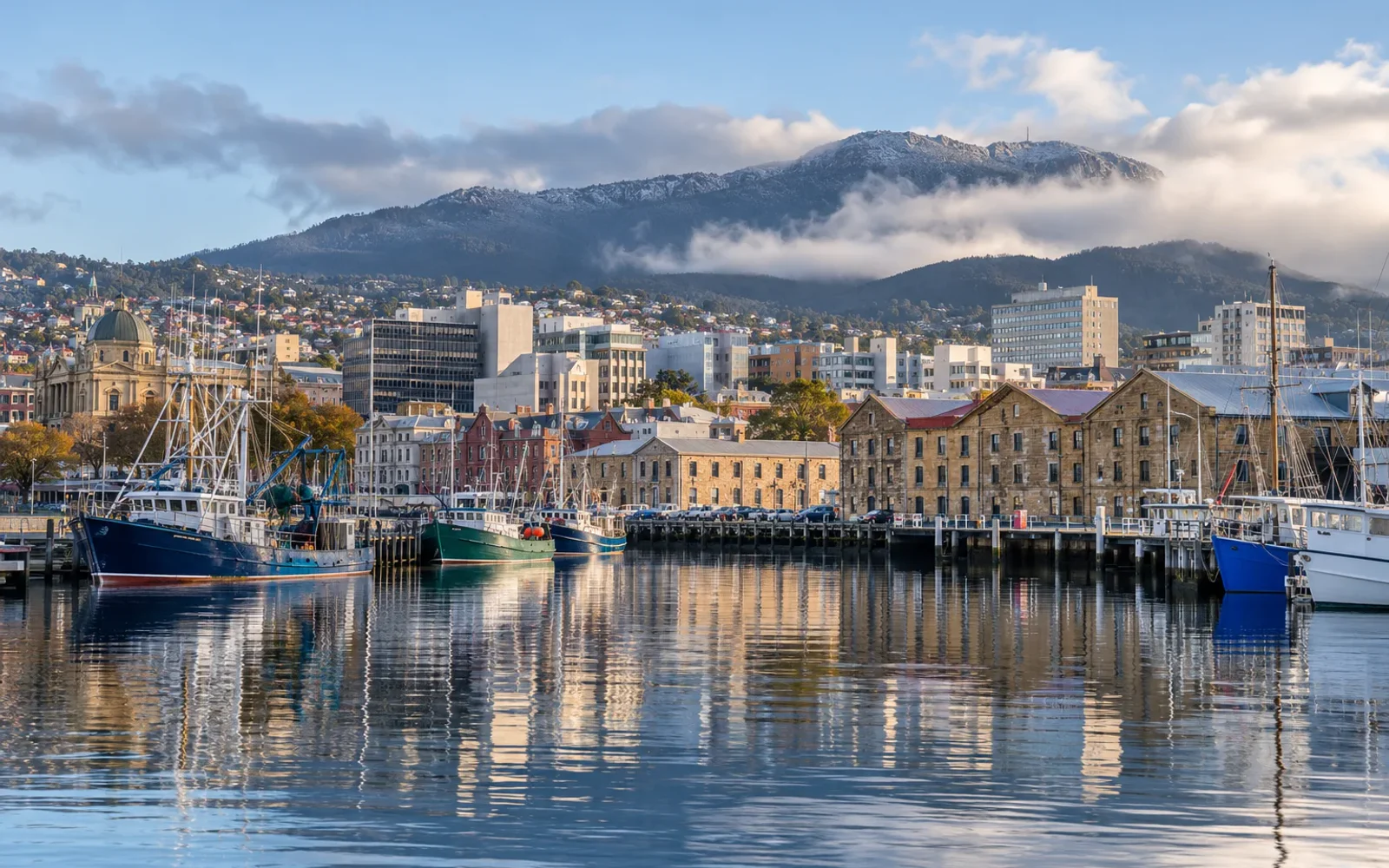
Cover: AI-generated illustration. © ANUSHKA DAHANAYAKE (PVT) LTD.
Hobart began as nipaluna, the Muwinina name for the country that includes kunanyi / Mount Wellington and the River Derwent. Aboriginal Tasmanians, who generally call themselves Palawa or Pakana, may have occupied this land for as long as 35,000 years. The first European settlement was a military camp at Risdon Cove in 1803, and in 1804 Captain David Collins moved it to Sullivans Cove, the present site of Hobart. That makes Hobart Australia's second-oldest capital after Sydney, and it was founded as a British penal colony.
Convict labour shaped the stone that visitors photograph. The Cascade Brewery, Australia's longest-operating brewery, was built with convict labour, and the Cascades Female Factory, built in 1828, is now part of the UNESCO-listed Australian convict sites. The sandstone warehouses of Salamanca Place, built in the 1830s, are among the finest Georgian dockside buildings left in the country. The Theatre Royal, which opened in 1837 and is described as Australia's oldest continuously operating theatre, still stages performances a short walk away. These buildings tell the colonial story, and the museum interpretation works best when it is paired with Aboriginal-led perspectives.
The harbour is the other half of the identity. Hobart is the home port for both Australian and French Antarctic operations, and its harbour is described as the second-deepest natural port in the world, with much of the waterfront on reclaimed land. Constitution Dock, where fishing vessels and ferries share the edge with public space, makes the working port easy to read. Salamanca Market has been held weekly since 1972 and remains the city's best-known stall-lined morning, a Saturday habit shared by locals and visitors, and it works best when the rest of the weekend is left loose for weather. Around it, Battery Point's lanes of small stone cottages show how a working port neighbourhood grew up behind the wharves.
Aboriginal heritage is part of that picture. The name nipaluna is not a footnote, and visitors who learn it alongside kunanyi read the city differently from the colonial street names around them. The city's modern pride is the Museum of Old and New Art, opened in 2011 by the collector David Walsh and described as the Southern Hemisphere's largest private museum. It changed how Hobart is seen from outside, adding a contemporary draw to a heritage city and giving the Derwent estuary a destination at the end of a ferry ride. Above it all stands kunanyi, which dictates the weather; the waterfront can be calm while the summit is in cloud, ice or dangerous wind.
Three days around harbour, MONA and mountain
On day one, start at Constitution Dock and continue through Salamanca and Battery Point on foot. Read about the port, Antarctic links and colonial settlement, and the continuing presence of Tasmanian Aboriginal people. The Tasmanian Museum and Art Gallery is a good indoor anchor and weather backup. Kitchens in Hobart can close earlier than visitors from larger cities expect, so verify dinner times.
On day two, coordinate MONA museum admission and ferry tickets before paying; a ferry ticket does not include museum entry. The ferry is scheduled transport, not a flexible harbour cruise, so arrive early and know the return options. MONA rewards several hours, some works may be confronting, and families should read its guidance first. The underground layout involves lifts, stairs and sustained walking, so contact the museum about seating and companion arrangements.
On day three, let kunanyi decide. Check the City of Hobart's live Pinnacle Road status and summit webcams that morning. The road may close for snow, ice, severe weather or congestion, and the summit is far colder and windier than the centre. Carry warm and waterproof layers, stay on open tracks and be ready to turn back. If the summit is unsuitable, use the Royal Tasmanian Botanical Gardens, TMAG or a longer neighbourhood walk instead. Bruny Island, the Tasman Peninsula, the Huon Valley and Richmond are separate full-day decisions, not additions to a mountain day.
Where to stay and what to eat
The waterfront and central business district suit a first visit on foot, Salamanca puts restaurants and the Saturday market close by, and Battery Point offers historic streets with hills and quieter evenings. North Hobart has an active food strip but adds a walk or bus ride to the harbour. Check the contour as well as the distance, since a short route can hide a steep climb or steps, and ask older converted buildings about step-free rooms. At Salamanca Market keep aisles open, ask before photographing stallholders and buy directly from producers whose work you sample. Seafood, bakery and market settings can hide allergens, so talk to staff directly.
Buses, ferries, weather and respect in one place
Central Hobart is walkable but not flat, and Metro buses cover the urban area while regional connections are infrequent. MONA ferry tickets and city bus tickets are separate systems, and ordinary city transport does not replace a planned summit service. Late public transport is more limited than in a large mainland capital. Hobart Airport lies outside the centre, so compare the airport bus, taxi or ride service for the group. In an emergency in Australia, call 000, and note that mobile coverage can be unreliable on mountain routes.
Tasmanian ultraviolet exposure can be strong even in cool weather, so carry sun protection, water and layers that block wind and rain. Ask about kerbs, gangways, lift sizes and accessible toilets, as steep streets and heritage buildings vary widely. Wildlife is active near roads at dawn and dusk.
Use the name kunanyi, stay on marked paths, do not fly a drone without permission and do not remove plants or rocks. Keep Battery Point's residential streets quiet and ask before photographing people.
Continue with the Australia destination hub or compare more practical country guides. On the mainland, the Adelaide guide, the Canberra guide and what makes Brisbane special show how other state capitals compare, while the Cairns reef and rainforest guide and the Darwin guide cover the tropical north. The Hobart city page adds a wider introduction.
Questions and answers
How many days are enough for Hobart?
Three days allow a waterfront and neighbourhood day, a dedicated MONA visit and a weather-dependent kunanyi day. Add time for Bruny Island, the Tasman Peninsula or another regional trip.
Can Hobart be visited without a car?
Yes for the centre, MONA ferry and booked kunanyi transport. A car becomes more useful for regional excursions, but it is unnecessary for a waterfront-focused day.
What needs advance booking in Hobart?
Coordinate MONA admission with ferry times and book any kunanyi transport or regional tour. Check the City of Hobart road status immediately before a mountain visit.
Sources
Melbourne · 37.8136° S, 144.9631° E
This story belongs to Hobart, Australia. A continent of the world's oldest continuing cultures, a World Heritage reef and cities that each began for different reasons.