Évora: Roman Temple, Jesuit University and Chapel of Bones
A UNESCO walled city where Roman columns, a medieval cathedral, a Jesuit university and the Chapel of Bones sit within a short walk.
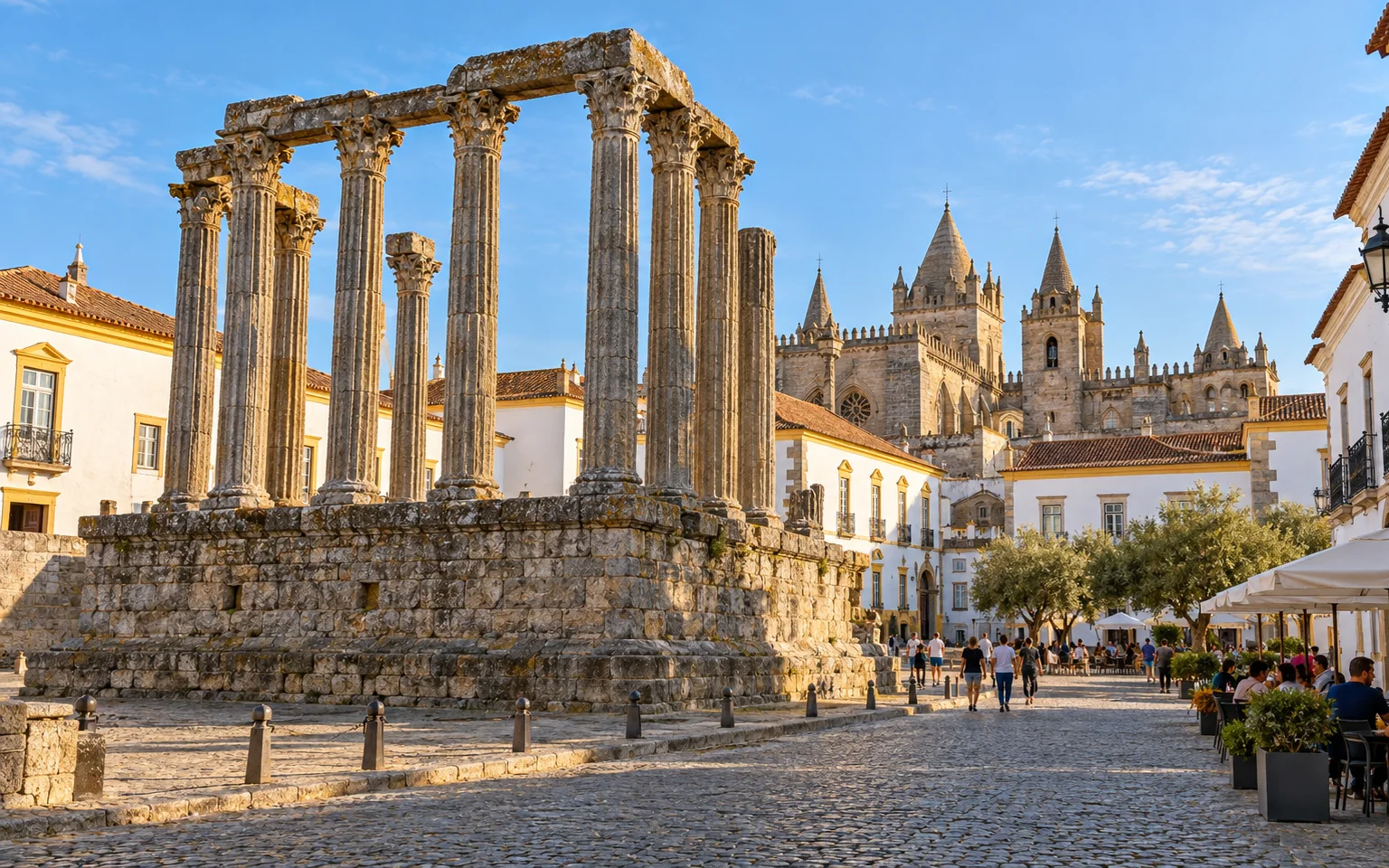
Cover: AI-generated illustration. © ANUSHKA DAHANAYAKE (PVT) LTD.
UNESCO inscribed Évora's historic centre in 1986 and described it as the finest example of a city of Portugal's golden age. The listing rests on layers that still stand within a few hundred metres: a Roman temple of the first century, a cathedral begun in 1186, a university founded in 1559, and whitewashed houses with azulejo trim and wrought-iron balconies from the sixteenth to eighteenth centuries. Évora was largely spared by the 1755 Lisbon earthquake, which is one reason these layers survive in the same streets.
A Roman temple and a Romanesque cathedral
The Roman Temple, popularly called the Temple of Diana, is thought to have been dedicated to the cult of Emperor Augustus, although dating varies between the first and third centuries. Its surviving columns stand in a public square, and the story of the city begins here as Roman Ebora. Évora Cathedral, which Britannica dates to 1186–1204 for the original Romanesque building, dominates the high ground. Its roof and tower routes involve stairs and uneven surfaces, so check access and weather at the desk; the view explains the dense centre and the wide Alentejo plain.
The Jesuit university and the city of scholars
The University of Évora was founded in 1559, with Jesuit teaching in the city beginning earlier. The Marquis of Pombal closed it in 1759 when the Society of Jesus was expelled, and the institution was re-established in the twentieth century, so the old university buildings in the centre are still used by students. That academic life gives Évora its evening character: students at café tables, term-time noise and a town that does not close when the day trippers leave.
The Chapel of Bones and the Franciscans
The Chapel of Bones in the Church of São Francisco was created by Franciscan monks in the late sixteenth century and holds the remains of an estimated 5,000 people, taken from town cemeteries that were filling up. It is a sacred memorial, not a novelty set. The church's own visitor page distinguishes free entry to the church from a paid combined ticket for the chapel and museum areas, and lists shorter winter hours and selected holiday closures, so check it before arriving late. Keep voices low, obey photography rules, and discuss the visit with children before entry.
Stones older than the city
Around Évora, the Almendres Cromlech is one of the largest stone circle complexes in the Iberian Peninsula. Sources date its earliest phases anywhere from more than 5,000 to over 7,000 years ago, and the stones were arranged and rearranged over thousands of years. Access roads, site conditions and visitor arrangements can change, so use a licensed guide or a suitable vehicle, confirm the route, and never drive onto tracks in poor conditions because an old review says it is possible. These are archaeological landscapes, not picnic furniture; do not touch, lean on or climb the stones, and remove all waste.
Alentejo on the plate and in the cork oak
The Alentejo is a major producer of cork, and the cork oak landscape around the city is part of daily life. Alentejo cooking makes purposeful use of bread, olive oil, herbs, pork and seasonal produce, so try açorda alentejana, migas or ensopado, and ask whether dishes are designed for sharing. State allergies clearly: bread, egg, pork and shared preparation appear frequently, and vegetarians should confirm whether soup stock contains meat. Wine is part of the region, but tasting needs a non-driving plan.
Two days on foot
Start near the Roman Temple before the heat and groups build, then visit the cathedral with respect for worship. Descend toward Praça do Giraldo through ordinary streets, take a long lunch, and return later for the sixteenth-century Água de Prata aqueduct, where houses built into the arches show how monumental infrastructure became part of daily life. On the second day visit São Francisco, the public garden and the Manueline-era royal remains, then choose a municipal museum, a university space or a market. Évora's lanes reward attention to doorways and courtyards, but residents' homes are private, so ask before photographing people.
Heat, transport and cost
Summer temperatures can be severe. Begin outdoors early, rest through peak heat and return in the late afternoon; carry water, a hat and sun protection, since stone streets radiate heat after noon. Spring and autumn suit walking, and winter brings quiet streets, shorter hours and rain. Évora is connected with Lisbon by rail and coach with varying frequency, so check CP or the coach operator directly and take a legal taxi to accommodation rather than dragging luggage over cobbles.
Many streets, squares, aqueduct views and the Roman Temple exterior are free. Budget for transport, two or three admissions, meals and perhaps a guided megalith visit. Combination tickets save money only when every site is open and wanted. The centre is cobbled with slopes, high kerbs and historic thresholds; contact each monument for its usable entrance and lift.
Lunch may run long and dinner later than some visitors expect, so save two restaurants and check their opening days; a small tip for good service is optional. Families should plan shade, toilets and a frank decision about the Chapel of Bones. Public gardens offer recovery time, and pushchairs with robust wheels cope better with the cobbles. If a car is used for rural Alentejo, park in an authorised area, remove luggage from view and ignore lanes that look narrower than the vehicle even if navigation suggests them.
Keep a few habits in mind inside the walls. Close bags in crowds, use marked crossings and secure valuables in accommodation; heat and driving fatigue are more predictable dangers than crime. Cathedral roof routes and some old interiors are not step-free, so a central taxi drop and shorter loops may suit travellers with limited mobility better than one long circuit.
More from Portugal
Read what makes Portugal special, pair inland Alentejo with the coast in the Algarve guide, explore the Portugal destination hub and more practical country guides. Two days before arrival, verify transport, check each priority interior, and leave a half-day open for heat, a long meal or an unexpected closure. Call 112 in an emergency and follow wildfire restrictions in the countryside.
Questions and answers
How many days are enough for Évora?
Two days allow the main monuments, local food and a slower walk beyond Praça do Giraldo. One long day works if transport is direct and major interiors are checked in advance.
Can Évora be visited without a car?
Yes. The walled centre is walkable from bus or rail arrival with planning. A car is useful for megalithic sites and rural Alentejo, not for moving between central monuments.
When is the best time to visit Évora?
Spring and autumn usually suit walking. Summer can be extremely hot, requiring early starts and an indoor midday break; winter is quieter with shorter hours and possible rain.
Is the Chapel of Bones suitable for children?
That depends on the child. Explain that it is a religious memorial containing human remains, keep behaviour quiet and skip it if the display could cause distress.
Sources
Lisbon · 38.7223° N, 9.1393° W
This story belongs to Évora, Portugal. A small country that faced the Atlantic, with the oldest alliance still in force, the first legally marked wine region and a quiet pride at home.