Mallorca: A Cathedral Over a Mosque, Terraced Mountains and Chopin's Winter
Palma Cathedral, Bellver Castle and the UNESCO-listed Serra de Tramuntana tell Mallorca's story from the 1229 conquest to the orange-trade railway to Sóller.
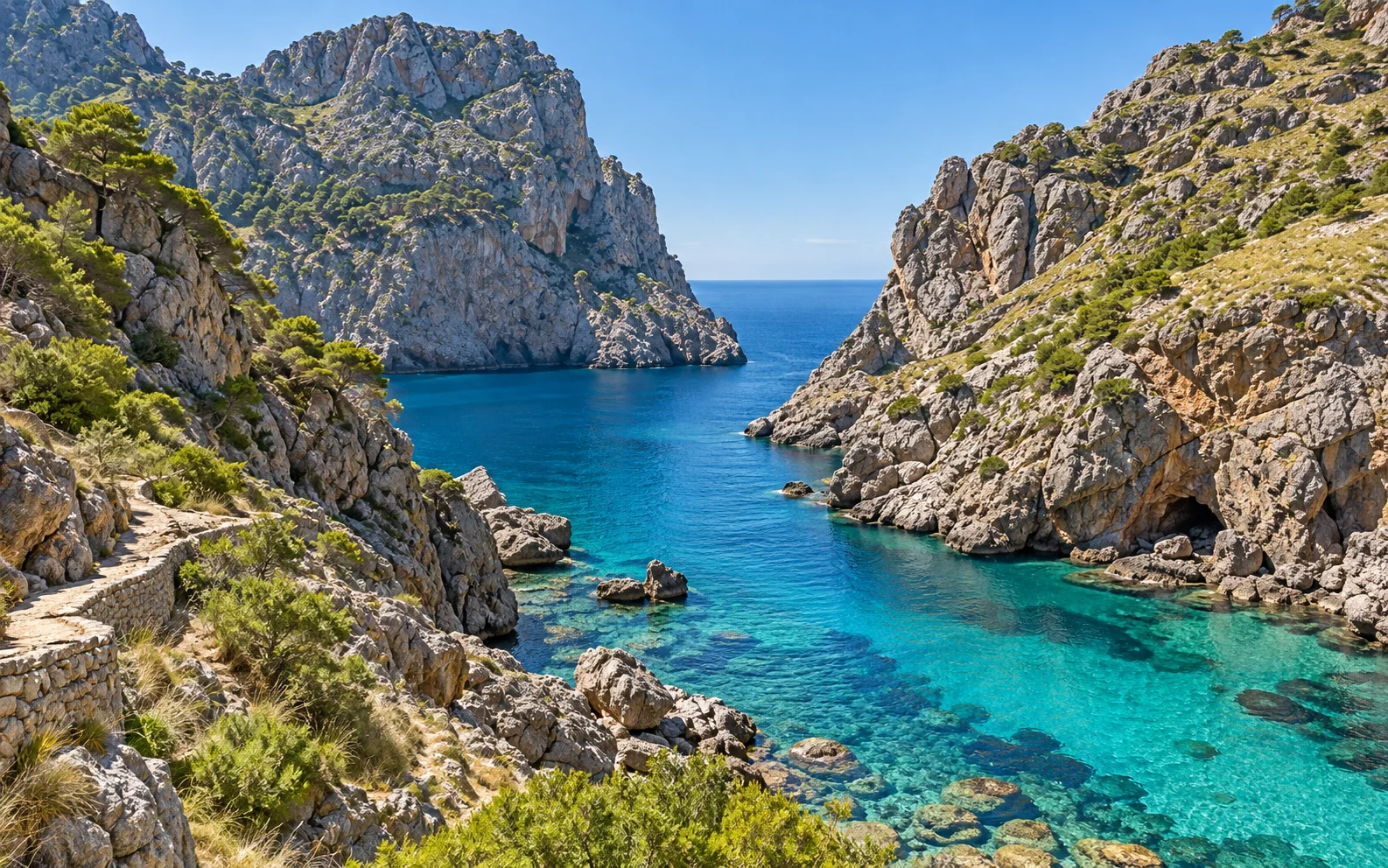
Cover: AI-generated illustration. © ANUSHKA DAHANAYAKE (PVT) LTD.
Mallorca's history is written in stone more clearly than on most islands. A cathedral stands where the largest mosque of Madina Mayurqa once did, a round castle looks down on the bay, and a whole mountain range has been terraced by hand. Visitors who come only for beaches miss that the island's best-known place names, such as Valldemossa and Sóller, belong to a deeper story than the coast.
La Seu, Gaudí and a rose window
Work on Palma Cathedral began shortly after the Christian conquest of 1229 and the site was consecrated in 1230, on ground that had held the city's main mosque. Construction continued into the seventeenth century, with 1601 usually given as completion. Standing between the Royal Palace of La Almudaina and the Episcopal Palace, the cathedral has a nearly 14-metre rose window described as the second-largest surviving Gothic rose window. Antoni Gaudí was invited in 1903 to oversee a restoration and worked on the interior until 1914, and the artist Miquel Barceló's major work in the cathedral, carried out between 2001 and 2006, is the modern chapter in that long building history.
Bellver Castle, on a hill about three kilometres west of the centre, was built between about 1300 and 1311 for King James II of Majorca. It is one of the few circular castles in Europe and the only one on the island, with round towers set against a central circular courtyard. After serving as a royal residence it became a prison, from the eighteenth century until the mid-twentieth, before the city took it over in 1931 and opened it as a museum the next year.
A mountain shaped by hand
The Serra de Tramuntana runs along the north-west coast, with Puig Major reaching 1,436 metres. UNESCO listed it in 2011 as a cultural landscape for the terraced farmland, water-management systems and dry-stone structures with which generations have turned steep limestone into orchards and groves. It is wetter and cooler than the rest of the island, and the range holds 25 endemic plant species, 7 of them found only on Mallorca.
Valldemossa gives the most famous chapter. The Royal Charterhouse was a royal palace until King Martin the Humane gave it to the Carthusians in 1399. In the winter of 1838–39 Frédéric Chopin and George Sand stayed in its cells, where Chopin completed his 24 Preludes and Sand wrote A Winter in Majorca; two cells now form a museum. Valldemossa is also the birthplace of Mallorca's patron saint, Catalina Thomàs.
Sóller is reached by a narrow-gauge railway through 13 tunnels, built from 1911 on the profits of the orange and lemon trade, which is why it is called the Orange Express. A tram continues to the port. Closer to the table, the ensaïmada, a spiral pastry made with saïm (pork lard), has been documented on the island since the seventeenth century and holds a European Protected Geographical Indication. The island's other staples are pa amb oli, tumbet (a vegetable bake) and coca, a flatbread.
A route that matches the history
Five to seven days allow two in Palma, one in the Tramuntana and two on different coasts without changing hotel every night. Road distances look short on the map, yet mountain bends, summer queues and parking searches consume hours, so one base plus well-chosen day trips beats a different bed each night.
On the first Palma day, take in the cathedral and the old quarter between its walls and the Plaça Major. On the second, choose Bellver, an art museum or the waterfront rather than all three, and use the afternoon for the shaded streets of Santa Catalina. Reading the cathedral and the castle together is rewarding: one is a statement of the 1229 conquest, the other of the age of the Kings of Majorca, and both explain why the island's old centre has the layout it does. Valldemossa and the Chopin cells make a good half-day if the road is tackled early; arrive before tour coaches and leave time for the village streets, which are more rewarding than the museum queue. Palma works without a car, so collect a rental only when the Tramuntana or the north coast needs it.
Begin at La Seu and Bellver, then spend a day in the Tramuntana. A car-free version takes the Sóller railway and tram from Palma; driving gives flexibility but the mountain roads are narrow and viewpoint parking is limited, so do not stop on bends or block entrances. Hiking in the range is not casual: carry water, footwear and an offline route, check heat and fire warnings, and respect gates, livestock and private land. Sa Calobra's road is dramatic but congested, so a boat or excursion may suit nervous drivers better.
Choose a beach for the group's actual needs: lifeguards, boardwalks, snorkelling or quiet. Mallorca's official beach guidance says to check sea conditions and follow flags. At fragile coves take everything away and use established paths, and if hiring a boat, ask the operator to use the Balearic government's Posidonia seagrass map, since anchors damage the meadows.
Palma bases, access and etiquette
Palma is the easiest car-free base, with airport buses, rail and intercity links; stay near the old centre, Santa Catalina or a frequent bus route. For a longer visit a second base in Sóller, Pollença or Alcúdia reduces cross-island travel. Dress respectfully for the cathedral, and reserve through its official channel if rooftop or special access matters. Palma's cobbles and thresholds are demanding for wheelchairs, so ask each venue about its usable entrance and lift; beaches publish their own details for boardwalks and bathing assistance.
Spain's emergency number is 112. Heat, dehydration, falls and sea conditions are more common holiday risks than crime. Mallorcan Catalan and Spanish are both official, and water is limited in dry months, so short showers and reused towels help. Summer rooms, rental cars and beachfront meals carry a premium; April to May and late September to October are calmer.
Compare onward ideas through the Spain destination hub, read what makes Spain special, or connect by sea to mainland cities with the Barcelona guide or the Valencia guide.
Questions and answers
Do you need a car in Mallorca?
No for Palma and several major towns or beaches, which are linked by public transport. A car helps for a carefully planned rural route, but parking and mountain-road congestion can outweigh the benefit.
How many days are useful for a first Mallorca trip?
Five to seven days allow two days in Palma, a Tramuntana outing and two different coastal or rural days without changing hotels constantly.
When is Mallorca least crowded?
April to May and late September to October generally offer milder walking weather and fewer visitors than July and August, although sea and mountain conditions still vary.
Sources
Madrid · 40.4168° N, 3.7038° W
This story belongs to Mallorca, Spain. A peninsula of strong regional cultures, from Altamira's cave art and the Alhambra to Gaudí's Barcelona and a pilgrim road walked for a thousand years.