Rovaniemi for First-Time Visitors: Arctic City Guide
Rebuilt after 1944 on Alvar Aalto's reindeer antler plan, Rovaniemi is Lapland's capital, home to the Arktikum museum and, since the 1980s, Santa Claus.
Cover: AI-generated illustration. © ANUSHKA DAHANAYAKE (PVT) LTD.
Rovaniemi is famous for Santa Claus, but the town itself has a harder and more interesting story. German forces destroyed most of it in 1944, and the plan that rebuilt it is one of the best-known pieces of Finnish urban design. Locals speak with pride about that recovery, about their Arctic museum and about the way a river junction turned into the capital of Lapland. The Christmas village is part of the picture, not the whole of it.
A river junction named in Sámi
Rovaniemi sits where the Kemijoki river meets its tributary, the Ounasjoki. The place name has Sámi roots: roavve in Northern Sámi refers to a forested ridge or the site of an old forest fire. Logging and mining in the 1800s boosted the town's growth. The township decree was issued on 27 June 1928, and Rovaniemi became a separate market town on 1 January 1929. In 2006 it was consolidated with the surrounding rural municipality, and it had 66,191 inhabitants at the end of 2025.
The Arctic Circle crosses the municipality: the city centre lies about 6 kilometres south of it. Rovaniemi Airport was taken over and expanded by German forces in 1941, and the support complex built then extended to what is now the Arctic Circle tourist area.
Burned in 1944, replanned by Aalto
Evacuation began on 16 September 1944, and in October, as German forces withdrew in the Lapland War, they destroyed the town; about 90 per cent of its property was lost. In 1945 the architect Alvar Aalto prepared a new town plan, known as the reindeer antler plan (Poronsarvikaava) a name that describes its layout. The plan shaped the roads, the riverside and the cultural and administrative buildings in the central area. That is why Rovaniemi has no old town: its heritage is reconstruction, and visitors read it in street layout rather than in surviving wooden houses.
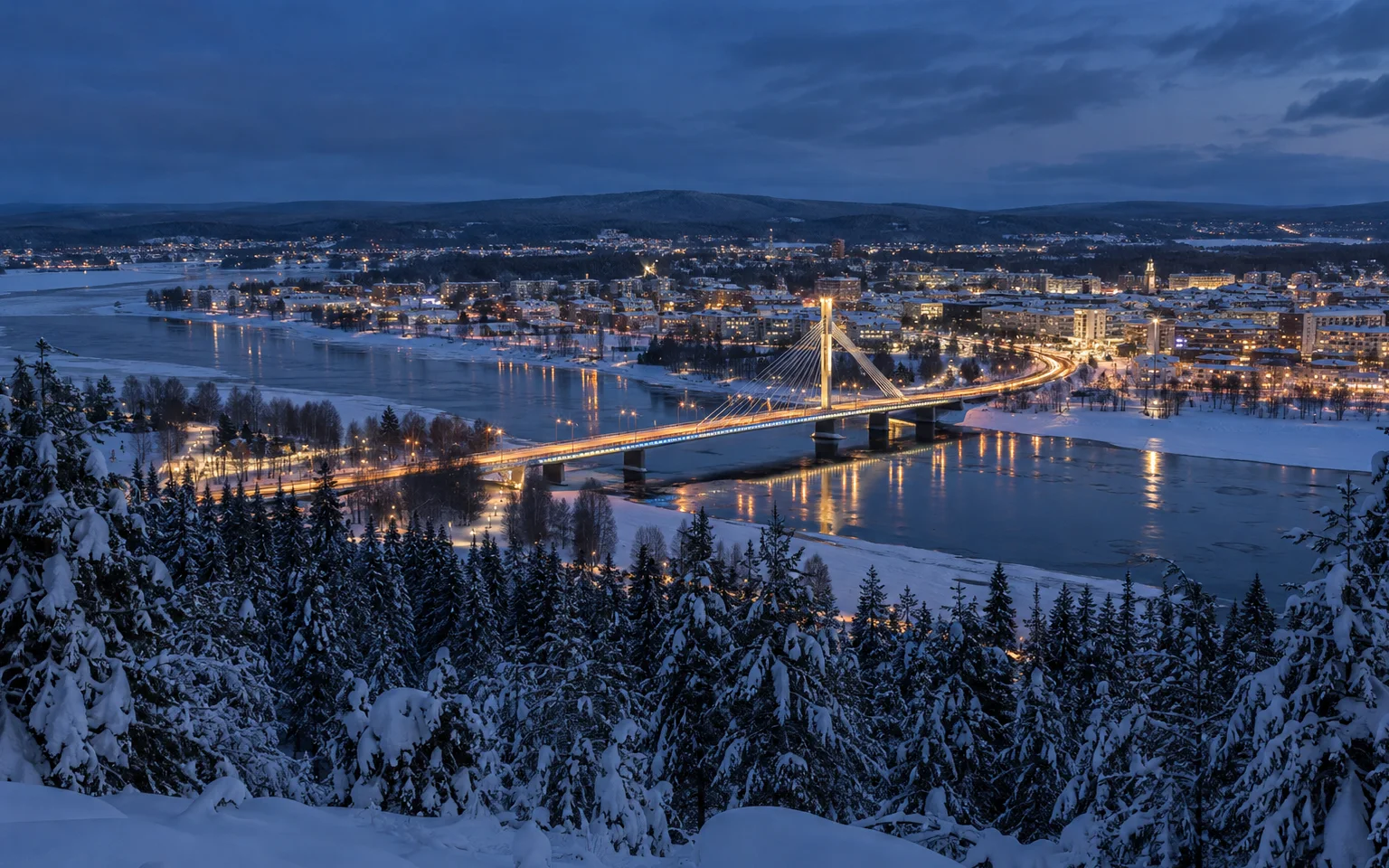
The Jätkänkynttilä bridge over the Kemijoki, with its eternal flame, is a local symbol of the rebuilt town and a natural stop for a daylight walk by the river.
Arktikum and the Arctic as a living place
Arktikum, on the bank of the Ounasjoki, opened on 6 December 1992, the 75th anniversary of Finnish independence. The original building was designed by the Danish architects Birch-Bonderup & Thorup-Waade, and a crescent-shaped annex by Claus Bonderup and Janne Lehtipalo was completed in the autumn of 1997. Its glass corridor is 172 metres long, is crossed by the 30-metre-wide Kittilä highway and is known as the "Gateway to the North". Two exhibitions share the building: the science centre of the Arctic Centre, and the Provincial Museum of Lapland, founded in 1975.
Give Arktikum two or three hours. Its exhibitions explain Arctic environments, Sámi culture and northern livelihoods, and they are the best way to meet the region before choosing activities. Read them carefully and avoid treating Indigenous culture as costume or decoration.
Santa Claus, and what is behind him
Rovaniemi was declared an official hometown of Santa Claus in 1980, and Santa Claus Village at the Arctic Circle, about 8 kilometres northeast of the centre and 2 kilometres from the airport, opened in the 1980s. A white line across the park marks where the Arctic Circle lay in 1865, although the line has since drifted and the true circle is about 700 metres to the north. The Roosevelt Lodge was built in the 1950s for Eleanor Roosevelt's visit. The village has an official Finnish post office where visitors can write to Santa.
Treat it as the commercial attraction it is: set a spending limit, check photography-package prices and allow children downtime. Locals also celebrate a very different Rovaniemi export. In 2006 Lordi, a monster-costumed rock band, won the Eurovision Song Contest, and a city square was named after them.
A two-day shape for the city
Day one. Start at Arktikum, then walk through the centre to see Aalto's plan from the ground, ending at the bridge and river. Spend the afternoon at Korundi for art or the Pilke science centre, depending on opening days, and finish with a Finnish sauna; confirm swimwear rules and whether towels are included.
Day two. Choose one well-run outdoor activity, not a conveyor belt of short experiences. Snowshoeing or cross-country skiing builds understanding of the winter landscape. For husky or reindeer visits, ask about animal welfare, rest, shelter and who owns the experience, and avoid operators who use Sámi culture as costume.
Practical notes for an Arctic town
Flights, daytime trains and overnight trains connect Rovaniemi with southern Finland; reserve sleeper cabins early for December to March. The railway station is west of the compact centre, and the current transport guidance explains buses and airport links. Ice changes ordinary distances, so allow extra time. Dress in layers designed for the cold, and never plan a tight airport connection around a seasonal attraction.
Aurora season needs dark sky, generally late summer into spring, and summer is too bright. The Finnish Meteorological Institute provides space-weather information, but local cloud decides the view. Leave city light safely with a guide or at a known public viewpoint, and never stop on a road shoulder, enter private land or walk onto uncertain river ice. Plan more than one evening and treat an aurora as a possible bonus; any company guaranteeing lights is selling confidence it cannot control.
Snowmobiles are noisy and carbon-intensive; share vehicles, remain on official routes and never drive after alcohol. Ask operators about group size, guide qualifications, insurance and cancellation thresholds. Accessibility is better in the centre than on trails, so ask lodging and tour providers about step-free access, snow clearing and transport.
Keep the final morning close to town. Store luggage through your accommodation, revisit the riverside in daylight and eat before boarding an overnight train. Winter delays are possible, so do not return from a remote safari immediately before departure. Continue through the Finland destination hub, read our deeper Lapland winter guide, break the rail journey in Oulu, or pair the journey with Helsinki.
Questions and answers
How many days should first-time visitors spend in Rovaniemi?
Three nights is a useful minimum for the city, one outdoor activity and more than one chance to see the northern lights. Four or five nights provide better weather flexibility.
Can the northern lights be guaranteed?
No. Darkness, clear sky and geomagnetic activity must align. Tours can improve access to clearer locations but cannot guarantee aurora, and visitors should reject operators making certainty claims.
Do visitors need a car in Rovaniemi?
Not for the centre, museums or scheduled tours. Local buses serve some attractions, while reputable activity operators commonly provide transfers. A car helps with independent rural travel only if the driver is confident on ice.
Is Rovaniemi only a winter destination?
No. Summer offers midnight light, hiking and river landscapes, while autumn brings colour and earlier dark skies. Winter provides snow experiences but also the highest prices and shortest daylight.
Sources
Helsinki · 60.1699° N, 24.9384° E
This story belongs to Rovaniemi, Finland. A country that built its identity from stories and language before it had a state, now known for sauna, lakes, light and Lapland.