Savonlinna for First-Time Visitors: Castle and Lake Saimaa
A fifteenth-century border castle that was never stormed, an opera festival revived in 1967 and the endangered Saimaa ringed seal define Savonlinna.
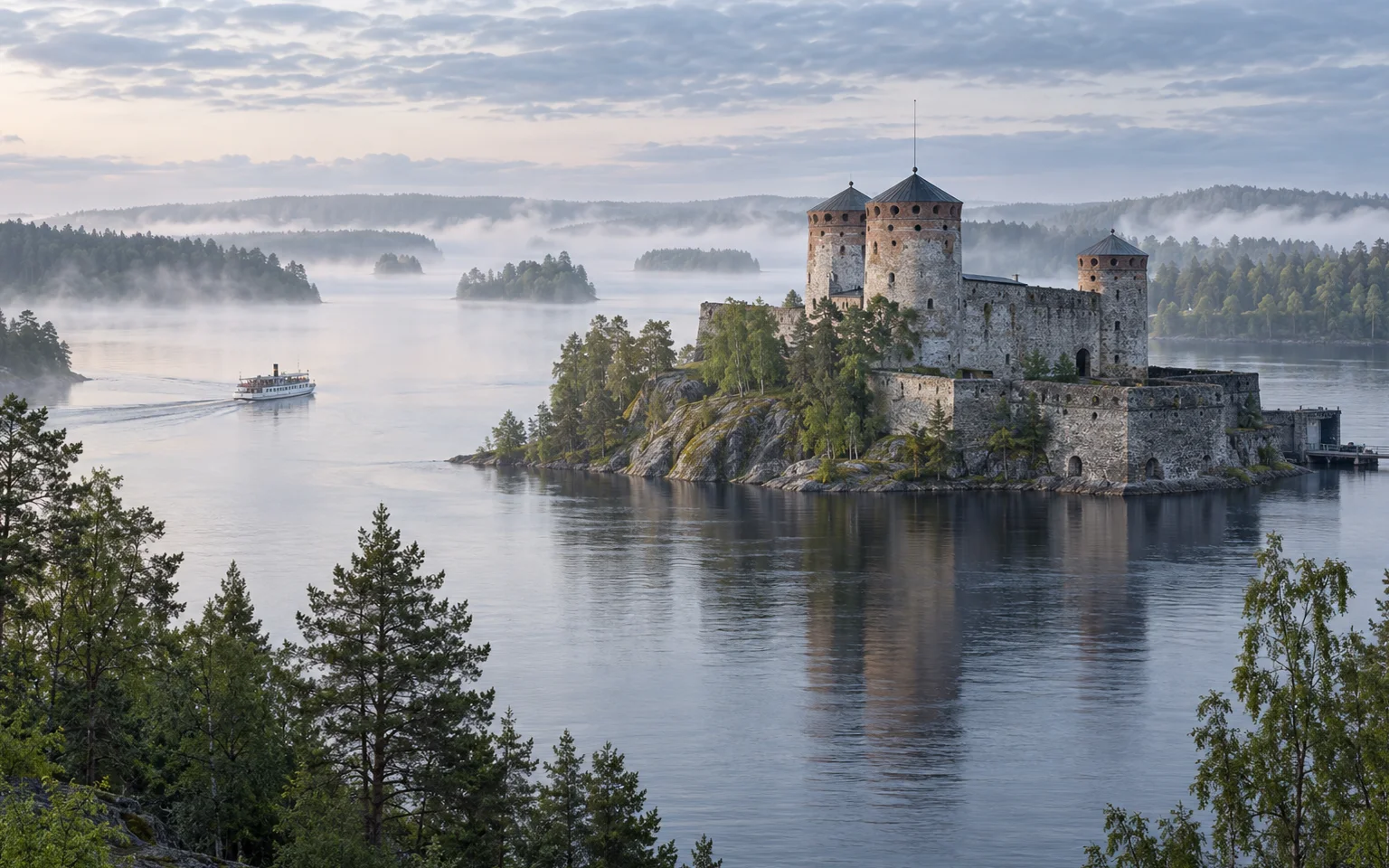
Cover: AI-generated illustration. © ANUSHKA DAHANAYAKE (PVT) LTD.
Savonlinna is the place in Finland where a medieval fortress, a lake labyrinth and an opera festival share the same few hundred metres of shoreline. Locals are proud of all three: of a castle that was never taken by assault, of a festival that returned after about fifty years of silence and of Lake Saimaa and the rare seal that lives in it. Learning those stories first makes everything else on a visit make sense.
A castle on a border
Olavinlinna was founded by Erik Axelsson Tott as Sankt Olofsborg, and construction began in 1475. The three-tower keep was completed in 1485, and the outer curtain walls with two towers followed in 1495. The fortress was meant to defend a contested frontier, and it quickly proved its worth: it withstood several Russian sieges during the First Russo-Swedish War in 1495-1497, and Russian forces were repulsed again in 1499. A 20-year truce was signed in September 1504.
The garrison later agreed to surrender to invading Russians on 28 July 1714 and again on 8 August 1743, but the castle was never taken by force. The Treaty of Åbo ceded it and the region to Russia. In the late eighteenth century the castle was converted into a Vauban-style fort, the Thick Tower exploded in 1791, and several fires in the nineteenth century destroyed much of its original furnishings. Russia held the castle from 1743 to 1812. The town of Savonlinna itself was founded in 1639 around the castle and is nicknamed the "Capital of Saimaa".
The opera that came back
In 1907 the soprano Aino Ackté attended a nationalist meeting at Olavinlinna and saw the potential of the castle courtyard as a stage. The first Savonlinna Opera Festival took place in 1912, with Ackté directing it for five summers and staging four Finnish operas alongside Gounod's Faust, the only non-Finnish work. The festival ran into trouble amid the First World War, Finnish independence and the Civil War, and fell silent for about fifty years.
It was revived in 1967, and a performance of Fidelio at the castle marks the start of the festival that exists today. Thirteen operas have premiered there since, including Paavo Heininen's The Knife in 1989 and Aulis Sallinen's Linna vedessä in 2017. The festival runs for about a month and draws roughly 60,000 visitors a year, around a quarter of them from abroad. Foreign companies have also performed, including Covent Garden in 1998 and the Welsh National Opera in 2014.
The lake and its seal
Savonlinna is built across waterways, which is why a destination that looks near on a map may need a bridge or a shoreline route. Lake Saimaa is also home to the endangered Saimaa ringed seal, one of the few freshwater seals in the world, found only in Lake Saimaa. Isolated from other ringed seals for about 9,500 years, since the land rose after the last ice age, it numbers about 500 individuals, up from roughly 100-150 in 1983. Finland has protected it by law since 1955, and net fishing is restricted near nesting sites in spring. Wildlife cruises sometimes seek it, and a responsible operator explains distances, slows near habitat, limits disturbance and refuses to guarantee sightings. Mothers and pups are especially vulnerable.
Nearby Kerimäki Church is described as the largest wooden church in the world, and Savonlinna hosts the Mobile Phone Throwing World Championships, held since 2000, a quirkier local tradition. Local fish, vendace in particular, appears at the market and in restaurants, fried, smoked or in other forms. Confirm bones, allergens and origin when ordering.
A castle day and a lake day
Day one. Walk to Olavinlinna in the morning. A guided tour makes its defensive architecture and layered history much clearer, and the National Museum describes the tour languages on its official pages, so ask when you book. The stairs, thresholds and narrow passages are part of the fortress, so ask staff which areas are accessible. Wear secure shoes and allow older visitors extra time. In the afternoon, continue through the old town and along the public shoreline paths, and visit a local museum or Riihisaari for Lake Saimaa's nature, boats and regional life before taking a cruise.
Day two. A scheduled sightseeing cruise is the simplest way to see the channels without a car. Compare duration, commentary, covered seating and return point, and carry a windproof layer because open water feels colder than the harbour. Kayaking suits experienced paddlers or beginners with a guide. Lake Saimaa has boat traffic and narrow passages, so wear a fitted buoyancy aid, carry communication in a waterproof case and never paddle after alcohol. Keep a fallback of museums, cafés and a sauna for wind or rain.
Practical notes for opera season and the lake
Trains connect Savonlinna with the national network, often with a change, and the centre, passenger harbour and castle are walkable. Stay centrally for a short visit and opera nights; lakeside cottages offer quiet and sauna but may need a car, groceries and confidence on narrow roads. During the festival, book early, buy tickets only through authorised channels, read the refund rules and check sightline information. Bring a warm layer even after a hot day, and arrive well before the performance because bridges and narrow routes concentrate crowds. Contact the festival about companion seating and transfers.
Water taxis and excursions may not run outside peak summer, so save offline directions. Tap water is excellent, so refill rather than buying bottles. Sauna rules vary: shower first, use a seat towel, ask before adding water and cool down safely. Lake swimming should use a known entry with attention to depth, temperature and boat traffic. Never approach seal haul-out rocks, use a drone near wildlife or share precise sensitive locations online.
Savonlinna deserves at least one unhurried castle day and one weather-flexible lake day. Browse the Finland destination hub, read what makes Finland special, compare city heritage in our Turku guide, or prepare for a northern contrast with the Rovaniemi guide.
Questions and answers
How many days are enough for Savonlinna?
Two full days allow Olavinlinna, the market and one lake experience. Add a third day for Punkaharju, a national park or a weather reserve.
Can Savonlinna be visited without a car?
Yes for the compact centre and castle. Trains serve the town and scheduled cruises leave centrally, but regional nature sites require careful bus, train, taxi or tour planning.
When is the Savonlinna Opera Festival?
It normally takes place during summer, but dates and programmes change annually. Use the official festival calendar and reserve accommodation early because availability tightens sharply.
Can visitors see a Saimaa ringed seal?
A sighting is possible but never guaranteed. Choose a responsible operator, keep legal distances, minimise noise and accept that protecting the endangered animal matters more than a photograph.
Sources
Helsinki · 60.1699° N, 24.9384° E
This story belongs to Savonlinna, Finland. A country that built its identity from stories and language before it had a state, now known for sauna, lakes, light and Lapland.