St Augustine Walking Guide: Fort, Old Streets and Responsible History
A one-day heritage route that puts the fort first, limits backtracking and helps visitors distinguish interpretation from decorative nostalgia.
St Augustine is easiest to understand on foot, but its attractive streets can blur entertainment, preservation and painful history. Begin with the fort’s primary interpretation, continue through the old city with questions in place of assumptions, and choose museums that add voices missing from a purely colonial postcard.
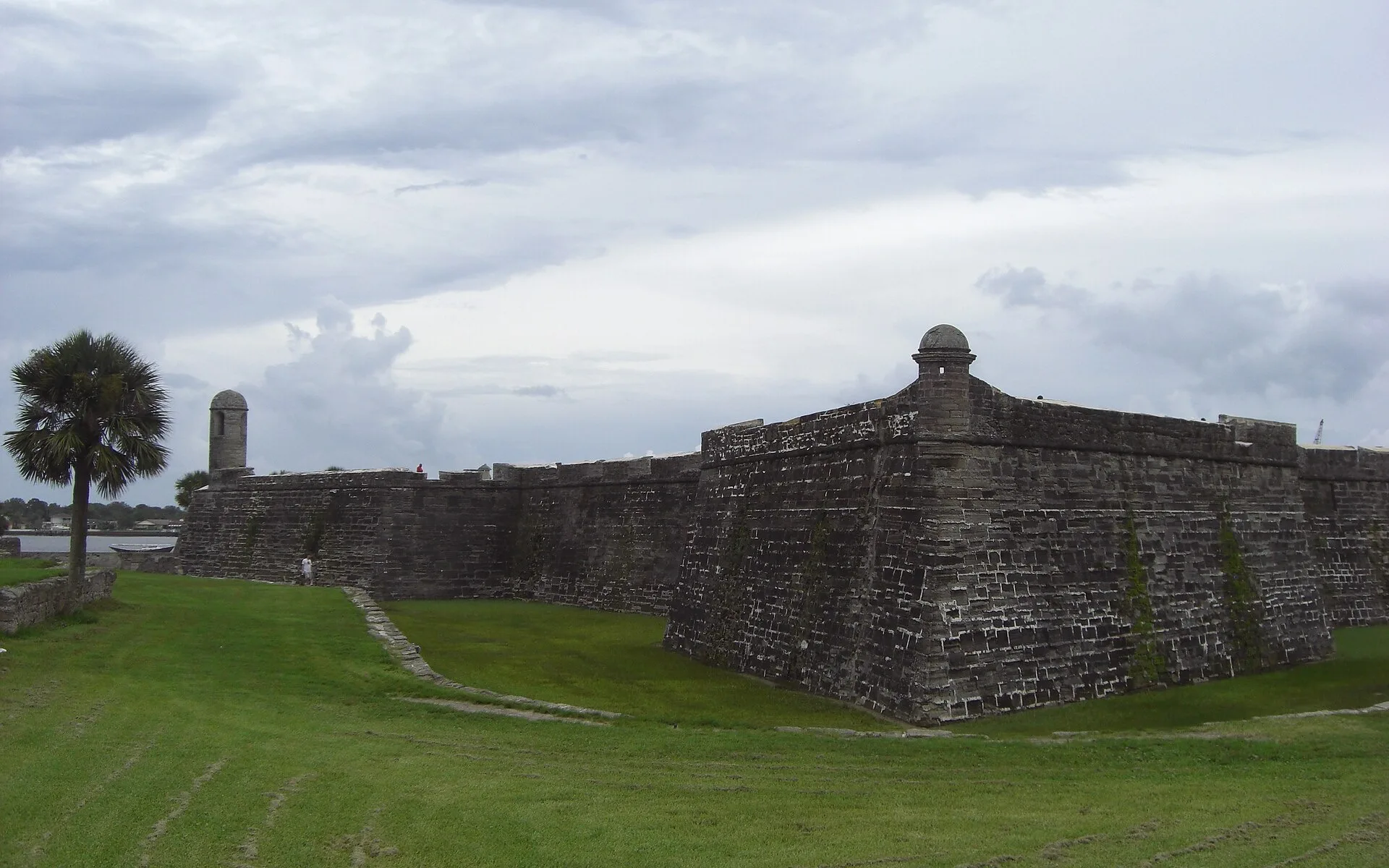
Cover photograph: Castillo de San Marcos, by Diego Delso / Wikimedia Commons, CC BY-SA 3.0. Cropped and converted to WebP.
Why St Augustine matters: a coquina fort that held
St Augustine stands on land the Timucua knew long before Europeans arrived, and its colonial story begins with the Spanish settlement established in 1565. What makes that story visible today is a single building material. Castillo de San Marcos is built of coquina, a shell-based stone quarried on Anastasia Island across the bay. The National Park Service records that Spanish construction began in 1672 and that the first phase was completed in 1695, when the fort was still smaller than the one standing now.
The stone was tested within a few years. In 1702, English forces under Governor James Moore of Charleston attacked St Augustine, and the coquina walls compressed and absorbed the shock of each hit, so cannonballs bounced off or lodged only a few inches deep. In 1740, General Oglethorpe's forces bombarded the Castillo for 27 days, and the walls stayed standing. For a small town on the edge of a contested empire, that resilience decided whether it survived at all.
The fort is also why the old city feels continuous. Spanish, British and American flags have flown over the same walls, and the streets around them hold the stories of Timucua communities, free and enslaved Africans, Minorcan settlers and the civil-rights activists of the 1960s. Many residents take quiet pride in that depth: the building that protected the town in those sieges still anchors the bayfront more than three centuries later, and the city around it has learned to tell a fuller version of its own past. The coquina is worth touching, too; its texture of tiny shells explains in one look why the walls absorbed cannon fire instead of shattering.
The walking route below starts where the stone does, at the fort, and then reads the rest of the city in layers.
Put the fort at the start of the route
Castillo de San Marcos is the strongest geographic and interpretive anchor. The National Park Service hours page lists first and last admission, holiday closures and crowd patterns. Arrive near opening on a weekday if possible, especially in hot months. Lightning can close the gun deck even when the lower fort remains available.
Allow time for exhibits and ranger interpretation; the walls reward more than a photograph. The coquina structure, shifting imperial control, military use and experiences of people confined or displaced here require more than one simplified founding story.
Use the bayfront to orient the day
After the fort, walk south along the bayfront before entering the densest pedestrian streets. The open view explains the defensive location and gives a quieter transition. Note the Bridge of Lions and Matanzas Bay, but keep moving; every waterfront attraction in one morning is too much.
Heat and humidity can be severe, and summer thunderstorms arrive quickly. Carry water, use shade and move indoors at the first sign of lightning. The most efficient route alternates outdoor history with an indoor museum or meal.
Read St George Street critically
St George Street is pedestrian-friendly and convenient, but retail presentation is not the same as historical evidence. Look for interpretation from museums, public agencies and documented sites. Ask whose labour built a property, which period has been reconstructed and which communities are absent from the story being sold.
Walk slowly enough to notice side streets and courtyards without blocking residents or shop entrances. If a costumed attraction makes a dramatic claim, compare it with the fort, a museum collection or a documented historic source.
Add one museum for a missing perspective
Choose according to the gap you want to address: Indigenous history, Spanish colonial life, Black history, civil-rights history, archaeology or decorative arts. Confirm opening days and accessibility directly. One substantial visit produces more understanding than rushing through three small admissions.
The city’s story includes the Timucua people, European empires, free and enslaved Africans, Minorcan settlers, U.S. expansion and civil-rights activism. No single house museum can hold all of that. Treat labels as a starting point and notice where language such as “settler” or “discovery” hides conflict.
Plan lunch away from the narrowest flow
The central pedestrian strip becomes congested. Reserve if a particular restaurant matters, or walk a few blocks beyond the busiest area. Keep a refillable bottle and do not wait until heat exhaustion to stop. Outdoor seating can be pleasant in winter but uncomfortable during midday humidity.
Support locally operated businesses, tip appropriately and remember that historic buildings can limit restroom or step-free access. Call ahead when access is essential, because an old doorway may not have been adapted.
Finish with the Plaza and civil-rights context
Continue toward the Plaza de la Constitución and nearby civic landmarks. Read public interpretation closely: plazas change meaning through ceremonies, protest, commerce and tourism. St Augustine played an important role in the 1960s civil-rights movement, a history that should not be reduced to a footnote after colonial architecture.
If time permits, select a relevant museum or documented walking resource. Avoid compressing centuries into “America’s oldest city” without explaining what that phrase counts, which earlier Indigenous presence it excludes and how sovereignty changed.
Make parking a one-time decision
Use the City of St Augustine’s official parking information to select a garage, legal space or current shuttle option. Park once. Moving the car between the fort, pedestrian streets and plaza wastes time and adds traffic to a compact centre.
Photograph the level or zone and check closing times. Never use residential, business or church parking without permission. If staying centrally, ask whether the hotel charges separately and whether re-entry is allowed.
Add a second day only for a clear reason
One day covers the fort and core streets; a second should deepen a subject, not repeat the same route. Archaeology, civil-rights history, maritime landscape or a documented excursion to Fort Matanzas can justify another day. Check transport and NPS conditions before treating Fort Matanzas as a quick extension, because access and boat operations are distinct from the Castillo.
An extra morning also allows the fort grounds or bayfront before crowds, followed by one reserved museum. In hot months, return to lodging through midday and continue later. Do not fill the second day with ghost claims presented as established history; enjoy evening entertainment while distinguishing performance from evidence.
Families can give children one observation task—coquina texture, flag changes or defensive sightlines—instead of expecting them to absorb every label. Adults should also pause. Heritage understanding grows through connections, not the number of plaques photographed.
Adjust for mobility and sensory needs
The NPS accessibility page states that the fort’s lower level is wheelchair accessible, while the gun deck requires stairs. Sand and crushed shell affect some exterior routes. The NPS app includes audio description, captioning and a virtual gun-deck experience; download offline content before entering thick coquina walls.
Elsewhere, old pavements and thresholds vary. Build shorter loops with indoor breaks and identify accessible restrooms. A trolley can reduce walking, but confirm boarding, wheelchair policies and narration style before buying.
Put Indigenous history before the colonial slogan
The phrase “oldest city” usually refers to the continuously occupied European-founded settlement established by Spain in 1565. It must not imply that human history began then. The Timucua lived across northeast Florida before Spanish colonisation, and the colonial story involves missionisation, warfare, displacement and changing imperial rule.
Ask what each museum or marker counts as its starting point and whose testimony supports the interpretation. Decorative Spanish imagery can create a single romantic era even though the city passed through Spanish and British periods and developed within a much longer Indigenous landscape. A responsible route leaves room for uncertainty and treats a superlative as a starting point for questions.
Travellers extending the heritage theme can compare the different public-history choices in the Charleston history walking guide and Savannah squares history guide. Those cities should not be treated as interchangeable “historic South” backdrops; each requires attention to enslavement, resistance and later civic memory.
Carry heat and lightning limits into the old streets
Florida heat can make a compact route physically demanding. Begin outdoors early, use shade, drink regularly and schedule the longest indoor interpretation for the hottest period. Stone and coquina surfaces radiate heat, while exposed fort areas offer limited relief.
During thunder, move to a substantial building or enclosed vehicle and follow staff instructions. Do not shelter on the seawall, under an isolated tree or in an open courtyard. A cancelled programme or shortened bayfront walk is preferable to waiting outside for the original itinerary to resume.
Use a history checklist, not an attraction checklist
At day’s end, ask whether you encountered Indigenous history, African and Black history, colonial conflict and modern civic life—not how many ticketed rooms you entered. Record questions that remain. Responsible heritage travel accepts complexity instead of searching for a charming, frictionless past.
When buying a book or souvenir, favour a museum shop or local bookseller whose material identifies authors and sources. Decorative “colonial” objects often merge periods and cultures without explanation. A well-chosen local history, archaeological guide or work by a regional author can continue the visit after departure. For children, look for material produced with educators over novelty punishment devices or sensational battle stories. Spending choices support the institutions that conserve objects, train interpreters and correct old narratives as research changes.
Keep the receipt or catalogue reference so the source can be found again later.
Continue with the United States destination hub for wider planning. In St Augustine, the best route is compact enough to walk and spacious enough to think.
For a contrasting Florida city, use the Miami Beach architecture guide.
Questions and answers
Why is Castillo de San Marcos built of coquina?
The Spanish began the fort in 1672 with coquina quarried on Anastasia Island. During the English attacks of 1702 and 1740 the stone compressed and absorbed cannon fire, so the walls stayed standing.
Is the St Augustine historic centre walkable?
Major old-city sights are close together, but heat, uneven surfaces and crowds affect the walk. Use a central parking or transit strategy rather than moving the car between stops.
Is Castillo de San Marcos wheelchair accessible?
The lower level and key facilities are accessible, while the gun deck is reached only by stairs. The NPS app offers a virtual alternative and current accessibility details.
Sources
New York City · 40.7128° N, 74.0060° W
This story belongs to United States. A country of home towns and large ideas, from Independence Hall and the first national park to jazz, skyscrapers and volcanic islands.