What Makes Aarhus Special: Vikings, an Open-Air Town and Bold Art
A Viking-age river mouth that grew into Denmark's second city: its record-setting cathedral, the Iron Age Grauballe Man, Den Gamle By, ARoS and a Capital of Culture year.
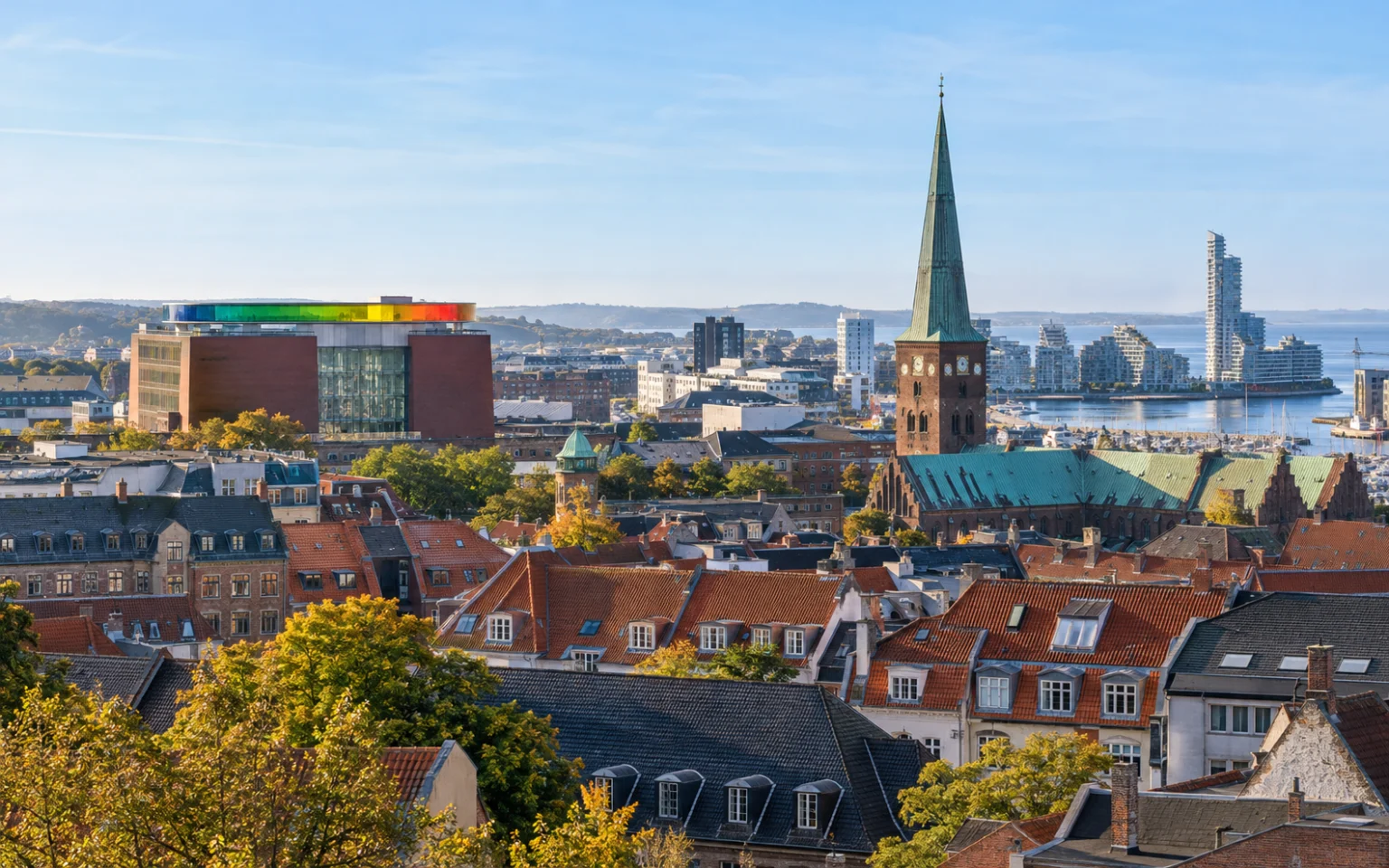
Cover: AI-generated illustration. © ANUSHKA DAHANAYAKE (PVT) LTD.
Denmark's longest and tallest church stands in Aarhus: the cathedral is 93 metres long and its tower rises 96 metres above a town that began as a Viking-age settlement at the mouth of a river. The name comes from Aros, "river mouth". Archaeology places a town here by the last quarter of the eighth century, long before the harbour, university and museums that now define Denmark's second city.
From Viking river mouth to cathedral town
Aarhus has traded and prayed on the same ground for more than a thousand years. The first Christian church, Holy Trinity, went up around 900, and defensive ramparts followed in the early tenth century. The Church of Our Lady, first built in 1060, is described as one of the oldest stone churches in Scandinavia. Elsewhere in Jutland, the Jelling stones, a World Heritage Site since 1994, carry the Viking-age record of Denmark's conversion: the larger stone, raised by Harald Bluetooth, shows a crucified Christ and is popularly called Denmark's baptismal certificate. Aarhus received market town privileges in 1441, and the old centre around the Latin Quarter, with half-timbered houses and cobbled lanes, is the city's oldest district.
The cathedral, dedicated to St Clement, patron saint of sailors, was begun in the 1190s under Bishop Peder Vognsen. A fire in 1330 damaged both church and town, and Gothic enlargements brought it to its present size by about 1500. Inside, about 220 square metres of late medieval frescoes, painted from roughly 1470 to 1520, are more than any other Danish church preserves. Bernt Notke carved the altarpiece, dedicated at Easter 1479, and Emanuel Vigeland's stained-glass window of 1926 is the largest in Denmark. The organ, built in 1730 by Lambert Daniel Kastens and restored in 2018-2020, has 89 stops.
Den Gamle By: a town saved from demolition
Denmark's first open-air museum of town life began with one threatened house. The Mayor's House, dismantled before demolition and shown at the 1909 Danish National Exhibition in Aarhus, was rebuilt as the core of Den Gamle By, which opened in 1914. Its founder, the teacher and translator Peter Holm, directed it until 1945 and brought in further buildings from other towns. The museum now holds some 75 historic buildings from about 20 towns, among them a merchant's house from Aalborg rebuilt in the 1920s and 1930s and the Coin Master's Mansion, reconstructed between 1998 and 2009. Walking its streets shows how Danish towns looked, smelled and sounded before the factory age.
Moesgaard and the man from the bog
South of the centre, the grass-roofed Moesgaard Museum, designed by Henning Larsen Architects and inaugurated in 2014, houses the Grauballe Man. Peat cutters found him near Grauballe in Jutland on 26 April 1952. He died between roughly 321 and 261 BCE, in the early Germanic Iron Age, with his throat cut; scholars still debate whether this was execution, punishment or sacrifice. Conservators tanned him with oak bark and oils, and after about 18 months of treatment he went on permanent display at Moesgaard in 1955. The museum calls him the world's best-preserved bog body. The same galleries hold Iron Age weapon deposits from Illerup Ådal, evidence of the wars fought in Denmark two thousand years ago.
Art, books and a year as Europe's cultural capital
ARoS Aarhus Kunstmuseum was founded in 1859, and its present building, by the Danish firm Schmidt Hammer Lassen, opened on 7 April 2004. Across ten floors and 20,700 square metres it is among the largest art museums in Northern Europe. On 28 May 2011 the roof gained Your rainbow panorama, Ólafur Elíasson's circular glass walkway, which has become the city's best-known image.
The harbour is the newer chapter. Dokk1, opened on 20 June 2015 by Schmidt Hammer Lassen with landscape architect Kristine Jensen, is described as Scandinavia's largest public library and was named IFLA's Public Library of the Year in 2016. In 2017 Aarhus shared the title of European Capital of Culture with Paphos in Cyprus, under the theme "Rethink". The former freight yard at Godsbanen, opened to the public in 2012 after its conversion, now works as a production centre for the arts.
Makers, students and a royal summer house
Aarhus University, founded in 1928, was the first university in Jutland and still gives the city its young population. The Ceres Brewery dates from 1856, and in 1874 Otto Mønsted founded a butter company in the city, followed in 1883 by Denmark's first margarine factory. Arla Foods and the wind-turbine maker Vestas have their headquarters here today.
Marselisborg Palace, built in 1899-1902 to designs by Hack Kampmann as a gift from the Danish people to Prince Christian and Duchess Alexandrine on their marriage, later became a royal summer residence. The park and gardens are open when the royal family is away; the palace itself never opens to visitors, and a guard changes at noon when the family is in residence. A square beside Dokk1 now carries Kampmann's name.
Seeing it well: half a day for the open-air town, a bus for the bog man
Give Den Gamle By at least half a day and enter the interiors; cobbles and thresholds make step-free routes worth confirming with the museum. Moesgaard is reached by bus from the centre, so check the return timetable before walking its landscape, and combine it with the Marselisborg forests rather than adding it to a museum-heavy day. The coloured rainbow walkway at ARoS suits most visitors, though anyone sensitive to heights can enjoy the galleries below. Intercity trains reach the centre, Midttrafik buses and the Letbane light rail cover the rest of the city, and the compact core is walkable.
Weather, cost and a table
May to September brings long daylight and the easiest coastal walking; winter suits the museums, though daylight is short and wind off the bay is sharp. Denmark is expensive, and the AarhusCARD has been discontinued, so buy museum entry separately and compare a Midttrafik day ticket with the rides you need. Try smørrebrød at lunch and pastries from a Frederiksbjerg bakery, the district locals call the larder of Aarhus. The seasonal Infinite Bridge appears only for part of the year, so confirm dates before planning around it.
Continue through the Denmark destination hub, read what makes Denmark special, compare the capital with our Copenhagen first-time guide, or break the rail journey at Hans Christian Andersen's birthplace with the Odense guide.
Questions and answers
How many days are enough for Aarhus?
Two full days cover the cathedral, ARoS, Den Gamle By and the waterfront. Add a third for Moesgaard Museum, where the Grauballe Man is displayed, and the Marselisborg coast.
Can Aarhus be visited without a car?
Yes. Intercity trains reach the centre, while buses and the Letbane light rail cover the city. A car is mainly useful for a wider Jutland itinerary.
Can visitors still buy the AarhusCARD?
No. VisitAarhus says the AarhusCARD has been discontinued. Buy museum admission separately and compare a Midttrafik day ticket with the local rides you actually need.
Is Aarhus accessible for limited mobility?
Modern museums and public transport offer useful access, but cobbles, older buildings and forest paths vary. Confirm lifts, entrances and toilets with each venue.
Sources
Copenhagen · 55.6761° N, 12.5683° E
This story belongs to Aarhus, Denmark. A small kingdom whose pride runs from a tenth-century rune stone to fairy tales, furniture and a kitchen revolution.